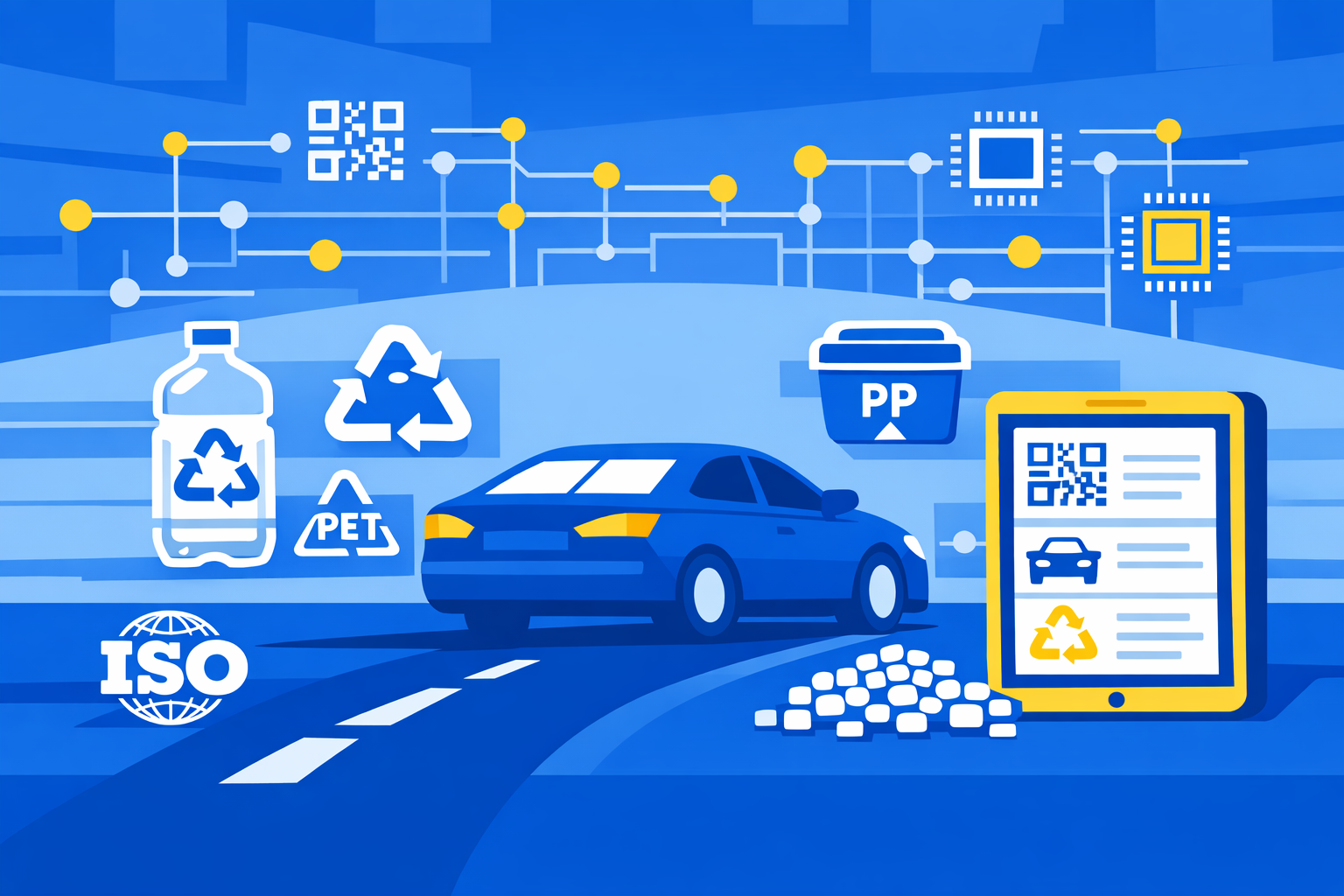
The European Union's phased rollout of Digital Product Passports is reaching the automotive sector, requiring OEMs and Tier suppliers to embed standardized lifecycle and packaging data - covering material content, recyclability, and supplier provenance - into components placed on the EU market, with the most binding deadlines taking effect from February 2027.
Background
The Ecodesign for Sustainable Products Regulation (ESPR), Regulation (EU) 2024/1781, entered into force in July 2024, establishing the framework for sustainable product design across the EU market. The Digital Product Passport (DPP) - a digital record consolidating essential information on a product's identity, compliance, safety, and sustainability - originates under ESPR and aims to make supply chains more transparent.
The DPP applies to "any physical product that is placed on the market or put into service," with limited exceptions including foodstuffs, medicines, and - under ESPR directly - complete vehicles. However, automotive components face DPP exposure through multiple converging instruments. As part of its broader effort to enhance circularity in the automotive sector, the European Commission has proposed a new regulation to replace the existing End-of-Life Vehicles (ELV) Directive, introducing several transformative measures including a mandatory Digital Product Passport for vehicles. The regulation establishes a Circularity Vehicle Passport, an EU-wide extended producer responsibility system, minimum recycled content requirements, and stronger rules on parts reuse and vehicle collection and treatment.
The digital "circularity vehicle passport," a core feature of the proposal, will be harmonized with other EU digital product passports to avoid duplication and improve data flow.
On the component side, the EU Battery Regulation (EU 2023/1542) mandates a Battery Passport, retrievable via QR code, for all electric vehicle and industrial batteries with a capacity over 2 kWh placed on the EU market from 18 February 2027, according to Hogan Lovells analysis of the regulation. The requirement also extends to Starting, Lighting, and Ignition (SLI) automotive batteries.
Mandatory Data Fields and Supply Chain Implications
Data requirements vary by product group but are expected to include material composition, substances of concern, environmental performance indicators, durability, and end-of-life information. For automotive batteries specifically, passport requirements encompass over 100 data attributes including material composition with geographic origin for conflict minerals, carbon footprint broken down by lifecycle stage, recycled content percentages, and performance data tracking state-of-health metrics.
The obligation to implement the DPP falls on the economic operator who places the product on the market or puts it into service, regardless of where the product is manufactured. Products manufactured outside the EU may be subject to the requirement if covered by a relevant delegated act. U.S. automotive manufacturers including General Motors, Ford, and Tesla producing vehicles for European markets require complete battery passport data, according to Fiegenbaum Solutions.
The data integration challenge is substantial. In multi-tier supply chains, 60-80% of the required data originates from suppliers across multiple tiers, many with differing technical capabilities. An automotive OEM's Battery Passport, for example, requires data from battery cell manufacturers down to raw material miners and recyclers. No single entity holds all the necessary data.
Typical automotive or electronics manufacturers source from 500-5,000 direct suppliers across 30-50 countries - a scale that makes uniform data collection a structural rather than purely technical challenge. ESPR mandates that DPP data be structured in open, machine-readable formats such as XML or JSON to ensure interoperability and prevent vendor lock-in. Compliance with international standards such as ISO/IEC 15459 for unique identifiers is required. Industry frameworks including GS1 and Catena-X further support consistent data exchange across supply chains.
The Catena-X DPP Expert Group addresses the challenge of integrating DPP data across the automotive supply chain, driven by evolving regulations including ESPR, the ELV Regulation, and the Battery Regulation. The group focuses on developing standards, data models, and processes for scalable supply-chain integration. In August 2025, the Catena-X Automotive Network and the OPC Foundation announced a strategic collaboration to accelerate standardized, cross-company data sharing across manufacturing, with the partnership supporting the upcoming EU regulation requiring a Digital Product Passport by 2027.
Access to DPP information will be via QR codes, RFID, or NFC tags on products or packaging. The regulation enforces tiered access controls: public data must be available in all 24 EU languages, while sensitive commercial data is restricted to authorized users, including repairers and regulators.
Outlook
By July 2026, the European Commission is required to deploy a central DPP registry to support enforcement and transparency, according to Hogan Lovells. Eight harmonized standards for the DPP data and interoperability framework are expected to be completed by 2026, according to the convenor of a key European working group. These standards will help ensure data consistency, scalability, and market-wide compatibility.[1]
Beyond batteries, the ESPR Working Plan indicates indicative delegated acts for tyres in 2027 and aluminium in 2027 - both material categories of direct relevance to automotive Tier suppliers. While often framed as a digital infrastructure initiative, the DPP is fundamentally a governance challenge. For manufacturers, importers, and brands operating in or exporting to the EU, the central question is not whether product data can be generated, but whether internal controls, supplier oversight, and documentation systems are robust enough to withstand regulatory scrutiny.