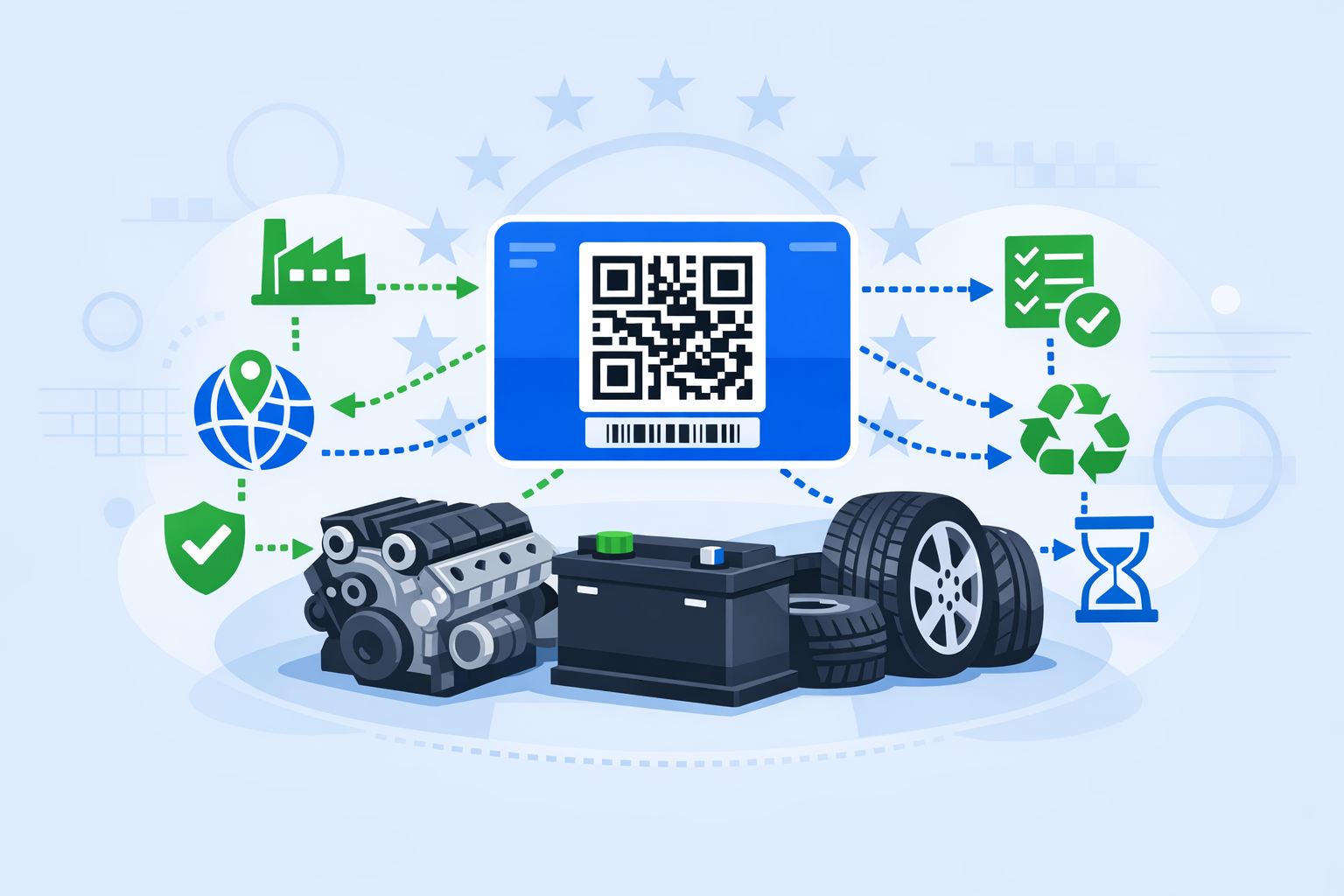
A typical automotive manufacturer sources components from 500 to 5,000 direct suppliers across 30 to 50 countries[1]. When the EU's Digital Product Passport becomes mandatory for each of those components, every link in that chain must be data-ready - and current pilot programs are revealing just how large that task is for Tier 1 and Tier 2 suppliers.
The EU's Ecodesign for Sustainable Products Regulation (ESPR)[2], Regulation (EU) 2024/1781, entered into force in July 2024 and established the Digital Product Passport (DPP) as the primary mechanism for product transparency, traceability, and circularity across the EU single market. For the automotive sector, the regulatory scope is expanding steadily - and the data collection burden is concentrating at the first mile of supply.
What the DPP Requires of Automotive Supply Chains
At its core, a DPP is a digital record[3] linked to a physical product that consolidates verified information on composition, environmental impact, safety certifications, repairability, and end-of-life processing. It must be accessible throughout the supply chain via a machine-readable data carrier - typically a QR code or serialized barcode - and must remain updatable across the product's lifecycle.
For automotive components specifically, the data categories are technically demanding. Automotive parts and tyres require serial-level information, detailed composition data, wear and performance metrics, and safe end-of-life processing instructions[4] linked back to vehicle-level records. This is not a single-field form - it is a structured, machine-readable lifecycle file that must be verified and maintained by every actor in the value chain.
The regulation places the compliance obligation on the economic operator placing the product on the EU market, which in most automotive supply chain structures means the OEM or a Tier 1 integrator. However, the data that populates the passport originates upstream - at Tier 2, Tier 3, and raw material suppliers.
Scope Expansion: Which Auto Components Are Now in Frame
The ESPR's 2025-2030 Working Plan[5], published by the European Commission on 15 April 2025, confirms the priority product groups and phased implementation schedule. Several categories directly relevant to automotive supply chains are now on the compliance calendar:
| Target Date | Product Category / Milestone | Key DPP Obligation | Status |
|---|---|---|---|
| July 2024 | ESPR enters into force | Legal basis for DPP established across all physical goods | ✅ Enacted |
| March 2025 | CIRPASS-2 Core Ontology | Interoperability reference for sector pilots published | ✅ Published |
| July 19, 2026 | EU Central DPP Registry | Central registry goes live; product data infrastructure operational | ⏳ Upcoming |
| Feb 18, 2027 | EV & Industrial Batteries (>2 kWh) | Battery Passport mandatory via QR code for all EU-market batteries | ⏳ Upcoming |
| 2027 | Tyres | Delegated act expected; serial-level composition & recyclability data | 📋 Planned |
| 2027 | Aluminium components | Secondary-material content and lifecycle disclosures required | 📋 Planned |
| 2028 | Iron & Steel components | Emissions, energy efficiency, and origin traceability data | 📋 Planned |
| 2029 | Electronics & Permanent Magnets | Critical raw material recyclability; motor vehicle magnets in scope | 📋 Planned |
| By 2030 | Most physical goods | DPP coverage extends to nearly all EU-market product categories | 📋 Planned |
From 18 February 2027, a unique Battery Passport retrievable via a QR code will be mandatory for all electric vehicle and industrial batteries placed on the EU market with a capacity over 2 kWh, regardless of their origin.
The permanent magnet obligation warrants particular attention for drivetrain and motor suppliers: from 24 May 2029, recyclability requirements for permanent magnets will apply to motor vehicles[6], bringing electric motor components directly into scope.
Key regulatory mechanic: Each delegated act gives companies an 18-month compliance window before enforcement begins[7]. The compliance deadline is not a fixed date - it is the publication date of the delegated act for a specific category, plus 18 months. Tier 1 suppliers must track the ESPR working plan closely, as product-specific delegated acts for tyres, aluminium, and iron/steel components are expected between late 2026 and 2028.
First-Mile Pilots: What Data Readiness Testing Reveals
The EU's primary pilot program for DPP implementation is CIRPASS-2[8], an Innovation Action project funded under the Digital Europe Programme and running from May 2024 to April 2027. CIRPASS-2 is demonstrating DPPs across four value chains - textiles, electronics, tyres, and construction products - through 13 large-scale lighthouse pilots, implemented by a consortium of 49 partners from industry, research, standardization, and digitalization.
CIRPASS-2 delivered the EU DPP Core Ontology in March 2025, which serves as the de-facto interoperability reference for sector pilots in its covered value chains. For the automotive sector, tyres are directly included.
The pilots have surfaced a consistent structural challenge: data quality and completeness degrade sharply at the first mile of supply. At the point of raw material extraction, component fabrication, and sub-assembly, data is frequently stored in incompatible formats - paper certificates, proprietary ERP fields, or unstructured PDFs - that cannot feed directly into a DPP-compliant record. A lack of standardization in data definition, data format, and IT infrastructure continues to hinder cross-sectoral interoperability[9].
Eight harmonised standards for the DPP data and interoperability framework under the EN 1821x series entered public enquiry in mid-2025, with final publication as EN standards expected in 2026. Until those standards are finalized, suppliers face a moving target for data schema design.
Implications for Tier 1 Suppliers: Three Priority Areas
1. Data Governance and Schema Alignment
Tier 1 suppliers must establish a single source of truth for component-level data spanning material origin, conflict mineral sourcing, carbon footprint by lifecycle stage, certifications, and end-of-life instructions. Much of this data already exists within the supply chain, but it will need stronger structure, governance, and verification as delegated acts are released[10].
Data governance must be strengthened to ensure accuracy, security, and interoperability[4], and supply chain transparency will demand disciplined engagement with upstream Tier 2 and Tier 3 suppliers - often across jurisdictions and systems.
Granular access control is also a compliance requirement: DPP data operates in tiers, with some information restricted to notified bodies and market surveillance authorities, while other data is publicly accessible[11]. Tier 1 suppliers must architect their data systems with role-based access from the outset.
2. IT Investment and Systems Integration
The DPP is not compatible with legacy documentation approaches. This shift replaces paper binders and scattered spreadsheets with a single, authoritative digital record[12]. Systems must integrate with ERP platforms, PLM tools, and supply chain management systems to ensure DPP data is generated automatically rather than assembled manually per batch.
The EU Central DPP Registry is scheduled to go live on 19 July 2026, meaning Tier 1 suppliers need data infrastructure capable of connecting to this central system ahead of the first mandatory deadlines. GS1 Digital Link, with GTIN as the unique identifier and a QR code resolving via the GS1 resolver to the DPP record, is explicitly recognized as a valid identifier pattern under ESPR[1] - making GS1-aligned identification systems the practical technical baseline.
Suppliers should also factor in the requirement for a DPP Service Provider - a certified third-party platform that hosts DPP data and ensures compliance with access rules, standards, and cybersecurity obligations. The European Commission published a final summary report in August 2025[11] on the consultation for the delegated act governing service provider certification, defining what accredited DPP hosting will require.
3. OEM Collaboration and Contractual Data-Sharing
Tier 1 critical strategic suppliers - typically 5 to 10% of the supplier base but representing 60 to 70% of spend - are expected to receive direct OEM engagement, including formal DPP data requirements, joint pilot projects, and potentially co-investment in technology infrastructure.
Proactive supplier engagement, contractual data-sharing obligations, and routine verification will be necessary across all sectors[4]. Tier 1 suppliers that wait for OEMs to dictate data requirements risk a reactive position with limited time to build compliant systems before delegated acts take effect.
The CIRPASS-2 pilots demonstrate that cross-pilot interoperability - sharing DPP data across sector boundaries - is technically achievable. These pilots confirm that DPP systems can exchange data and coordinate activities across sector boundaries[13], directly relevant to automotive suppliers whose components span multiple regulated categories.
The data readiness imperative: Companies that struggle with DPP compliance will not fail because they lack sustainability knowledge - they will fail because they do not understand their own data[14]. The immediate priority for Tier 1 suppliers is a structured internal data audit: mapping which component categories fall within the ESPR working plan, identifying data gaps, and establishing supplier data-sharing agreements before OEMs mandate them.
What Tier 2 Suppliers Should Know
The compliance burden does not stop at Tier 1. OEMs will push DPP data requirements down the supply chain through procurement contracts. Tier 2 suppliers - particularly those producing castings, stampings, fasteners, electronics sub-assemblies, and chemical compounds - should expect formal data specification requirements from Tier 1 customers as early as 2026, ahead of the first battery and tyre deadlines.
Large suppliers are already implementing battery passport infrastructure, while SMEs lag significantly[1]. This gap represents a supply chain risk for OEMs and Tier 1 assemblers that depend on data completeness to issue compliant passports.
For suppliers already working on packaging and parts traceability - through RFID and smart labeling initiatives, for example - DPP readiness can build on existing digital infrastructure. Smart packaging traceability programs already operating in automotive spare-parts logistics provide a practical data-collection foundation that can extend to meet DPP composition and origin requirements.
FAQ
Q: Does the DPP apply to non-EU automotive manufacturers exporting to Europe? Yes. All products in relevant categories entering the EU market, regardless of country of manufacture, must carry a DPP[15]. The obligation falls on the economic operator placing the product on the EU market.
Q: What data specifically must an automotive DPP contain? Requirements vary by delegated act, but the baseline includes a unique serialized product identifier, material and component composition with origin, carbon footprint data, safety certifications, and end-of-life processing instructions. For batteries, the passport must also include recycled-content data and state-of-health performance metrics[1].
Q: When will the EU Central DPP Registry be operational? The EU Central DPP Registry is scheduled to go live on 19 July 2026, providing the infrastructure for authorities to verify passport authenticity and product market eligibility.
Q: Can a Tier 1 supplier use its existing ERP or PLM system for DPP compliance? Existing systems can serve as the data source, but they must integrate with DPP-compatible software that generates structured, machine-readable passport records aligned with ESPR requirements and GS1 Digital Link standards. Standalone ERP outputs are unlikely to suffice without DPP-specific middleware or a certified DPP Service Provider.
Q: What happens if a supplier's component is missing from a DPP? Non-compliant products may be refused entry to the EU market, barred from sale, or face penalties under market surveillance[5]. Incomplete DPP data - including missing upstream supplier records - is treated as a compliance failure of the economic operator responsible for the passport.
For context on how smart packaging and RFID traceability infrastructure is advancing across automotive spare-parts logistics ahead of these requirements, see Smart Packaging Advances in Auto Spare-Parts Logistics.