After a yearlong split that cost UPS an estimated $100 million in Q3 2025 alone, the carrier and the U.S. Postal Service have relaunched their last-mile delivery partnership - and the ripple effects are already reaching automotive supply chains. For packaging engineers, operations managers, and supply chain directors shipping aftermarket and OEM parts to dispersed residential and semi-rural locations, the renewed program introduces both cost opportunities and new packaging requirements that demand attention now.
How the UPS-USPS Ground Saver Partnership Works
UPS was sending approximately 977,000 parcels per day to the U.S. Postal Service for last-mile delivery in Q1 2026 as part of a relaunched Ground Saver agreement, according to UPS CEO Carol Tomé.[1] The carrier aims to increase those handoffs to roughly 1.5 million packages per day in Q2.
The program's history provides important context. Ground Saver - formerly UPS SurePost - relied on USPS to handle final-mile delivery of millions of parcels. At the start of 2025, the two sides halted their arrangement as USPS overhauled its service agreements. UPS determined the agency's changes posed service risks and cost challenges, opting to make all Ground Saver deliveries in-house. After the split, UPS raised rates on the service by a nearly 10% average.
Tomé described the renewed collaboration as a "win-win-win" for the Postal Service, UPS, and customers. The strategy: leverage what each carrier does best - USPS at final mile, UPS at middle mile. For auto parts shippers, the service will once again cover addresses outside the contiguous U.S., including Alaska and Hawaiʻi, as well as PO Boxes.
Ground Saver Service Levels: What Auto Parts Shippers Must Know
Understanding Ground Saver's operational parameters is essential before routing any automotive component through the program.
Key differences from UPS Ground include transit times of 2-7 business days (versus 1-5 for Ground), declared value coverage capped at $50 per package (versus up to $50,000 for Ground), and a maximum weight of 70 pounds (versus 150 for Ground). The hybrid approach cuts costs but adds time, as UPS trucks handle most of the journey before handing off to USPS for final-mile delivery.
The table below compares both services across the criteria most relevant to automotive shippers:
| Factor | UPS Ground | UPS Ground Saver (USPS Last Mile) |
|---|---|---|
| Transit Time | 1-5 business days | 2-7 business days (+1-2 vs. Ground) |
| Delivery Network | UPS end-to-end | UPS middle mile + USPS final mile |
| Max Weight | 150 lbs | 70 lbs |
| Declared Value Coverage | $100 (up to $50,000 with add-on) | $50 (no add-on available) |
| PO Box / AK / HI | No (contiguous U.S. only) | ✅ Reinstated with USPS handoff |
| Service Guarantee | None | None |
| Residential Surcharge | Applies | Waived |
| Best Fit for Auto Parts | High-value/urgent components | Low-value consumables, rural reach |
⚠️ Liability Gap Alert: UPS explicitly disclaims liability for packages while in USPS custody. Auto parts suppliers shipping components valued above $50 - including sensors, ECUs, or premium brake components - should route via UPS Ground or secure separate insurance to avoid unrecoverable loss exposure.
Tomé described Q1 as a ramp-up period during which the two parties had to "work through dual labeling" and other transition requirements - a detail with direct implications for packaging label design and placement.
Packaging for Multi-Carrier Handoffs: Five Practical Steps
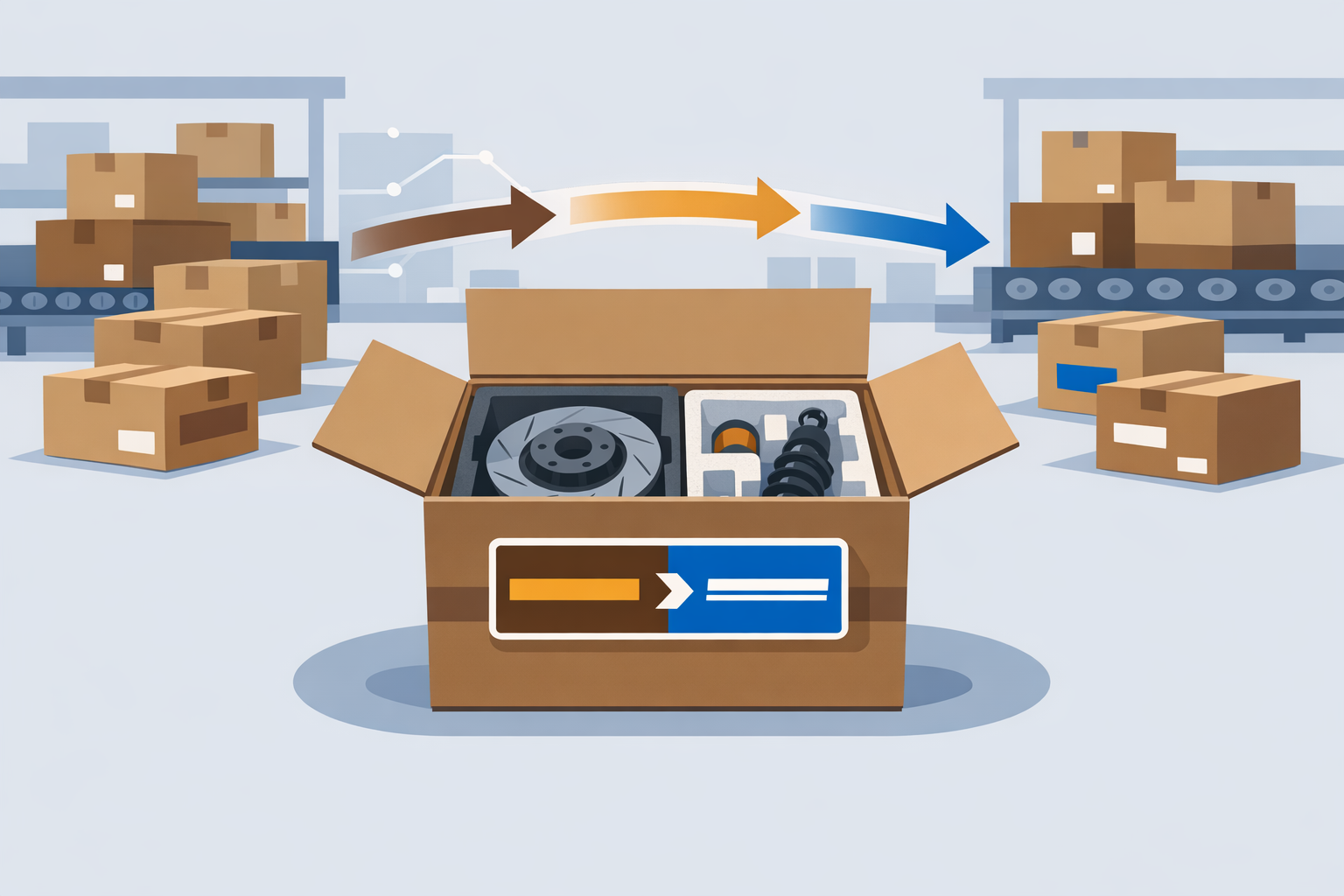
The core packaging challenge is straightforward: a Ground Saver parcel changes hands at least twice - from shipper to UPS to USPS - before reaching the customer. Products pass through multiple handling points, requiring adequate protection from shock, vibration, and other hazards. In a dual-carrier model, that exposure is amplified.
Here are five steps auto parts suppliers should implement:
Step 1 - Standardize Carton Sizes Design outer shippable cartons around common industry dimensions (e.g., 12×10×8 in. and 16×12×10 in.) to ensure compatibility with both UPS and USPS automated sorting systems. Standardized footprints reduce relabeling errors at injection points and streamline palletization.
Step 2 - Engineer Interior Protection for Dual-Network Handling Use molded foam, die-cut corrugated inserts, or engineered dunnage to control part movement and absorb impacts. Electronic components require anti-static protection, machined metal parts need cushioning against vibration, and optical components must remain free from even microscopic contamination. VCI-enhanced poly bags and films protect metal auto parts against rust and corrosion - critical for bare machined components that may sit in a postal sorting facility overnight.
Step 3 - Apply Dual-Label Protocols Given the dual-labeling requirements UPS and USPS worked through during the Q1 ramp-up, suppliers should use scannable labels satisfying both carriers' barcode standards. Place labels on the largest flat face of the carton, away from seams and tape edges, to support automated optical scanning at USPS distribution centers.
Step 4 - Implement Serial-Number-Based Tracking Tracking visibility can degrade at the carrier handoff point. Implement SKU-level tracking at pack-out and use a TMS that aggregates scan events from both UPS and USPS networks. This supports end-to-end visibility, warranty validation, and faster resolution of transit exceptions - particularly relevant for just-in-time repair shops where minimal inventory buffers make component damage especially disruptive, with some assembly lines losing $50,000 or more per minute of downtime.
Step 5 - Segment SKUs by Value and Weight The $50 declared value cap and 70-lb limit make Ground Saver structurally unsuitable for high-value or heavy components. Automotive packaging professionals should establish routing rules that direct only low-value consumables - filters, belts, trim pieces, fasteners - below 10 lbs through Ground Saver, while routing heavier or higher-value parts via UPS Ground or LTL freight.
Sustainability Trade-Offs: Gains and Caveats
One underreported benefit of the cross-carrier model is its potential to reduce last-mile carbon intensity. USPS carriers already service every residential address on fixed routes - adding Ground Saver volume to existing postal routes reduces incremental vehicle miles compared to dispatching dedicated UPS trucks to low-density rural stops. This efficiency gain is precisely what Tomé cited when describing the rationale: "The way to do that is to leverage what they're best at, which is final mile, and what we're best at, which is middle mile."
The sustainability calculus is not entirely straightforward, however. Ground Saver adds 1-2 business days beyond standard Ground transit, putting the range at 2-7 business days - meaning packages spend more time in the network, potentially across additional sort facilities, before final delivery. Suppliers who shift to lighter, right-sized packaging to qualify more SKUs for Ground Saver can simultaneously reduce material waste and dimensional weight charges, reinforcing both cost and sustainability objectives. For suppliers already familiar with smart packaging advances in auto spare-parts logistics, integrating RFID or serialized label data into dual-carrier shipments extends the traceability value of those investments across the full delivery chain.
Eco-friendly packaging materials such as recyclable corrugated fiberboard and biodegradable foams provide necessary protection while reducing environmental impact - and both UPS and USPS have publicly stated preferences for recyclable outer packaging that aligns with carrier sortation guidelines.
Regulatory Watchlist: Policy Factors That Could Reshape the Program
Auto parts suppliers operating national distribution networks should track several emerging regulatory vectors that intersect with packaging decisions under a multi-carrier model:
State-Level Packaging EPR Seven states have enacted packaging EPR laws as of 2025: Maryland, Washington, Minnesota, Colorado, California, Oregon, and Maine. These laws are quickly reshaping compliance obligations, shifting the financial and operational burden of packaging waste management from local governments to manufacturers, importers, and distributors. Suppliers using non-recyclable void fill or expanded polystyrene in Ground Saver shipments destined for Oregon, Colorado, or California face direct fee exposure. Budgeting for a 15-40% uplift on packaging spend is increasingly prudent for high-volume shippers.
Recyclability Labeling Legislation Labeling legislation in New York, New Jersey, Massachusetts, and Oklahoma is on the radar for 2026. Suppliers should verify that "How2Recycle" or equivalent on-pack labeling is accurate for all outer carton materials used in Ground Saver shipments, ahead of potential state-level requirements.
USPS Operational Financial Risk USPS posted total operating revenue of $80.5 billion for fiscal year 2025 but recorded an operating loss of $2.7 billion, up from $1.8 billion in 2024. Suppliers relying heavily on the USPS handoff for rural coverage should monitor postal agency stability and maintain contingency routing options.
Key Takeaways
The UPS-USPS Ground Saver relaunch opens a legitimate cost and coverage opportunity for auto parts suppliers shipping non-urgent, low-value consumables to residential and rural addresses - including previously inaccessible PO Boxes and non-contiguous states. Realizing that opportunity requires deliberate packaging decisions: standardized carton dimensions, component-specific interior protection rated for dual-carrier handling, dual-label compliance, serial-number-level tracking, and strict SKU segmentation by declared value.
Suppliers who treat packaging as an afterthought in carrier selection will encounter the liability gap, tracking blind spots, and EPR compliance exposure that the program's economics do not compensate for. Those who engineer their packaging strategy around the multi-carrier handoff will capture the cost savings - and the rural reach - that the renewed partnership is designed to deliver.