Last-mile delivery remains the costliest segment of the automotive supply chain - and for rural distribution hubs, it is also the most vulnerable. A single road closure, weather event, or driver shortage can halt production lines hundreds of miles away. Now, a landmark regulatory shift from the Federal Aviation Administration is bringing a structural solution into range.
On August 7, 2025, the FAA and the Transportation Security Administration jointly published a Notice of Proposed Rulemaking for Beyond Visual Line of Sight drone operations[1], formally designated as Part 108. The proposed rule introduces performance-based regulations for the design and operation of unmanned aircraft systems at low altitudes beyond visual line of sight, as well as for third-party services - including UAS Traffic Management (UTM) - that support these operations. For automotive suppliers and logistics planners, the rule represents a viable regulatory runway to scale drone delivery of components to facilities that traditional ground transport struggles to serve reliably.
From Waivers to a Scalable Framework: The Regulatory Timeline
The FAA first convened a special advisory committee in 2021 to develop recommendations, and a comprehensive report followed in 2022. Despite legislative pushes - including a mandate in the 2024 FAA Reauthorization Act for a proposed rule by September 2024 - deadlines repeatedly slipped.
Progress accelerated sharply in mid-2025. On June 6, 2025, President Trump issued Executive Order No. 14307, Unleashing American Drone Dominance, directing the FAA to issue a proposed rule enabling routine BVLOS operations for commercial and public safety purposes, with a final rule to be published within 240 days.
The NPRM followed within weeks. Previously, operators needed individual waivers or exemptions to fly drones beyond visual line of sight - approved case by case through a cumbersome process. By eliminating these requirements, the proposal significantly expands commercial drone use cases in manufacturing and parts distribution.
The regulatory trajectory is now well-defined:
| Milestone | Date | Significance |
|---|---|---|
| FAA BVLOS ARC Formed | 2021 | First formal step toward scalable framework |
| ARC Report Published | March 2022 | 70 recommendations, proposed CFR Part 108 |
| BVLOS Waivers Reach 190 | Oct 2024 | 134 operators cleared; multi-operator airspace proven in North Texas |
| Part 135 Certificates Issued (6) | 2024 | Processing time reduced from 2.5 years to 6-8 months |
| Executive Order 14307 | June 6, 2025 | White House directive accelerates rulemaking |
| BVLOS NPRM (Part 108) Published | Aug 7, 2025 | Performance-based framework for routine commercial BVLOS |
| Public Comment Period Closed | Oct 6, 2025 | Industry operational feedback submitted |
| Final Rule Expected | Early 2026 | Waiver-free drone last-mile becomes feasible at fleet scale |
What Part 108 Requires from Operators
The FAA's proposed rule sets detailed requirements for operations, aircraft manufacturing, drone separation from other aircraft, operational authorizations, security, information reporting, and record keeping.
Three operational requirements stand out as particularly relevant to auto parts logistics:
1. Detect-and-Avoid Technology The proposed rule would require detect-and-avoid technology enabling drones to autonomously identify and steer clear of obstacles, other aircraft, and people on the ground - ensuring safe operations even when the pilot has no direct line of sight to the drone.
2. Organizational Accountability Over Individual Pilots The proposed rule takes a new approach to operational responsibility for scaled, digital aviation by embedding automation and organizational control into its framework. By shifting accountability from individual human pilots to the organizations behind automated systems, the rule codifies the reality of modern operations and clears a path for national-scale deployment.
3. UAS Traffic Management (UTM) Integration In July 2024, the FAA authorized multiple operators to fly BVLOS commercial drones in the same airspace in North Texas - a first for both industry and the agency. This achievement, enabled by UTM services, demonstrates the potential for truly scalable operations. The Part 108 framework formalizes UTM as a core requirement, meaning logistics operators must align with certified UTM service providers before commencing BVLOS routes.
Note on HAZMAT: Industry operators, including Google's Wing, have flagged proposed HAZMAT provisions as potentially overreaching for small-component deliveries. Applying HAZMAT rules designed for large-scale cargo operations to drone deliveries of small, everyday items runs counter to the risk-based approach called for in the FAA Reauthorization Act of 2024. Requirements should be proportionate to actual risk, not a one-size-fits-all standard. Auto parts suppliers transporting hazardous sub-components - such as battery cells or brake fluids - should closely monitor how this provision develops in the final rule.
The Rural Auto Parts Opportunity: Why This Matters Now
In rural logistics, drones overcome infrastructure limitations by delivering essential supplies to remote locations. For the automotive sector, this translates directly to maintaining parts availability at assembly plants, dealership networks, and regional distribution hubs in areas where trucking is infrequent, expensive, or weather-dependent.
The first real-world validation has already emerged. A pilot program between blueflite and a Michigan-area automotive dealership aims to reduce downtime, strengthen supply chain resilience, and establish a new logistics model for the auto sector - marking one of the first drone delivery pilots in the industry. The flights operate in the metro Detroit area, connecting to the expanding Ann Arbor-Detroit drone corridor, a region quickly becoming a national testbed for advanced air mobility.
The cost case is also becoming clearer. Research indicates drone delivery costs approximately $1.23 per delivery compared to $5.33 for a four-mile trip by electric van[2] - a differential that compounds rapidly across high-frequency, short-haul auto parts runs. For rural routes where diesel van costs and driver time add further premiums, the economics are more compelling still.
The Scalability Gap: Where the Industry Still Falls Short
Regulatory progress, while significant, has not yet unlocked the full economic potential of BVLOS. Of the more than 44,000 BVLOS flights conducted under the FAA's BEYOND program, operators flew fewer than 763 - approximately 2% - without a visual observer. In PSP/IPA programs, no operators conducted flights without visual observers. Eliminating visual observers is widely considered essential for economic scalability.
This distinction matters for supply chain planners modeling drone ROI. A BVLOS operation that still requires visual observers at multiple waypoints along a rural corridor negates much of the labor cost savings. Part 108's organizational accountability model is designed specifically to address this bottleneck, but full implementation awaits the final rule.
Strategic Implications for Auto Parts Suppliers and Logistics Planners
For mid- to senior-level operations and supply chain professionals, the window to prepare is now - not after the final rule publishes. Key actions include:
- Map rural last-mile vulnerabilities. Identify distribution points where road-dependent delivery creates lead-time risk or high per-unit cost. These are primary candidates for BVLOS drone routes.
- Engage UTM service providers early. The FAA established the Near-Term Approval Process (NTAP) to expedite approval of third-party UTM service suppliers, issuing its first letter of acceptance in May 2024. This process enables proven UTM services to receive expedited review when other operators seek to use them. Partnering with an NTAP-accepted provider now reduces future approval timelines.
- Audit payload compatibility. Assess which auto parts - sensors, filters, fasteners, smaller assemblies - fall within the sub-110 lb MGTW thresholds referenced in the NPRM. These are the most viable initial SKUs for drone delivery.
- Monitor Part 108 HAZMAT provisions. If components include classified materials, track how the final rule handles proportionate risk standards for small UAS.
- Participate in state-level pilot programs. Michigan is pushing to lead in uncrewed aircraft systems, and Governor Whitmer's Executive Directive 2025-4 supports drone use for both business and government operations. Similar programs in other manufacturing states offer early-mover operational data before federal finalization.
For context on how drone and autonomous systems are already reshaping automotive warehouse operations, see our earlier analysis on AI and automation transforming automotive cold chain logistics.
Looking Ahead: A Regulatory Window That Will Not Stay Open Long
The global drone logistics market is projected to surpass $50 billion by 2029, with an estimated CAGR of 23.5%, driven by enhanced infrastructure, expanding urban and rural logistics networks, stronger supply chain resilience, and greater public acceptance of drone-based transport.
For U.S. automotive logistics, the competitive calculus is straightforward: organizations that invest in drone fleet strategy, UTM partnerships, and payload-compatible network design ahead of the final rule will be positioned to move at scale the moment the regulatory path clears. Those waiting for full certainty risk ceding first-mover advantage in a market where infrastructure development - landing pads, charging stations, airspace corridors - takes months to establish.
The FAA has spent four years building the evidentiary and technical foundation for Part 108. The final rule, when it arrives, will not be a starting gun - it will reward those who have already been training.
Frequently Asked Questions
What is the FAA's Part 108 BVLOS rule? Part 108 is the FAA's proposed performance-based regulatory framework for normalizing Beyond Visual Line of Sight drone operations. Published as an NPRM on August 7, 2025, it sets standards for aircraft design, operator accountability, detect-and-avoid technology, and UTM services - replacing the existing case-by-case waiver system.
When will BVLOS commercial drone operations be fully legal for auto parts delivery? Based on the 240-day timeline in Executive Order 14307 (issued June 6, 2025), the final rule is targeted for early 2026. Until then, operators may apply for waivers or Part 135 air carrier certificates, with FAA processing times now averaging 6-8 months.
What payload limits apply under the NPRM? The NPRM references airworthiness standards for UAS weighing under 110 lbs (MGTW) for small package delivery. Suppliers should assess component weights against these thresholds when evaluating drone suitability for specific SKUs.
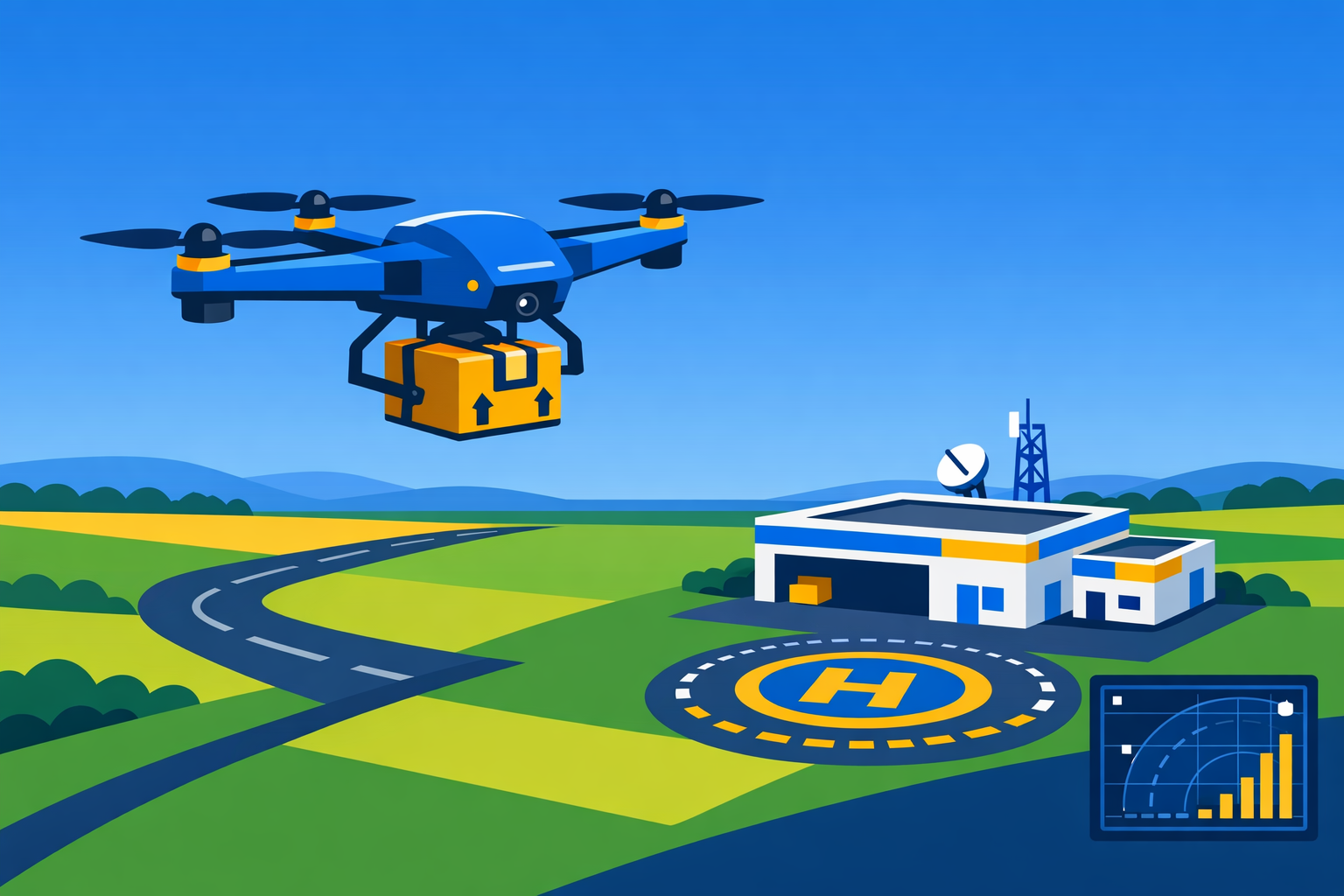
What infrastructure does a rural distribution hub need? At minimum: designated landing and takeoff zones, real-time TMS/WMS integration for dispatch and tracking, communications infrastructure for command and control, charging and maintenance stations, and an agreement with a certified UTM service provider.
How does BVLOS differ from current Part 107 drone operations? Part 107 requires a Remote Pilot in Command to maintain continuous visual line of sight with the drone. Part 108 removes that constraint, enabling longer autonomous routes and fleet-scale operations - provided operators meet the new performance-based airworthiness and UTM requirements.