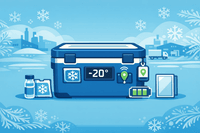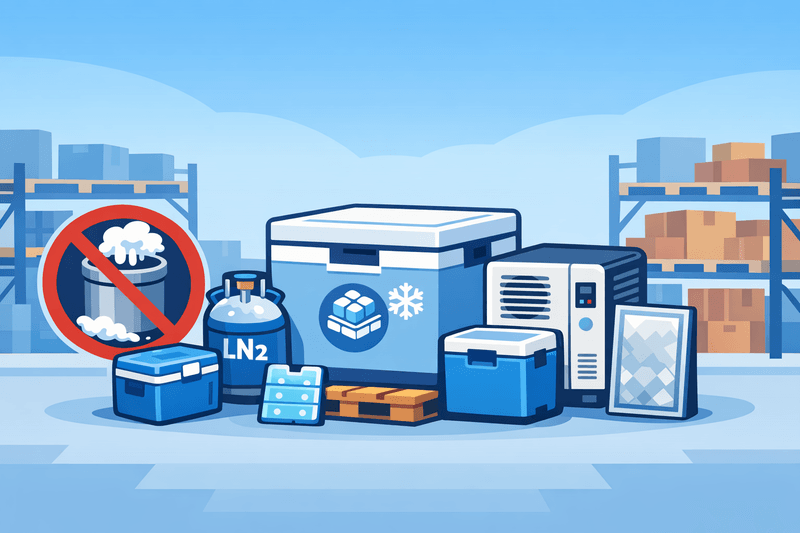
Global cold-chain operators are accelerating their move away from dry ice as CO₂ supply shortages drive up costs and heighten disruption risks. Manufacturers and logistics providers are adopting phase-change materials (PCMs), liquid nitrogen, mechanical refrigeration, and smarter packaging to maintain temperature control for EV batteries and pharmaceuticals.
The constrained CO₂ market, where supply has grown about 0.5% annually while dry-ice demand has increased 5% per year-reaching approximately 4,600 tonnes per day (≈1.25 million tonnes annually)-has tightened availability and raised prices CO₂ supply growth lagged far behind rising demand for dry ice, reaching approximately 4,600 tonnes per day1Dry ice faces supply crunch as CO2 shifts to sequestration | Dry Ice | gasworld. This imbalance has heightened concerns of structural shortages through 2026 if production does not recover, prompting firms to seek alternative cooling technologies 2Cold-chain packaging companies adapt as dry ice supply falters | Supply Chain Dive.
Background
Dry ice has long been preferred for ultra-cold shipping due to its strong cooling capacity, sublimation without liquid residue, and cost efficiency 2Cold-chain packaging companies adapt as dry ice supply falters | Supply Chain Dive. However, volatile CO₂ supply-worsened by energy costs, industrial disruptions, and dependence on a limited number of producers-has underscored cold-chain vulnerabilities 3The Dry Ice Market in 2025: Dynamics, Challenges & Industry Responses - ThermoSafe. The pharmaceutical and direct-to-consumer food sectors are especially impacted due to their strict temperature requirements and need for supply continuity 2Cold-chain packaging companies adapt as dry ice supply falters | Supply Chain Dive.
Details
Packaging suppliers are increasing investment in R&D to develop alternatives balancing performance, safety, and sustainability. PCMs are seeing wider adoption for refrigerated (2-8 °C) shipments, providing precise temperature buffering despite higher unit costs than dry ice 2Cold-chain packaging companies adapt as dry ice supply falters | Supply Chain Dive. In the biopharma sector, PCMs are gaining ground, with the cold-chain packaging market projected to expand from USD 20.6 billion in 2025 to USD 83.2 billion by 2035, reflecting a 15% CAGR. Passive packaging-including PCMs-is expected to make up 72.5% of the market in 2025 4Pharma Cold Chain Storage: 2025 Trends, Einhaltung & Best Practices - Tempk.
Liquid nitrogen and active mechanical refrigeration are being used for ultra-low-temperature applications, such as EV battery transport and critical drug shipments. While these options are more expensive, they decrease reliance on CO₂ and offer controlled cooling 5Cold Chain Industry Adapts to Dry Ice Shortage with New Solutions. Companies are also implementing advanced insulation, such as vacuum panels, and redesigning packaging-including reusable coolers-to maintain temperature integrity and reduce dry-ice demand 6Cold‑Chain Packaging Shifts Amid Dry Ice Constraints.
Logistics strategies are shifting as well. Shippers are decentralizing cold-storage networks to shorten transit times and lower dry-ice use, and diversifying CO₂ procurement-including sourcing from bio-based ethanol plants-to strengthen resilience 2Cold-chain packaging companies adapt as dry ice supply falters | Supply Chain Dive.
Outlook
With supply volatility expected through 2026 and beyond, cold-chain operators are poised to incorporate more hybrid cooling approaches and scalable alternatives. Greater adoption of PCMs, active refrigeration, and packaging innovations may reduce reliance on dry ice, though it is likely to remain essential for certain ultra-cold applications. Strategic investment and supply-chain diversification will shape the future of temperature-controlled logistics.