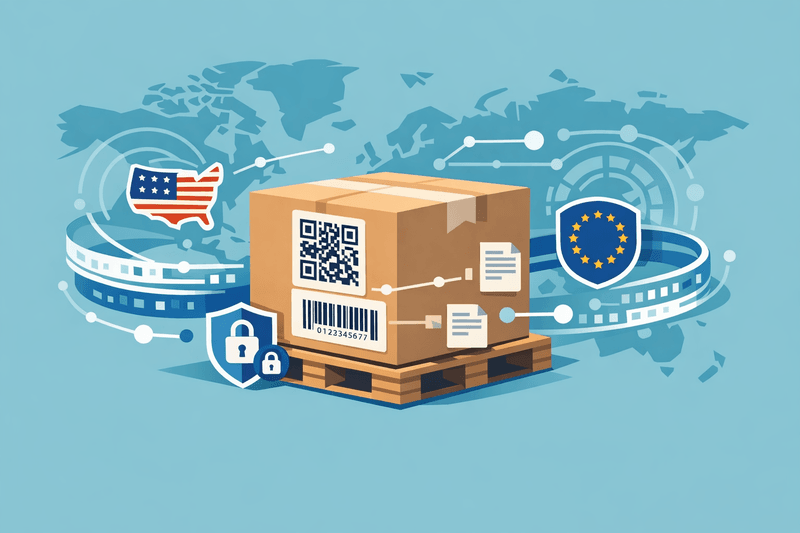
Regulatory alignment among the U.S., the EU, and global markets is reshaping packaging design and traceability requirements in cold chain supply chains under DSCSA, EU PPWR, and FSMA 204.
From August 12, 2026, the EU's Packaging and Packaging Waste Regulation (PPWR) will require all packaging placed on the EU market to comply with harmonized design, recyclability, labeling, and traceability standards. These mandates apply to manufacturers, importers, and distributors, and are supported by a formal declaration of conformity and technical documentation1PPWR – Die neue EU-Verpackungsverordnung ab 2026. This change shifts the EU from fragmented national rules to unified, traceable packaging requirements2Packaging waste - Environment - European Commission.
In the U.S., the Food and Drug Administration has postponed enforcement of the Food Traceability Rule (FSMA 204), extending the compliance deadline from January 20, 2026, to July 20, 2028, after a 30-month enforcement grace period3Food Traceability Rule Guide: How to Meet FSMA 204 Compliance in 8 Steps. FSMA 204 still requires businesses in the food supply chain to maintain electronically sortable and retrievable traceability records for items listed on the Food Traceability List4FSMA 204 Compliance Guide | FDA Food Traceability Rule.
The U.S. Drug Supply Chain Security Act (DSCSA) maintains traceability requirements for pharmaceutical products. Growing emphasis on interoperable serialized systems and data-sharing platforms is tightening packaging and information-sharing protocols for domestic and cross-border cold chain logistics. While DSCSA provisions continue to evolve, the trend toward harmonized traceability is reflected in PPWR and FSMA 204 developments.
Background
The PPWR, published in early 2025 and entering into force on February 11, set an 18-month transition period, culminating in full applicability in August 20265THE EU PACKAGING AND PACKAGING WASTE REGULATION. Its main objectives include eliminating harmful substances such as PFAS, enforcing recyclability standards, imposing minimum recycled-content percentages, regulating empty space ratios, and standardizing labeling to support packaging traceability1PPWR – Die neue EU-Verpackungsverordnung ab 2026.
FSMA 204, published in 2022, requires digital traceability for food from production to end user. The deadline extension provides the industry with more time to prepare systems for capturing and sharing critical tracking events and key data elements4FSMA 204 Compliance Guide | FDA Food Traceability Rule.
DSCSA requirements, fully operational since 2023, mandate electronic tracking of prescription drugs at the package level. These systems now face increased pressure to integrate with global cold chain partners and packaging systems to meet both regulatory and operational needs.
Details
The PPWR requires packaging to include identifiers such as manufacturer name, batch or serial numbers, and digital carriers like QR codes for traceability6The new EU Packaging Regulation: Key requirements from August 2026 | Gleiss Lutz. From 2030, transport and e-commerce packaging must maintain empty space below 50%, and gradual increases in minimum recycled content for plastics, ranging from 10% to 35%, will phase in through 20401PPWR – Die neue EU-Verpackungsverordnung ab 2026. Compliance will depend on formal conformity assessments and technical documentation1PPWR – Die neue EU-Verpackungsverordnung ab 2026.
FSMA 204 mandates that firms keep legible electronic records of events such as harvesting, cooling, packing, shipping, and receiving. These records must be stored for 24 months and made accessible within 24 hours7FSMA 204: Traceability is. The enforcement delay now gives businesses until mid-2028 to develop interoperable digital systems and synchronize data-sharing with suppliers and customers4FSMA 204 Compliance Guide | FDA Food Traceability Rule.
DSCSA requires serialized barcoding and interoperable electronic tracing for pharmaceutical units. Packaging must preserve serial data integrity throughout the cold chain, necessitating advanced labeling and data integration across production, warehousing, and logistics operators.
Outlook
As the EU, U.S., and global frameworks converge on traceability and sustainable packaging, manufacturers, logistics providers, and suppliers across pharmaceutical, food, and consumer goods sectors must invest in digital traceability systems, compliance documentation, and supply-chain integration. Early adoption of harmonized packaging designs, serialization methods, and technical documentation is critical before the PPWR 2026 deadline and FSMA 204 enforcement. Companies that clearly assign roles and responsibilities across DSCSA, PPWR, and FSMA 204 will better manage compliance risk, cost, and cold chain resilience.