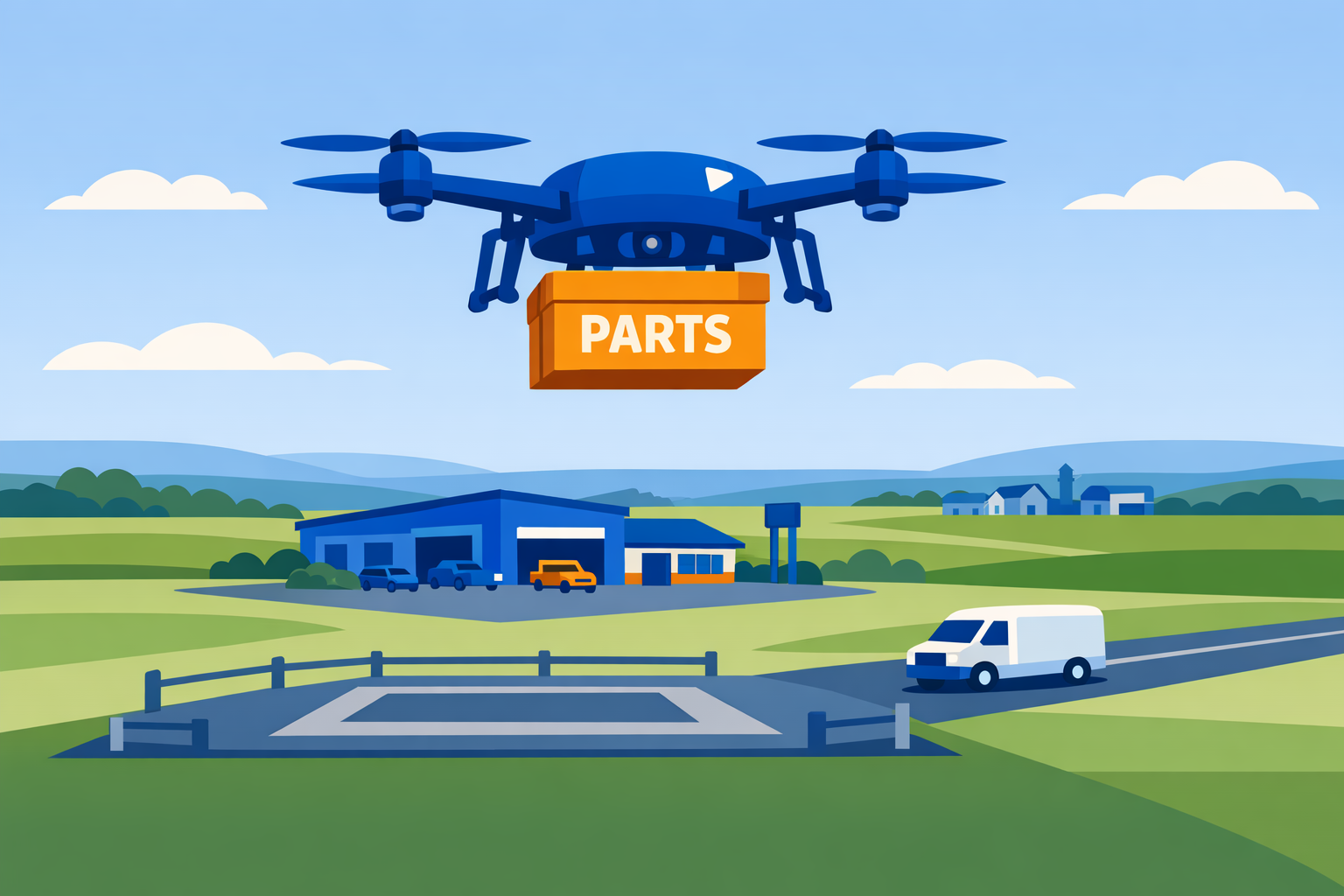
The Federal Aviation Administration's proposed framework for routine beyond visual line of sight drone operations is opening a credible pathway for automotive parts delivery by air - a development that could reshape last-mile logistics for rural dealerships and suppliers across the United States.
Background
For years, BVLOS drone operations in the U.S. required operators to apply for individual, case-by-case waivers - a process that limited commercial scalability. On August 7, 2025, the FAA released its Notice of Proposed Rulemaking (NPRM) for Part 108, establishing a proposed regulatory framework for BVLOS drone operations. Legal analysts at DLA Piper described the rule as "the most significant development in commercial drone regulation since Part 107 was introduced in 2016." It targets package delivery, infrastructure inspection, precision agriculture, and public safety use cases.
The rulemaking was mandated by Executive Order 14307, "Unleashing American Drone Dominance," signed by President Trump on June 6, 2025, which directed the FAA to publish a final BVLOS rule within 240 days. The public comment period on the NPRM closed on October 6, 2025, with the FAA receiving over 3,000 submissions from industry stakeholders.
Details
The proposed Part 108 framework replaces the waiver-based system with a performance- and risk-based regulatory approach, scaling compliance requirements to each operation's complexity and risk profile. Drones weighing up to 110 pounds are eligible for BVLOS operations under Part 108, compared to the 55-pound limit under Part 107. Operations must occur at or below 400 feet above ground level, launching from pre-designated, access-controlled locations. Operators are required to secure FAA approval for intended flight areas, specifying boundaries, daily operation estimates, and zones for takeoff, landing, and loading, as well as maintaining reliable communications and lost-link procedures. Two new personnel roles - an operations supervisor and a flight coordinator - are mandated for every mission.
The automotive sector is already moving to capitalize on the emerging regulatory environment. A Michigan-based consortium led by drone company blueflite launched a pilot program to deliver automotive parts by air to Ford dealerships in Southeast Michigan, backed by a $740,000 grant from Michigan's Advanced Air Mobility (AAM) Activation Fund. The program operates within a 12-mile radius of Jack Demmer Ford locations in the metro Detroit area, connecting to the Ann Arbor-Detroit drone corridor. Partners include Airspace Link and DroneUp. The project team said the pilot is designed to "generate critical operational insights to inform policy, accelerate industry adoption, and serve as a blueprint for scaling drone logistics across the automotive sector."
Governor Gretchen Whitmer issued Executive Directive 2025-4 in support of drone use for both business and government in Michigan. The state's positioning reflects a broader national trend: FAA data from 2025 reports over 865,000 registered drones in the U.S., with commercial drone operations growing 18 percent year over year.
Industry groups have raised concerns about the NPRM's compliance burdens. According to DLA Piper, smaller operators and public safety agencies warned that requirements for full safety management systems and organizational-level approvals could create disproportionate barriers to entry. Manufacturers also flagged that country-of-origin provisions in Section 108.700 would limit airworthiness acceptance to U.S.-manufactured aircraft or those from countries with existing bilateral airworthiness agreements - agreements that do not currently exist for unmanned aircraft.
For automotive OEMs and Tier 1 suppliers, the implications extend beyond dealership parts runs. Rural distribution hubs historically underserved by road freight stand to benefit as BVLOS corridors reduce dependency on ground transport, particularly for time-sensitive components that cause production line stoppages.
Outlook
According to legal analysis from Pillsbury Law, a final BVLOS rule could be published as early as Q1 2026, consistent with the 240-day deadline established by the Executive Order. The FAA is expected to revise the NPRM based on the more than 3,000 public comments received, potentially modifying personnel requirements, country-of-origin rules, and risk classifications. Supply chain operators piloting drone delivery programs - such as the Michigan Ford corridor - are generating the real-world flight data regulators have indicated will inform the final rule's scalability.