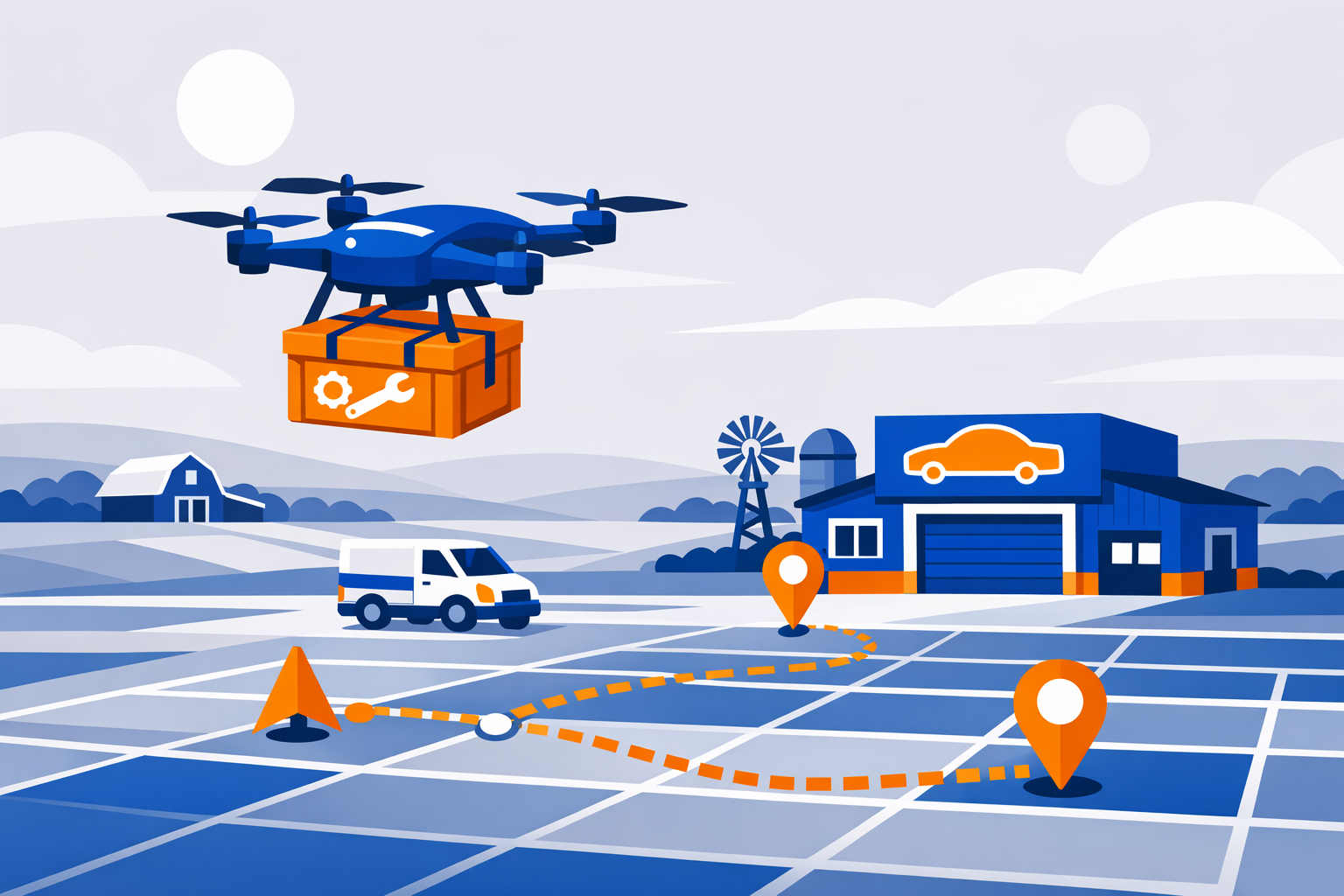
The FAA's proposed Part 108 framework for routine Beyond Visual Line of Sight drone operations positions last-mile drone logistics as a viable option for automotive parts delivery to rural repair shops and dealerships - a segment long strained by ground-transport delays on aging rural corridors.
Background
The Federal Aviation Administration released its Notice of Proposed Rulemaking for Part 108 on August 7, 2025, establishing the proposed regulatory framework for BVLOS drone operations. The 700-plus-page proposal represents the most significant development in commercial drone regulation since Part 107 was introduced in 2016.[1]
The rulemaking follows a direct political mandate. On June 6, 2025, the President issued Executive Order No. 14307, "Unleashing American Drone Dominance," directing the FAA to issue a proposed rule enabling routine BVLOS operations for commercial and public safety purposes, with a final rule to be published within 240 days.
For years, unmanned aircraft systems deployment in U.S. airspace was constrained by regulations limiting operations beyond the sightline of a human controller, requiring individual waivers or exemptions for any BVLOS flight. Industry stakeholders consistently cited these restrictions as a barrier to widespread UAS deployment in areas such as package delivery and supply chain logistics. Since 2020, the FAA steadily increased the number of BVLOS waivers issued - from just 6 in 2020 to 122 in 2023 - with 190 waivers issued as of October 2024.
Details
After years of drafting and delays, the proposed rule would create a standardized regulatory framework enabling commercial drone operators to fly beyond visual line of sight without applying for individual waivers.[2] Rather than a one-size-fits-all approach, the rule scales requirements and permissions to the type of operation - high-risk operations require an operating certificate, while lower-risk operations may qualify for an FAA permit.[3]
The rule would primarily cover operations at or below 400 feet above ground level, from pre-designated and access-controlled locations, and would require FAA approval for the area of intended flight. It also introduces a regulatory framework for Automated Data Service Providers - entities that support scalable BVLOS operations by providing strategic deconfliction, conformance monitoring, and UAS Traffic Management services.
For automotive supply chain operators, the implications are direct. In July 2025, blueflite, Jack Demmer Ford, Centrepolis Accelerator, Airspace Link, and DroneUp launched a state-backed drone delivery initiative focused on transporting automotive parts by air in the Detroit metro area. The project contributes to the Ann Arbor-Detroit drone corridor and is expected to generate critical operational insights to inform policy and serve as a blueprint for scaling drone logistics across the automotive sector.
The proposed Part 108 core framework includes two approval levels - Permitted Operations and Operating Certificates - five risk categories based on population density, and operational area approvals that replace per-flight waivers. Technical requirements mandate detect-and-avoid systems, Remote ID, continuous position tracking, and integration with UTM traffic management systems.
After a 60-day comment period that closed on October 6, 2025, the FAA received over 3,000 public comments reflecting widespread but not uniformly positive perspectives from industry stakeholders.[4] Key concerns include airspace coordination with low-altitude manned aviation and the cost of equipping existing commercial drone fleets with new detect-and-avoid hardware. Commenters raised the prospect of a "one-way visibility gap" in which manned aircraft cannot detect drones while drones may only partially detect manned aircraft - arguing this creates unacceptable collision risks for helicopter operations, agricultural spraying, and aerial firefighting.[5]
Market projections underscore the commercial urgency. The global drone logistics and transportation market was estimated at USD 1.61 billion in 2024 and is projected to reach USD 16.15 billion by 2030, growing at a CAGR of 48.1%. The U.S. is positioned at the forefront of commercial drone delivery, advancing at a CAGR of 33.0% from 2025 to 2035, driven by a strong technology base, widespread e-commerce penetration, and adoption of automated logistics.
Outlook
Publication of the final Part 108 rule is expected in spring 2026, with implementation likely beginning in late 2026 to early 2027, allowing 6 to 12 months for operators to prepare. That timeline was extended after a 43-day U.S. government shutdown delayed FAA rulemaking, pushing the 240-day executive order deadline to approximately March 16, 2026.
For automotive parts suppliers and distribution center operators, the compliance window is narrow. Commercial drone operators seeking to scale BVLOS delivery operations must transition from waivers and exemptions to the new permit and certification regime and update their compliance infrastructure. UAS manufacturers must meet new airworthiness acceptance standards, provide required documentation and maintenance instructions, and support operational recordkeeping. Packaging for drone-delivered parts will also require reassessment - payloads must meet dimensional and weight constraints, carry scannable tracking data for UTM integration, and maintain part integrity across variable-altitude transit conditions.