The Federal Aviation Administration is nearing a pivotal regulatory milestone for commercial drone operations. A final rule on Beyond Visual Line of Sight (BVLOS) flights is expected in spring 2026-a development automotive parts distributors and logistics operators are watching closely as they prepare air delivery networks for high-turnover components.
Background
On August 5, 2025, U.S. Department of Transportation Secretary Sean Duffy announced the release of the long-awaited Notice of Proposed Rulemaking (NPRM) for the BVLOS rule, known as Part 108. After years of drafting and delays, the proposed rule would create a standardized regulatory framework enabling commercial drone operators to fly beyond visual line of sight without applying for individual waivers.[1]
The NPRM followed Executive Order No. 14307, signed on June 6, 2025, titled "Unleashing American Drone Dominance," which directed the Secretary of Transportation to issue a proposed rule enabling routine BVLOS operations for commercial and public safety purposes.[2] Under that order, a final rule is required within 240 days of its signing.
The 700-plus-page proposal represents the most significant development in commercial drone regulation since Part 107 was introduced in 2016. Since 2020, the FAA has steadily increased the number of BVLOS waivers issued-from just 6 in 2020 to 122 in 2023-and had granted 190 waivers as of October 2024. Despite this growth, the existing waiver system requires separate FAA approval and site-specific authorization for every operation, constraining commercial scale-up.
Details
Rather than propose a one-size-fits-all framework, Part 108 scales regulatory requirements to the type of drone operation: higher-risk operations require an operating certificate, while lower-risk operations qualify for an FAA permit. The new regulations support operations at or below 400 feet above ground level in FAA-approved areas, with drones weighing up to 1,320 pounds-a significant increase from Part 107's 55-pound limit.
The proposed rule requires drones to carry technologies enabling automatic detection and avoidance of other aircraft; drones would yield to all manned aircraft broadcasting their position via ADS-B. The NPRM also proposes establishing Automated Data Service Providers (ADSPs), a new regulated entity certified by the FAA under a new Part 146, to supply real-time data helping drone operators deconflict airspace and manage operational efficiency.
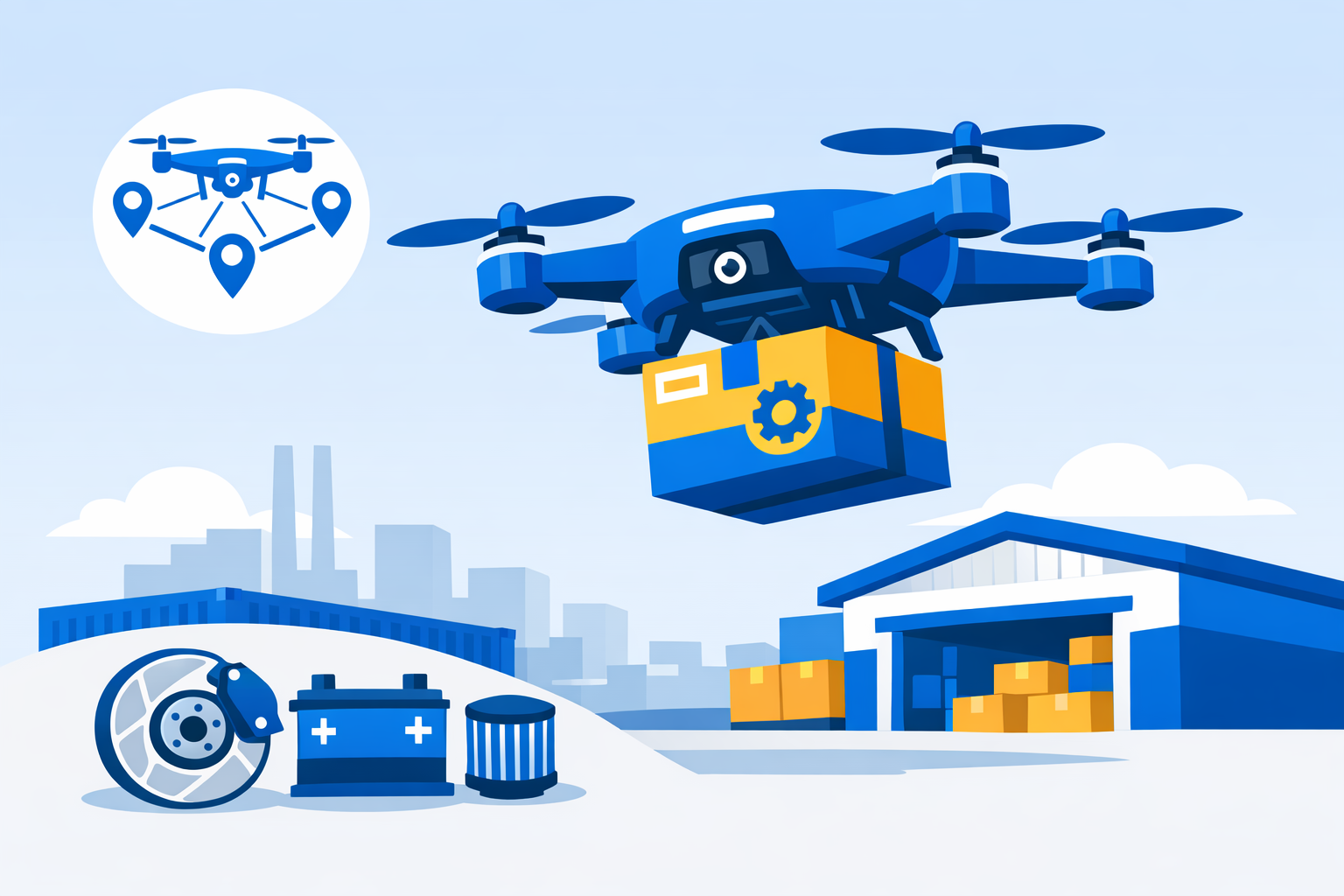
For the automotive supply chain-where brake pads, filters, batteries, and other fast-moving components are regularly needed at service centers and repair shops-the framework's package delivery category is particularly relevant. The proposed rule explicitly lists package delivery among the operations BVLOS authorization would enable.
The FAA received over 3,000 public comments during the initial 60-day period that closed October 6, 2025. Industry drone associations noted that the NPRM lacks a clear mechanism for operators with existing Part 107 BVLOS waivers to transition to Part 108 and would eliminate the ability to obtain new Part 107 BVLOS waivers. Drone companies also criticized the NPRM's reliance on population density as the primary risk determinant, arguing that many commercial operations occur at access-controlled sites where geofencing, site access control, and parachute systems significantly reduce risk regardless of surrounding population density.
The FAA reopened the comment period until February 11, 2026, with the renewed feedback window specifically targeting input on electronic conspicuity devices, including alternatives to ADS-B Out for both manned and unmanned aircraft.
Outlook
After months of anticipation and a 43-day government shutdown-the longest in U.S. history-the FAA's Part 108 regulations carry a revised proposal deadline of March 16, 2026. That date reflects the 43-day delay added to the original February 1 target mandated by the June 2025 executive order. Publication of the final rule is expected in spring 2026, with implementation likely beginning in late 2026 to early 2027, giving operators 6 to 12 months to prepare.
For automotive parts distributors and fleet operators, finalization of Part 108 would mark a shift from experimental drone corridors to scalable, permitted air-delivery infrastructure. The global autonomous last-mile delivery market was estimated at $1.3 billion in 2025 and is projected to reach $11.5 billion by 2035, according to Global Market Insights, at a compound annual growth rate of 24.5%. Packaging and labeling requirements for drone-carried automotive parts-including environmental sealing, weight-compliant parcels, and machine-readable tracking-are expected to become a key consideration for supply chain managers as operational approvals expand.