The Federal Aviation Administration has published a landmark proposed rule to standardize commercial drone operations beyond visual line of sight, creating a regulatory pathway that automotive shippers targeting rural hubs and remote dealerships must now prepare for.
Background
For years, U.S. drone operations have been constrained by regulations requiring operators to obtain individual waivers or exemptions for flights beyond visual line of sight (BVLOS). The FAA first convened a special advisory committee in 2021 to develop BVLOS recommendations, and despite a congressional mandate in the 2024 FAA Reauthorization Act requiring a proposed rule by September 2024, deadlines repeatedly slipped.
On June 6, 2025, President Trump issued Executive Order 14307, "Unleashing American Drone Dominance," directing the FAA to issue a proposed rule enabling routine BVLOS operations for commercial and public safety purposes, with a final rule due within 240 days. On August 5, 2025, U.S. Department of Transportation Secretary Sean Duffy announced the release of the long-awaited Notice of Proposed Rulemaking (NPRM), also known as Part 108.
Key Rule Details and Operator Requirements
The proposed rule would create a standardized framework enabling commercial drone operators to fly beyond visual line of sight without applying for individual waivers. The FAA's approach is performance- and risk-based, reflecting the diversity of drone types and operations. Rather than a one-size-fits-all framework, the rule scales requirements to the type of operation-high-risk missions require an operating certificate, while lower-risk operations require only an FAA permit.
Operations would occur at or below 400 feet above ground level, launching from pre-designated, access-controlled locations. Operators must secure FAA approval for their intended flight areas, specifying boundaries, daily operation estimates, and zones for takeoff, landing, and loading. They must also ensure reliable communications and maintain procedures for lost links.
The rule introduces a framework for "Automated Data Service Providers" (ADSPs)-entities that support scalable BVLOS operations by providing strategic deconfliction, conformance monitoring, and UAS Traffic Management (UTM). Operators may serve as their own ADSP or contract with another company for those services.
Under the proposed Part 108, drones up to 110 pounds are eligible for BVLOS operations - double the 55-pound weight limit under the existing Part 107 framework. The Trump Administration directed the final rule to be published by February 1, 2026. Analysts at Pillsbury Law note the final BVLOS rule could arrive as early as the first quarter of 2026.
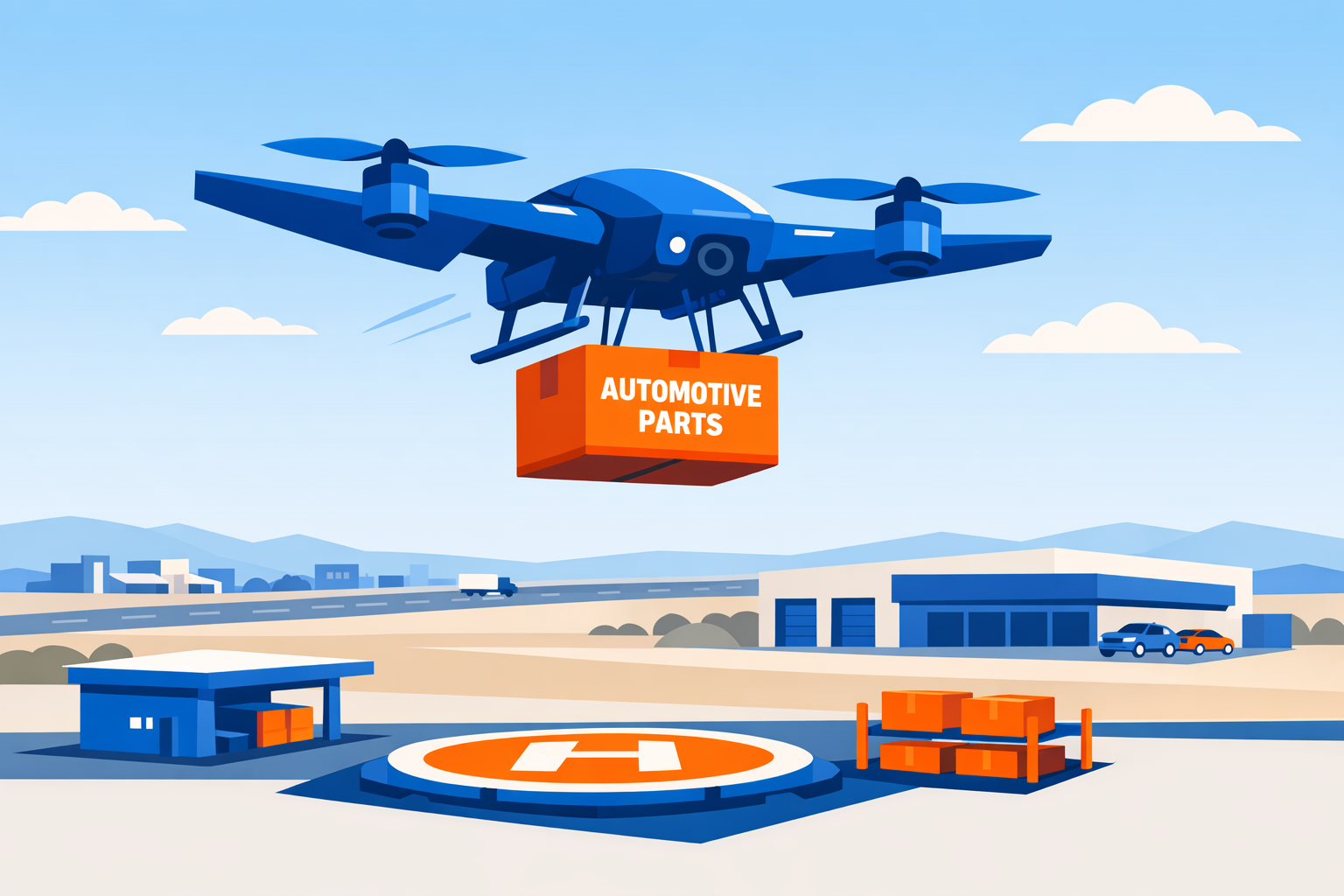
For automotive supply chains, the implications are direct. In July 2025, blueflite, Jack Demmer Ford, Centrepolis Accelerator, Airspace Link, and DroneUp launched a drone delivery pilot focused on transporting automotive parts by air, backed by a grant from Michigan's Advanced Air Mobility Activation Fund. The project uses autonomous drones to deliver high-demand car parts within a 12-mile radius of Jack Demmer Ford dealerships in Southeast Michigan. Deliveries take place in the Detroit metro area, contributing to the growing Ann Arbor-Detroit drone corridor.
Under the proposed rule, all BVLOS-capable drones must meet new airworthiness acceptance standards, provide required documentation and maintenance instructions, and support operational recordkeeping and reporting. ADSPs and UTM service providers must pursue FAA certification and authorization, implement safety management system (SMS) and cybersecurity programs, and comply with ongoing oversight, reporting, and record retention requirements.
Outlook
The proposed rule includes detailed requirements for operations, aircraft manufacturing, drone separation from other aircraft, operational authorizations, security, and information reporting and recordkeeping. Auto shippers targeting rural dealerships and remote distribution hubs will need to audit their drone fleets for Part 108 airworthiness compliance, map intended flight corridors for FAA approval, and determine whether their planned operations require a permit or a full operating certificate before the final rule takes effect.
The North American drone logistics transportation market was valued at USD 248.5 million in 2025 and is projected to grow from USD 286.4 million in 2026 to USD 639.8 million by 2034, exhibiting a CAGR of 14.8% during the forecast period, according to Intel Market Research. For automotive parts logistics-where service uptime at remote dealerships depends on last-mile speed-the BVLOS framework represents a material shift in delivery network design.