The U.S. Federal Aviation Administration released a landmark proposed rule in August 2025 to normalize Beyond Visual Line of Sight (BVLOS) drone operations, creating a standardized regulatory pathway that supply chain operators-including auto-parts suppliers-can use to launch commercial aerial delivery programs. The move follows a direct presidential mandate and coincides with the first real-world drone delivery pilot for automotive parts, already underway in Michigan.
Background
On August 5, 2025, U.S. Department of Transportation Secretary Sean Duffy announced the release of the long-awaited Notice of Proposed Rulemaking (NPRM) on BVLOS operations, designated as Part 108. The proposed rule responds directly to Executive Order 14307, "Unleashing American Drone Dominance," signed on June 6, 2025, which directed the FAA to finalize a BVLOS rule within 240 days.
Until this NPRM, the FAA granted BVLOS approvals only through case-by-case waivers or exemptions, a process that industry stakeholders said impeded scalable commercial operations. The proposed Part 108 would replace that approach with a clear, repeatable approval pathway. A government shutdown of 43 days pushed the expected final rule publication date from the original February 1, 2026 target to approximately March 16, 2026.
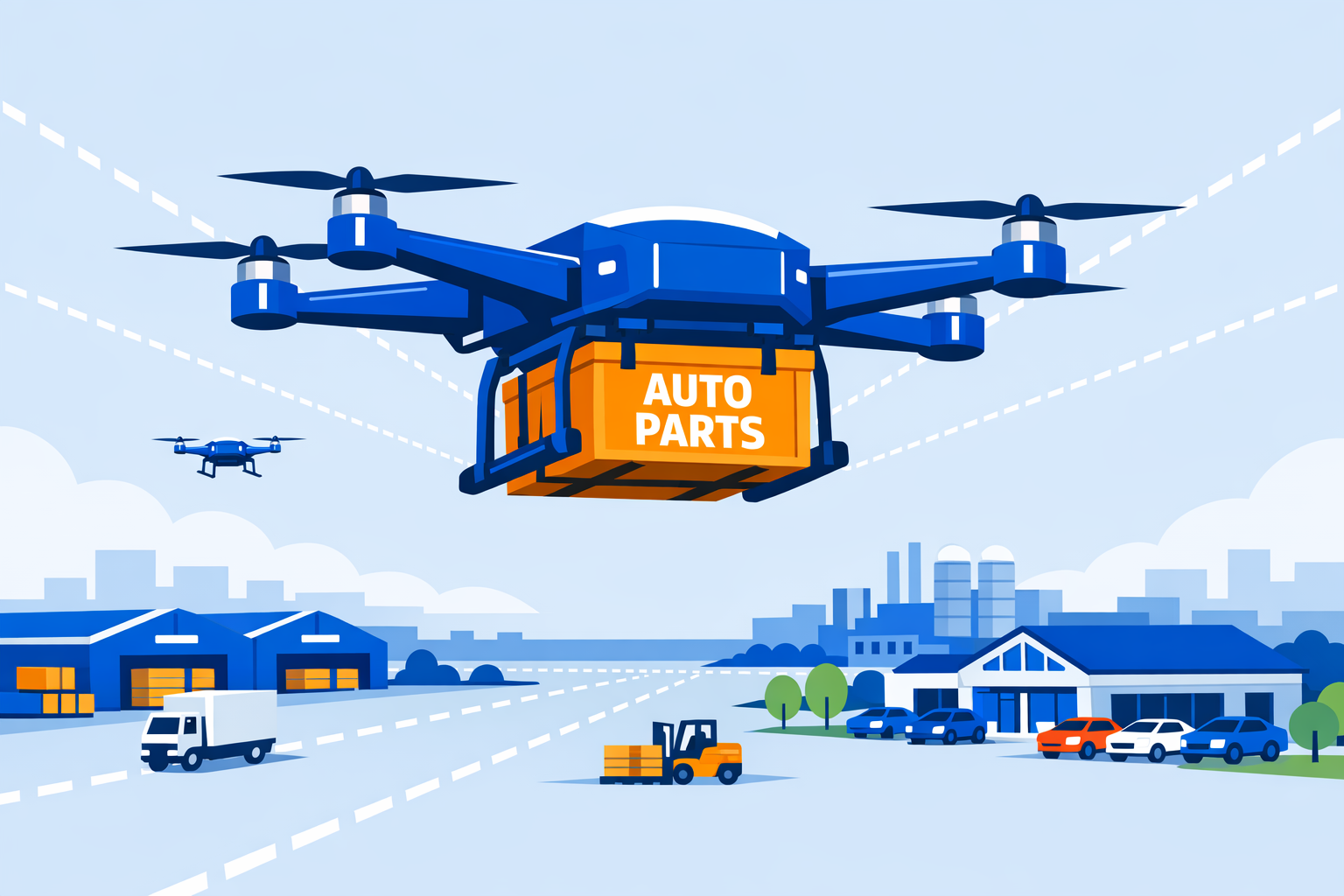
The automotive sector has a particular stake in this development. In July 2025, blueflite, Jack Demmer Ford, Centrepolis Accelerator, Airspace Link, and DroneUp launched a drone delivery pilot in the Detroit metro area backed by a $740,000 grant from Michigan's Advanced Air Mobility Activation Fund. The program tests autonomous drones delivering high-demand car parts to Ford dealerships within a 12-mile radius, operating within the Ann Arbor-Detroit drone corridor.
Key Rule Details and Operator Requirements
The proposed Part 108 framework introduces a tiered authorization structure. Operators can apply for a 24-month BVLOS permit suited to pilot projects with less FAA oversight, or an open-ended operating certificate requiring routine FAA surveillance and more detailed safety program documentation.
All BVLOS operations under the proposed rule would occur at or below 400 feet above ground level, launching from pre-designated, access-controlled locations. Operators must secure FAA approval for their intended flight areas, specifying boundaries, daily operation estimates, and zones for takeoff, landing, and loading, and must ensure reliable communications with procedures for lost-link events.
The proposed rule raises the eligible drone weight from the current 55-pound limit under Part 107 to 110 pounds under Part 108, allowing heavier payloads consistent with automotive component shipments. Higher-risk operations-defined by factors such as aircraft size, weight, speed, and overflight area-would require an operating certificate, while lower-risk operations could qualify for a permit.
On the safety and security side, all UAS operating under Part 108 must detect and yield right-of-way to aircraft broadcasting their position via Automatic Dependent Surveillance-Broadcast (ADS-B) equipment. Personnel with unsupervised access to UAS equipment must complete an enhanced TSA security threat assessment, which includes criminal history, immigration, and intelligence database checks, and an in-person visit to a TSA center. All BVLOS-enabled drones must broadcast lighting and Remote ID at all times.
For package delivery specifically, operators must currently hold a Part 135 air carrier certificate-a five-phase certification process-and obtain a separate BVLOS exemption or waiver before conducting commercial drone deliveries. As of April 2025, Drone Express, Inc. (DEXA) became the seventh drone operator to receive a Part 119 air carrier certificate with authority to conduct Part 135 on-demand package delivery, operating in Dayton, Ohio.
Airspace management will eventually migrate to the FAA's Unmanned Aircraft System Traffic Management (UTM) framework. UTM will enable multiple drones operating BVLOS at low altitudes under 400 feet AGL, with operators responsible for managing their operations safely within FAA-issued real-time constraints without receiving direct air traffic control services.
What Auto-Parts Suppliers Must Do Now
Auto-parts suppliers and carriers seeking to participate in BVLOS drone corridors face a multi-step compliance process. Operators must determine whether their planned operations qualify for a permit or require a full certificate under Part 108, then begin assembling the required safety program documentation-including ground risk assessments, area-of-operations plans, communication service assessments, and collision avoidance strategies.
Firms should also evaluate partnerships with FAA-approved Automated Data Service Providers to meet UTM integration requirements, and initiate background screening for relevant personnel well in advance of operational launch.
Outlook
The FAA's revised target for publishing the final Part 108 BVLOS rule stands at approximately March 16, 2026, following a 43-day extension caused by the government shutdown. Once finalized, the rule is expected to accelerate regional drone corridor buildout across industrial logistics hubs. The Commercial Drone Alliance stated it would work to ensure the final rule "accelerates the expansion of commercial and public safety drone operations throughout the United States, while enhancing the safety and transparency of the national airspace." Auto-parts suppliers, dealership networks, and third-party logistics providers in corridor regions such as Southeast Michigan should begin assessing aircraft capabilities, ADSP options, and security protocols to be ready when the rule takes effect.