The Federal Aviation Administration has released a landmark proposed rule to normalize beyond-visual-line-of-sight (BVLOS) drone operations across the United States, positioning automotive manufacturers and industrial logistics operators to scale drone-enabled parts delivery to remote facilities and distributed manufacturing sites under a predictable regulatory framework.
On August 7, 2025, the FAA published a 731-page Notice of Proposed Rulemaking (NPRM) for Part 108 in the Federal Register, proposing performance-based regulations for routine BVLOS drone operations at low altitudes. The rule, formalized under Docket No. FAA-2025-1908, follows Executive Order 14307 - "Unleashing American Drone Dominance" - signed by President Trump on June 6, 2025, which directed the FAA to publish a final BVLOS rule within 240 days. The proposed framework targets commercial applications including package delivery, precision agriculture, infrastructure inspection, and public safety missions.
Background
For years, industrial drone operators seeking BVLOS authorization have faced a fragmented and unpredictable approval process. Under the current Part 107 structure, every BVLOS operation requires a separate FAA waiver, with each flight needing individual safety documentation, site-specific authorization, and case-by-case approval. Approved BVLOS flights rose from approximately 1,200 in 2020 to more than 26,000 by 2023, according to the U.S. Department of Transportation's Office of Inspector General, yet industry participants have consistently identified the waiver process as a barrier to economically scalable operations.
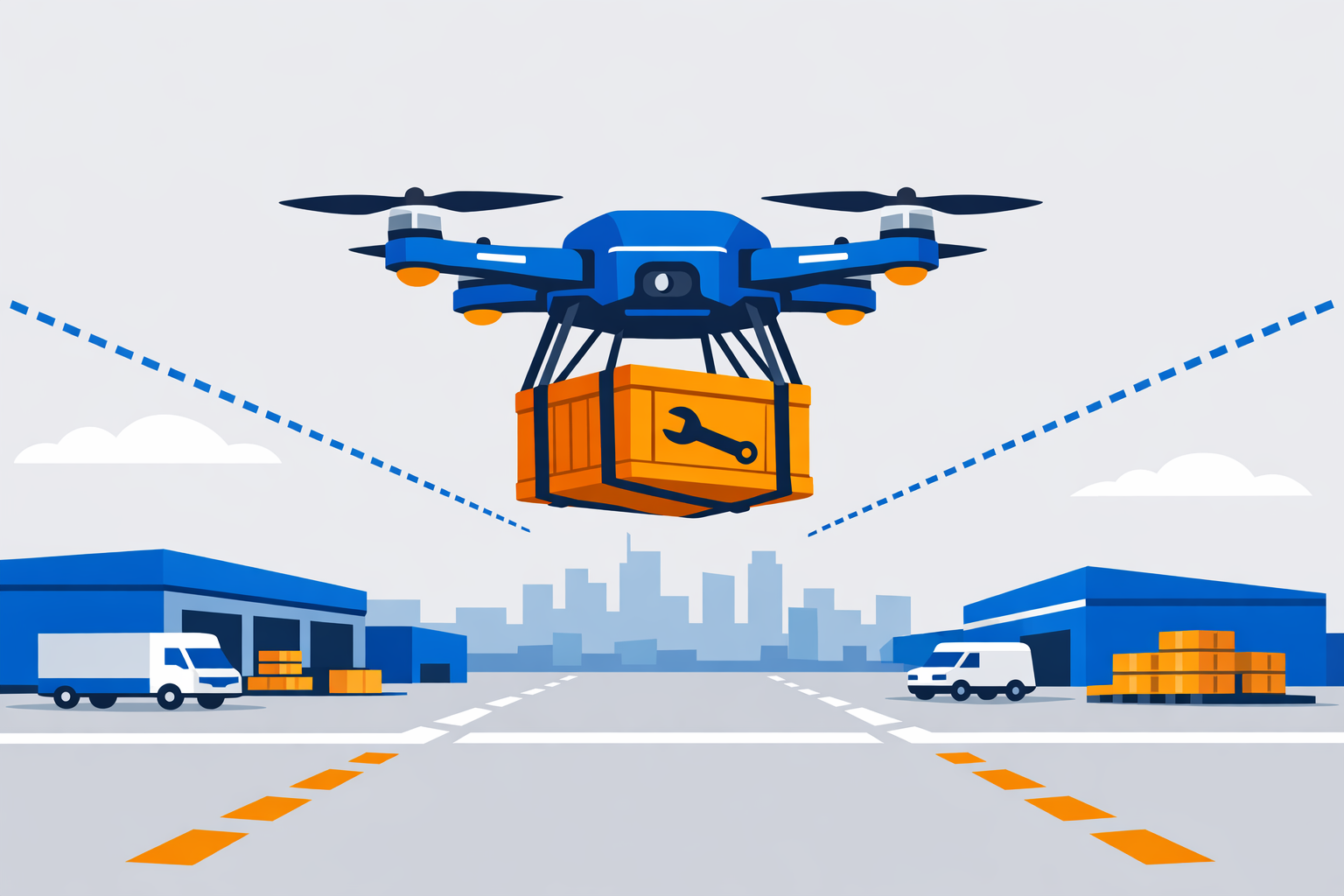
The automotive sector faces particular exposure to this bottleneck. Remote assembly plants, maintenance depots, and supplier yards - often located beyond the visual range of any single ground operator - require time-sensitive, low-volume parts movements that make conventional last-mile trucking cost-prohibitive. An active pilot program in Detroit illustrates the use case: drone delivery company Aerialoop is piloting the delivery of automotive and micro-mobility parts from Beacon Manufacturing's warehouse to Newlab's campus at Michigan Central station, a 1.2-mile BVLOS middle-mile corridor, operating through the Advanced Aerial Innovation Region (AAIR), a 3-mile aerial zone with cross-border routes established via a public-private partnership with MDOT Aeronautics.
Key Regulatory Details
The proposed Part 108 rule would replace the existing waiver-based system with two standardized authorization pathways: a BVLOS permit valid for 24 months for lower-risk, smaller-scale missions, and an operational certificate with no expiration for large-scale or complex deployments such as drone delivery networks. Operations would occur at or below 400 feet above ground level, launching from pre-designated, access-controlled locations, with operators required to secure FAA approval for flight area boundaries, daily operation estimates, and takeoff and landing zones.
The proposed rule also expands eligible aircraft. Drones weighing up to 110 pounds would be eligible for BVLOS operations under Part 108, compared to the 55-pound ceiling under Part 107 - a threshold that accommodates heavier industrial payloads such as automotive components. On the safety side, Part 108 mandates redundant power and propulsion systems, cybersecurity protections, Remote ID broadcasting, detect-and-avoid (DAA) technology, and integration with UAS Traffic Management (UTM) systems.
A key structural shift concerns operational accountability. Under Part 108, compliance responsibility moves from the individual remote pilot to the operating organization, which must demonstrate a robust safety management system, trained personnel, and documented risk controls - a model more analogous to corporate aviation than traditional drone piloting.
The FAA received more than 3,000 public comments by the October 6, 2025 deadline. Industry associations raised concerns including disproportionate compliance burdens for smaller operators, the absence of a streamlined transition path for existing Part 107 BVLOS waiver holders, and the NPRM's heavy reliance on population density as the primary risk determinant - a metric critics argue fails to credit operational mitigations such as geofencing at access-controlled industrial sites.
Security requirements from the Transportation Security Administration are also embedded in the proposed rule. Three principal security concerns identified in industry filings to the FAA include unauthorized access to BVLOS operations, security vetting of operators, and cybersecurity protections for drone systems.
Outlook
The original final-rule deadline of approximately February 1, 2026 was extended to around March 16, 2026 after a 43-day federal government shutdown disrupted the FAA's rulemaking process. Legal analysts at Pillsbury and DLA Piper note that the volume and complexity of public comments make the revised deadline challenging, with implementation expected to occur in phases as operators obtain permits or certificates.
For automotive supply chain operators, the period before a final rule is issued represents a preparatory window. Carriers and automakers intending to deploy drone logistics corridors will need to assess aircraft capability against Part 108 airworthiness standards, develop safety management systems, and engage with Automated Data Service Providers (ADSPs) for UTM integration. Transport Canada implemented comprehensive BVLOS regulations in late 2025, and international regulatory differences have created competitive dynamics affecting where drone delivery companies develop operations and conduct testing - a factor that adds urgency for U.S. industrial operators to establish BVLOS readiness ahead of final rule enactment.