Automation in packaging is advancing rapidly. Modular robotic cells, AI-driven predictive maintenance, and vision-based inline quality control are merging with regulatory and sustainability demands, positioning 2026 as a critical year for warehouse and packaging operations.
This analysis examines the maturation of these technologies, their measurable ROI, and the priorities mid- to senior-level leaders in operations, packaging, and supply chain management should consider for their 2026 planning.
2026: An Inflection Point for Automated Packaging Lines
Warehouse automation and robotic packaging have moved beyond pilot projects. They now form essential infrastructure in automotive, e-commerce, food and beverage, and aftermarket parts networks.
The global warehouse robotics market is projected to rise from about USD 6.5 billion in 2025 to around USD 25.4 billion by 2034, with a compound annual growth rate near 17%.Analysts estimate the global warehouse automation market at USD 24.6 billion in 2025, reaching USD 26.1 billion in 2026, and USD 44.2 billion by 2035. These transitions confirm a fundamental shift toward automated handling and packaging.
Key forces driving this change include:
- Ongoing labor shortages and turnover in packing and palletizing
- SKU proliferation in e-commerce and automotive aftermarket, increasing changeover complexity
- Stricter expectations for defect-free output and supply chain traceability
- ESG and regulatory requirements, especially regarding packaging waste in the EU
- Maturing modular automation, AI-based maintenance, and vision inspection technologies
By 2026, the central question shifts from whether to automate to how to sequence automation investments for flexibility, compliance, and resilience.
Market Snapshot: Automation Momentum
| Segment | 2025 Size (USD bn) | 2034/2035 Forecast (USD bn) | Comment |
|---|---|---|---|
| Warehouse robotics | ~6.5 | ~25.4 (2034) | Strong growth in palletizing, picking, packing |
| Warehouse automation (overall) | 24.6 | 44.2 (2035) | Robotics and AI widely integrated |
More than one-third of logistics firms have implemented fully automated sorting and packaging to meet e-commerce demand.
Modular Packaging Platforms Enable Reconfigurable Warehouses
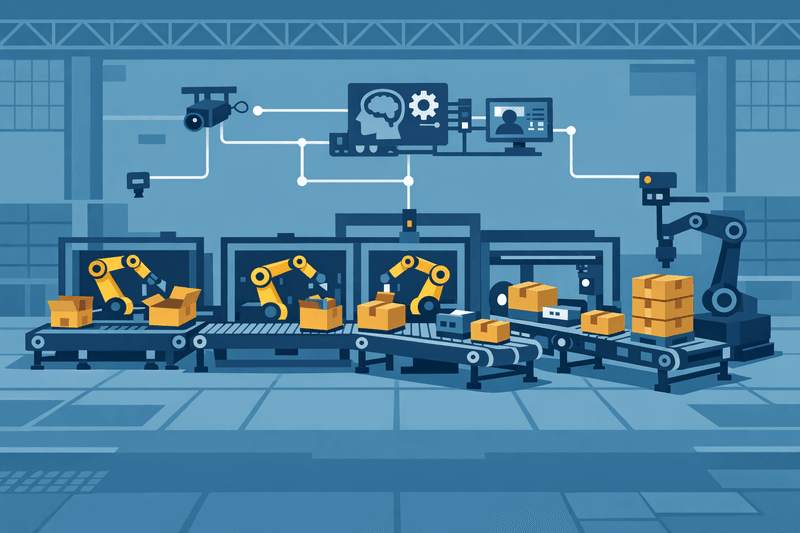
Traditional end-of-line packaging systems are monolithic, with single layouts and long retooling periods. New modular architectures break lines into standardized, swappable cells.
Suppliers now deliver pre-engineered robotic packaging cells for tasks such as carton erecting, case packing, sealing, labeling, and palletizing. These can be combined and extended, sharing common controls and easily augmented with conveyors or vision systems as needed.
Characteristics of modular packaging automation include:
- Functional cells: Distinct modules for each major packaging function
- Plug-and-play integration: Standard mechanical and controls interfaces to minimize engineering work during upgrades
- Configurable logic: Tools allowing operators to adjust recipes and patterns independently
- Data connectivity: Built-in integration with WMS/ERP for order management and performance feedback
Design Principles for Modular Packaging Automation
To succeed with modular automation, operations teams should:
- Standardize interfaces between mechanical components and PLC/fieldbus systems for new robotic cells.
- Separate core infrastructure (conveyors, safety) from swappable functional cells like case packers.
- Engineer for quick changeovers using digital work instructions and downloadable parameters.
- Plan for expansion by reserving space and network capacity for future modules.
This approach supports multi-SKU operations. Distribution centers for automotive and industrial parts can direct products through specialized cells and redirect robots as demand shifts.
Sector-Specific Use Cases
Automotive and aftermarket
- Flexible case packing for diverse small parts
- Heavy-duty robotic palletizing for engines and glass
- Fast line reconfiguration for model changes
E-commerce fulfillment
- Modular carton erectors with right-size box-making
- Dedicated cells for fragile, bulky, or hazardous goods
- Capacity surges via module addition during peak
Cold-chain and perishables
- Packaging cells within climate-controlled tunnels
- Quick swaps of film or tray formats
- Inline inspection tailored for chilled or frozen goods
For most operators, modular cells serve as building blocks for long-term automation strategies.
AI-Powered Predictive Maintenance Protects Throughput
Increasing automation density raises the cost of unexpected downtime. Packaging and conveyor systems are prime applications for AI-based predictive maintenance and analytics.
A 2026 case study at a food packaging facility reported a 50% decrease in conveyor belt failures after adopting AI-based predictive maintenance and real-time vibration monitoring. Studies show that analytics combining alarms with anomaly detection improve maintenance decisions over rule-based methods.
From Time-Based Service to Condition-Based Decisions
Most operations rely on interval-based preventive maintenance. This risks both over-servicing healthy assets and missing early failure signs.
Predictive maintenance for packaging includes:
- Sensorization: Installing accelerometers, current sensors, encoders, and temperature probes on critical assets
- Data aggregation: Streaming telemetry from PLCs/drives to historians or analytics platforms
- Feature extraction: Analyzing vibration spectra, temperature trends, and cycle data
- Failure modeling: Using machine learning on multi-variable series to detect fault patterns
- Work order automation: Directly linking predictive alerts to maintenance management systems
Model performance often depends on how early faults can be predicted and the quality of collected history. Deep learning suits systems with complex, time-varying precursors; simpler methods work well in stable, repetitive processes.
Data and Integration Requirements
Successful deployment requires:
- Clean asset mapping between hardware and data tags
- Defined response rules aligning prediction severity with action thresholds
- Integrated operator workflows via dashboards and alerts
- Continuous feedback loops to refine models and reduce false alarms
When implemented correctly, predictive maintenance reduces unplanned stops, lengthens asset life, and enables higher OEE targets-especially in cold-chain setups where interruptions risk product quality.
Vision Inspection and Inline Quality Control Go Mainstream
High-speed vision inspection and AI-driven defect classification have transitioned from specialized pilots to standard components of packaging automation.
Modern deep-learning systems in food and beverage inspect for foreign substances, verify seals, check assemblies, and perform label OCR at full production speeds. Industry solutions now combine cameras, lighting, and AI to spot surface defects, verify barcodes and text, and perform pre-shipment quality checks.
Meanwhile, inline inspection tools for labels now feature pre-trained AI models to categorize defects and distinguish critical from minor issues-improving accuracy, reducing false stops, and supporting circular-economy goals.
AI inspection platforms provide:
- Multi-class defect detection across seal, print, labeling, and contamination issues
- Automated classification and logging for root-cause and compliance analysis
- Retrainable deep-learning models managed by QA teams
- Real-time feedback that triggers rework and line adjustments
From Sampling to 100% Inline Inspection
Historically, visual checks relied on sampling small case volumes. Deep-learning vision and robotic integration now make continuous, inline inspection economically viable.
Automated inspection tasks include:
- Verifying seal integrity and tamper-evidence
- Checking label placement, artwork, and regulatory marks
- Reading data/lot codes with OCR
- Detecting carton damage and deformation
- Spotting contamination or foreign objects
Inspection technology evolution:
| Inspection Task | Legacy Approach | Emerging 2026 Approach |
|---|---|---|
| Seal presence | Sensors, manual checks | Vision systems with contour/texture analysis |
| Label placement/text | Manual sampling, 1D scanners | High-res cameras, OCR, automated comparison |
| Carton damage | Manual checks at pallet build | Inline 2D/3D vision triggering automatic rework |
| Code/ID verification | Random handheld scans | 100% inline scanning with data integration |
In automotive and aftermarket supply chains, this level of inline QC reduces returns and enhances traceability with serialized barcodes or digital passports.
Enabling Traceability and Regulatory Compliance
Traceability is gaining prominence due to EU rules. The new Packaging and Packaging Waste Regulation (PPWR) will unify packaging and labeling requirements and intersect with digital passport initiatives.
The EU's PPWR will take effect on 12 August 2026, replacing the directive-based system.In 2022, EU residents generated about 186.5 kilograms of packaging waste per capita, including roughly 36 kilograms of plastic-about half a kilogram per day. These statistics highlight increasing expectations for recyclability and material traceability.
Advanced inspection and inline control systems help operators comply by:
- Capturing package images for audit trails
- Verifying required recycling and sorting labels
- Ensuring packaging matches recycling-oriented specifications
- Delivering data for digital packaging passports
Sustainability, Workforce, and TCO: Strategic Impacts
While automation has often focused on throughput and labor, sustainability and total cost of ownership (TCO) are increasingly key.
Energy and Resource Efficiency
Research into automated warehouses demonstrates measurable sustainability improvements.
Warehouse automation reduces energy use by 35-45% and material waste by 25-35%, with concurrent double-digit cost savings. These gains stem from optimized robot movements, tighter controls, and reduced manual rework and packaging use.
Right-size packaging systems are particularly impactful. Automation trims excess void, lowers shipping emissions, and reduces transport damage.
Commercial right-size packaging machines produce about 500 custom boxes per hour and can cut void-fill usage up to 50%.
For volume-driven e-commerce and spare-parts warehouses, this translates to:
- Less corrugated and filler per shipment
- Reduced transport damage from oversized cartons
- Lower volumetric weight charges for shipping
Workforce Transformation
As automation scales, workforce needs evolve:
- Fewer repetitive manual tasks, such as hand-packing or visual seal checks
- More technical roles in supervision, robotics, analytics, and maintenance
- Increased training for safety with collaborative robots and high-speed equipment
Most deployments shift personnel from basic tasks to oversight and optimization roles, supporting stable operations in tight labor markets.
Rethinking TCO for Packaging Automation
With modular systems and AI, TCO analyses must include more than capex:
- Initial investments for modular cells and controls
- Integration with WMS/MES and safety platforms
- Ongoing software licensing
- Energy and efficiency savings
- Material reductions from right-size packaging
- Labor cost shifts and productivity gains
- Risk mitigation from improved compliance and quality
Robust business cases help organizations plan staged rollouts across sites while minimizing asset risk.
Actionable Steps for 2026 Packaging Line Roadmaps
For leaders planning 2026 projects, recommended steps include:
Assess current performance
- Track OEE, changeover, defect, return, energy, and material use per order.
Prioritize candidate lines/sites
- Target bottlenecks, high-SKU/seasonal, or high-turnover/quality-challenged areas first.
Adopt modular strategies
- Specify functional, standardized cells for future adaptability.
Invest in data infrastructure
- Make sensor and control data available and properly tagged for condition monitoring.
Advance inline quality controls
- Gradually move toward 100% vision inspection for critical SKUs.
Align with PPWR and ESG mandates
- Compare packaging formats against forthcoming EU compliance needs.
Expand capabilities and partnerships
- Strengthen robotics and analytics expertise and select OEMs supporting open, modular solutions.
Treating packaging automation as a configurable platform enables faster adaptation to regulations, demand shifts, and sustainability targets.
Frequently Asked Questions
How is modular packaging different from traditional fixed lines?
Traditional lines are monolithic, with limited flexibility and lengthy retooling. Modular packaging applies standardized automation cells-such as carton erectors, case packers, labelers, and palletizers-that can be combined or reconfigured.
This enables fast changeovers, incremental capacity additions, and rapid response to new SKUs or packaging requirements, without full system rebuilds.
Where does predictive maintenance provide the most ROI?
Predictive maintenance is most valuable for assets that, when they fail, cause major downtime or product loss-such as conveyor loops, case packers, thermoformers, and robotic palletizers.
By monitoring vibration, temperature, and current, AI models can detect issues before failures occur, especially in cold-chain, high-speed food, or automotive packing operations.
What types of defects do modern vision systems detect?
Modern deep-learning vision systems identify defects such as seal gaps, mislabeled or missing labels, print errors, unreadable barcodes, dents, crushed corners, tears, and contamination.
They perform OCR on dates/codes, confirm artwork accuracy, and verify regulatory and recycling markings. Many inspections operate at line speeds and integrate directly with rejection or rework systems.
How do these technologies support EU PPWR compliance?
Modular automation allows rapid changes to meet recyclability and reuse targets. Right-size systems advance waste reduction.
Vision-based quality control verifies required labels and coding, supplying data for compliance and digital packaging passports. Integrating these technologies aligns operations with PPWR rules and circular-economy objectives.
What's a practical starting point for a mid-sized warehouse?
Start with a pilot line or site. Priorities include modular carton erecting/case packing, AI vision inspection for priority SKUs, or predictive maintenance on key conveyor segments.
The goal: achieve measurable OEE, defect, and material savings within 12-18 months, then scale with standardized processes and governance across the network.