Promix Solutions' microcellular foam extrusion technology is advancing from pilot applications toward broader commercial adoption in automotive packaging, as supply chain partners invest in compatible materials and OEMs face tightening EU recyclability mandates. The technology reduces raw material consumption in extrusion processes by up to 20% without sacrificing mechanical properties[1], according to the Switzerland-based company, positioning it as a practical tool for packaging engineers aiming to cut waste while maintaining part-protection performance.
Background
The automotive packaging sector faces mounting regulatory pressure. The EU's Packaging and Packaging Waste Regulation (PPWR) entered into force on 11 February 2025 and will generally apply from 12 August 2026. The regulation aims to make all packaging on the EU market recyclable in an economically viable manner by 2030. The EU has also set clear reduction targets for packaging waste: 5% by 2030, 10% by 2035, and 15% by 2040.
For automotive supply chains, where multi-material dunnage and foam inserts remain common, industry guidelines increasingly favor PP and HDPE foamed, molded, and extruded materials. These materials are viably recyclable, and the pathway to get them to recyclers carries the fewest financial and logistical hurdles, according to the Suppliers Partnership for the Environment.
Details
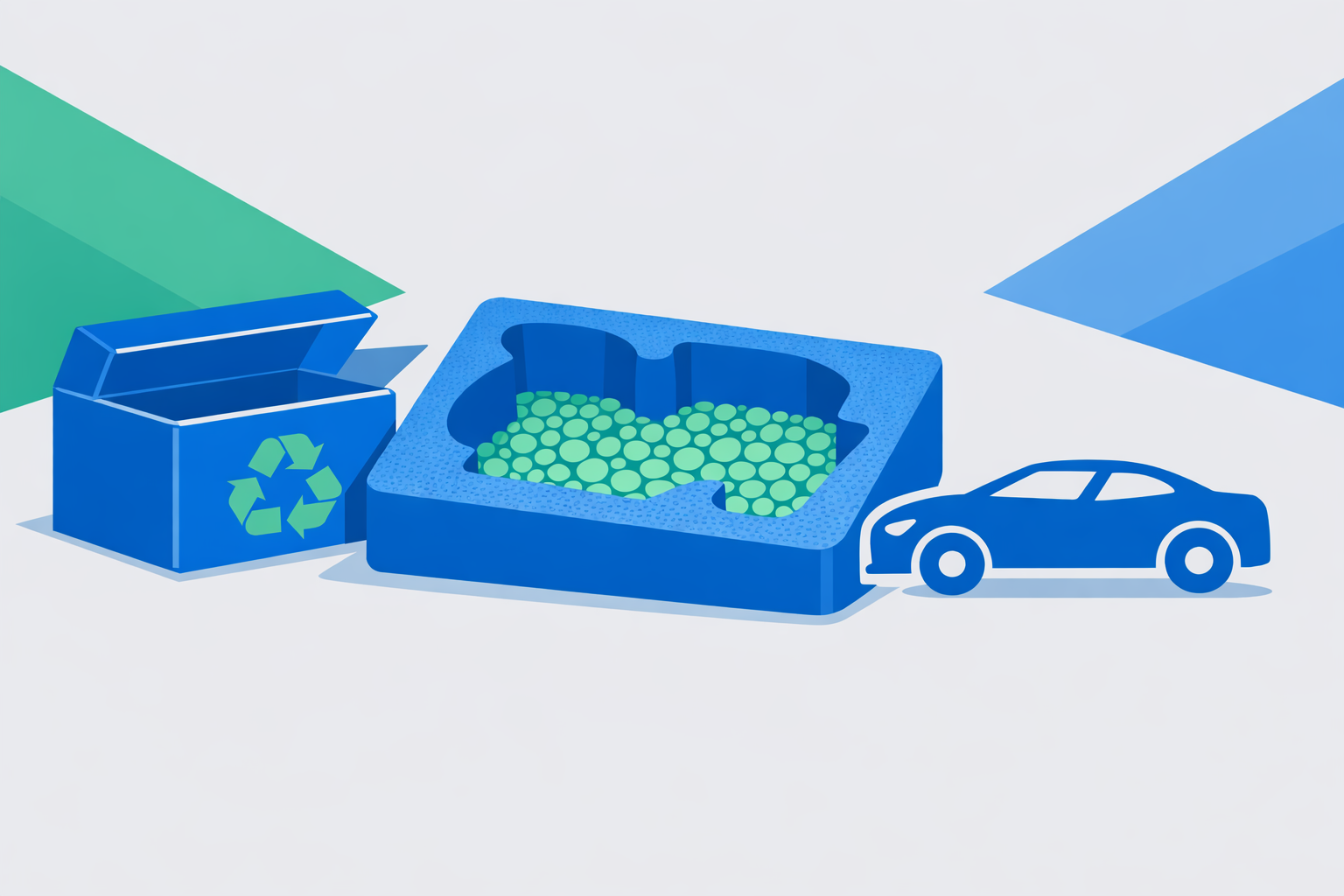
Promix's Microcell Technology creates a microcellular foam structure in polymer during extrusion by injecting environmentally neutral atmospheric gases-CO₂ and nitrogen-rather than chemical blowing agents. Tests have shown that very small, evenly distributed cells significantly improve mechanical strength: a foam with 50 μm cell size contains 27 times more cells than one with 150 μm cell size at the same density. The technology is compatible with PP, PET, PS, PLA, biopolymers, LDPE, HDPE, PBT, EVA, polyolefin elastomers, and PVC, according to Promix.
The foamed products are easily recyclable. Unlike chemical additives, the gases do not accumulate in the plastic, making the technology fully closed-loop compatible, according to Promix. It can be retrofitted to existing extrusion lines or installed on new ones.
A key supply-side development is the partnership between Promix and resin producer Borealis. Working together, the two companies have developed recyclable, lightweight packaging using Borcycle M materials with post-consumer recycled content. The collaboration has produced recyclable packaging solutions combining Borcycle M, virgin polypropylene, and high melt strength materials, delivering strong mechanical performance and visual quality while meeting future PPWR requirements.
Borealis is also investing to secure resin supply for foam-based applications. Borealis is investing over €100 million in a new High Melt Strength polypropylene line at its Burghausen, Germany, facility, scheduled to start up in the second half of 2026. The new line will triple Borealis' HMS PP supply capability, supporting the transition to more circular and recyclable material solutions for customers in consumer products, automotive, and building and construction. In the automotive sector, Borealis' Daploy HMS PP is used for ultra-lightweight foamed interior and under-the-hood components, typically 60-90% lighter than non-foamed alternatives.
For automotive packaging specifically, the recyclability case is straightforward: internal and external recyclability remains 100% intact and equivalent to non-foamed products, Promix states. This is a critical consideration for OEMs and tier suppliers whose packaging contracts increasingly include end-of-life compliance clauses aligned with PPWR timelines.
Outlook
As PPWR recyclability design criteria take full effect by 2030 and Borealis' expanded HMS PP capacity comes online in late 2026, automotive packaging specifiers will gain broader access to foamable, recyclable polypropylene resins compatible with microcell extrusion. The convergence of regulatory deadlines, material availability, and retrofit-friendly hardware positions microcellular foam technology as a practical pathway for OEMs and suppliers seeking to reduce packaging volume and material use without compromising protection or recyclability.