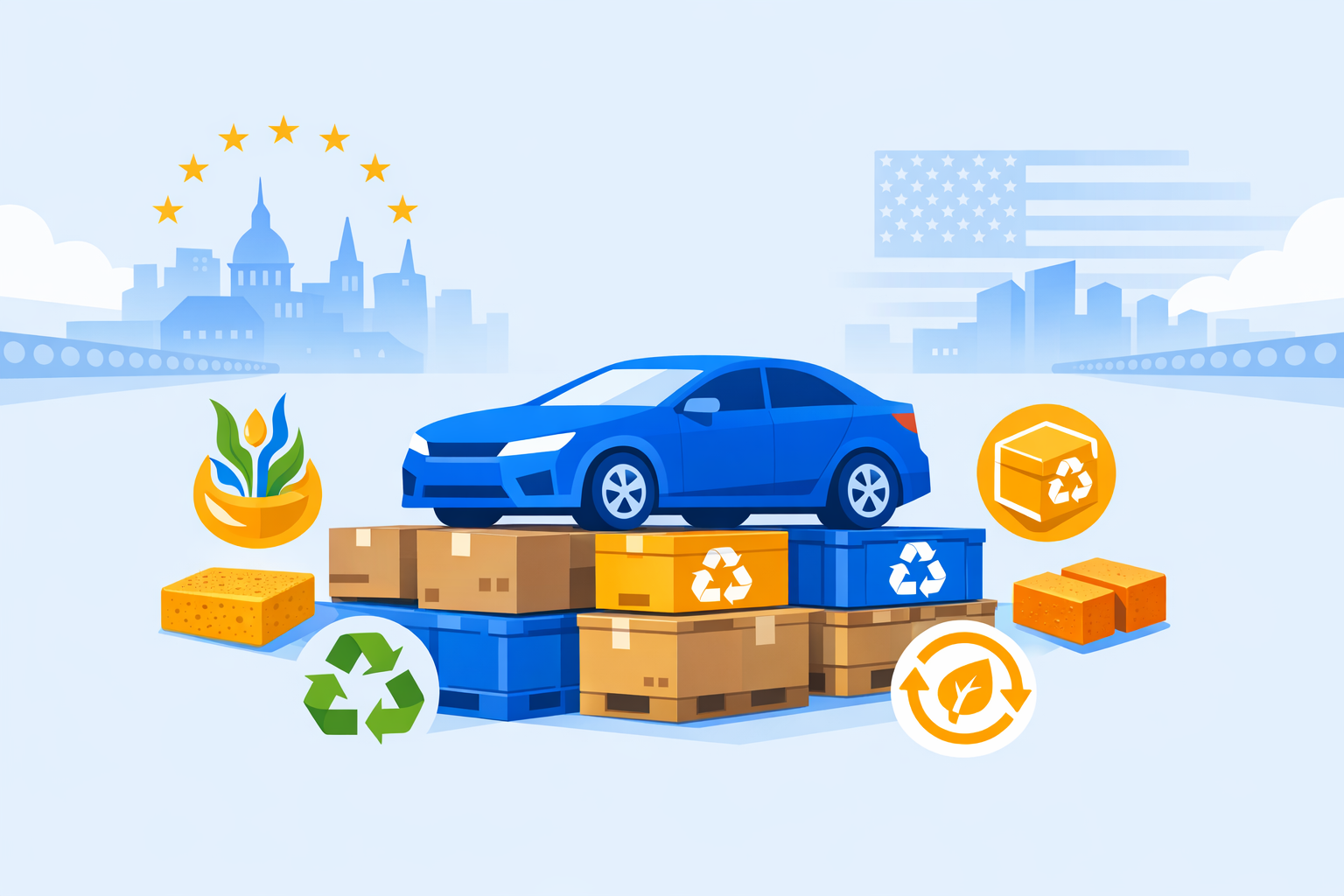
Automotive OEMs and their suppliers face mounting pressure to overhaul packaging contracts as the European Union's Packaging and Packaging Waste Regulation (PPWR) takes effect on 12 August 2026, coinciding with a wave of extended producer responsibility (EPR) fee obligations now active or imminent across seven US states. The dual regulatory push is accelerating adoption of alternative materials - including seaweed-derived bio-packaging and microcellular foam technology - as the industry seeks compliant, cost-effective solutions for protecting fragile automotive components.
Background
The EU formally adopted the PPWR as Regulation (EU) 2025/40, which entered into force in February 2025. Companies must prepare for sweeping changes in packaging materials, design, and labeling by 12 August 2026. Unlike its predecessor directive, the PPWR requires all packaging placed on the EU market to be recyclable according to defined, measurable performance criteria. Mandatory recycled content thresholds for plastic packaging take effect from 2030, with targets ranging from 30% to 65% depending on material and application category. Eco-modulation of EPR fees will expand under the regulation, meaning packaging that is difficult to recycle will attract higher fees, while compliant designs benefit from lower financial burdens.
The regulation's reach into transport and industrial packaging is particularly significant for automotive supply chains. Logistics leaders cannot treat packaging as an afterthought; the regulation extends deep into purchasing, IT, plant operations, and cross-border flows. The PPWR applies to all packaging, including transport packaging, pallets, drums, crates, IBCs, and reusable industrial packaging.
In the United States, seven states - Maine, Oregon, Colorado, California, Minnesota, Maryland, and Washington - have enacted comprehensive EPR packaging laws. Colorado's first EPR fee invoices were scheduled for January 2026, while Oregon began collecting producer fees in July 2025. The year 2026 will be defined by the first major fee payment cycles and the expansion of EPR.
Details
The Suppliers Partnership for the Environment (SP), through a collaborative process co-chaired by Magna International and Toyota Motor North America and including Ford, General Motors, Honda, and Stellantis, has produced sustainable packaging guidance for the automotive industry. The guidelines aim to minimize packaging waste by addressing barriers to recyclability during the design phase.
Purchasing is becoming the decisive lever for translating new packaging requirements into supplier specifications, contracts, and cost models. Ernst Hahn, managing director at a packaging solutions firm, noted that "numerous questions regarding practical implementation - such as role allocation in complex supply chains - have not yet been conclusively clarified."
Meanwhile, alternative materials are gaining traction. The global seaweed-based packaging market was valued at approximately USD 750 million in 2025 and is projected to reach USD 1.08 billion by 2031, growing at a CAGR of 6.18%, according to Mordor Intelligence. Blended bio-polymer pellets are attracting interest because they run on existing plastics machinery, shortening buyers' transition timelines. The automotive sector accounted for 8% of seaweed foam market demand in 2023, primarily for insulation materials.
On the process technology front, Promix Solutions' Microcell Technology offers another compliance pathway. The physical foaming process uses eco-friendly agents - atmospheric CO₂ and nitrogen - to reduce material density by 20% to 70% depending on the application, lowering costs and carbon footprint while maintaining mechanical properties. Internal and external recyclability remains fully intact and equivalent to non-foamed products. In collaboration with Promix Solutions, Borealis has developed recyclable, lightweight packaging using post-consumer recycled content.
Outlook
With the PPWR application date four months away and US EPR fee cycles intensifying, automotive OEMs face a narrowing compliance window. Businesses must plan for phased compliance rather than a single implementation event; delaying preparation significantly increases risk, particularly for companies with complex packaging supply chains. Cross-border harmonization remains the central challenge, as divergent EU and US state-level requirements complicate procurement and logistics for North American and European operations alike.