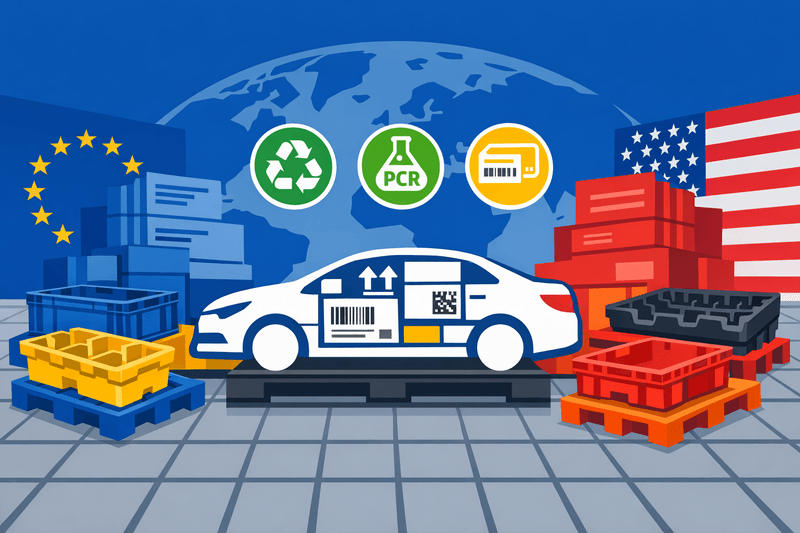
Executive summary. Emerging alignment between EU and U.S. packaging regulations is prompting automotive OEMs to standardize packaging specifications, labeling, and documentation on a global scale. The new EU Packaging and Packaging Waste Regulation (PPWR), alongside expanding U.S. state-level extended producer responsibility (EPR) laws, will influence 2026 automotive contracts-shaping material choices, returnable packaging systems, and requirements for data-sharing and audit rights.
Procurement, logistics, and packaging engineering teams must now adopt a cross-Atlantic approach to packaging compliance, recyclability targets, and certification regimes to prevent costly requalification and re-sourcing after 2026.
1. A New Regulatory Baseline on Both Sides of the Atlantic
1.1 Europe: PPWR becomes the reference point
The EU Packaging and Packaging Waste Regulation (PPWR, Regulation (EU) 2025/40) entered into force on 11 February 2025 and will generally apply from 12 August 2026.
The PPWR replaces the 1994 Packaging and Packaging Waste Directive, applying to all packaging placed on the EU market, regardless of material or origin, with harmonized rules for:
- Design and composition, including recyclability and hazardous substance restrictions
- Minimum recycled content in plastic packaging
- Waste prevention and packaging minimization
- Reuse targets for specific packaging, including transport packaging
- Labeling and information requirements to support sorting and traceability
In 2022, packaging generated 186.5 kg of waste per person in the EU, accounting for about 40% of all plastics used in the region. These figures drive political pressure to reduce material use and increase recycling rates.
From 2030, all packaging on the EU market must be recyclable in an economically viable way, with performance grades specifying acceptable recyclability. The regulation also sets circular-economy targets for transport packaging, closely affecting the automotive supply chain.
The PPWR sets reuse targets for transport packaging such as pallets, plastic crates, foldable boxes, pails, and drums, requiring 30% reusability by 2030 and 90% by 2040.
1.2 United States: State-level EPR and recyclability expectations
The U.S. lacks a unified federal packaging framework; packaging rules instead emerge from state-level extended producer responsibility (EPR) laws and related recycling reforms.
By 2025-2026, seven U.S. states-Maine, Oregon, California, Colorado, Minnesota, Maryland, and Washington-will implement EPR laws for packaging and paper products.
Although specific requirements vary, states commonly require:
- Producer registration and reporting of packaging placed on the market
- Producer Responsibility Organizations (PROs) managing collection and recycling
- Eco-modulated fees based on recyclability and material choices
- Pressure for recycled content and transparent labeling of recyclability claims
Automotive OEMs and Tier 1 suppliers shipping parts into these states face producer obligations similar to EU rules.
1.3 Why 2026 sourcing cycles are the tipping point
Automotive programs sourced in 2026 will often run into the 2030s. Packaging specifications agreed upon must anticipate:
- EU PPWR general application from August 2026 and phased obligations through 2030 and 2040
- U.S. EPR schemes intensifying reporting, fee schedules, and recyclability standards through the same period
- Additional national rules, such as PFAS restrictions, polystyrene bans, or deposit return schemes affecting acceptable packaging
Contracts and RFQs are shifting the definition of a "global" packaging solution: materials, formats, and labeling that fail under either EU PPWR or leading U.S. EPR-state requirements may become non-compliant mid-contract.
2. Technical Convergence: Recyclability, Recycled Content, and Reuse
2.1 Recycled-content benchmarks as global design constraints
PPWR formalizes minimum recycled-content obligations for plastic packaging.
From 1 January 2030, agreed EU targets require minimum recycled content in plastic packaging: 30% for contact-sensitive PET (excluding single-use beverage bottles), 10% for other contact-sensitive plastics, 30% for single-use plastic beverage bottles, and 35% for other plastic packaging, with higher thresholds from 2040.
U.S. EPR laws do not yet set uniform PCR thresholds, but fee structures and advisory targets increasingly reference recyclability and post-consumer recycled (PCR) content. Within cross-border supply chains, this is driving trends in 2026 RFQs:
- Global minimum PCR baselines: OEMs specify a PCR range for key plastic packaging families accepted in both EU and U.S. markets
- Polymer family consolidation: Specifications favor mono-material or compatibly recyclable polymer families for trays, tote liners, and dunnage
- Phase-out of problematic materials: EPS and mixed foams are being removed in favor of molded fiber, PP, or PE solutions that align with EU and U.S. recycling criteria
These changes directly impact cost models and supplier selection, as quotations must now factor in PCR availability, quality, and regional price volatility.
2.2 Returnable and reusable packaging as the industry norm
Returnable KLTs, racks, and steel containers form the backbone of automotive packaging. Regulatory convergence is formalizing this practice:
- EU reuse targets make closed-loop systems a compliance tool, not just a cost saver
- U.S. EPR schemes reward reusable packaging and penalize difficult-to-recycle, single-use formats
Industry frameworks support the transition. The German Association of the Automotive Industry's guideline VDA 4560, published in late 2025, sets waste reduction, recycling, and environmentally friendly packaging strategies across the supply chain.
Practical changes in 2026 contracts include:
- Extending returnable packaging to more component categories
- Standardizing VDA-compliant KLT footprints and palletization for exports, streamlining reuse and pooling
- Elevating requirements for life-cycle durability, cleaning compatibility, and reparability of containers
3. Data, Labeling, and Traceability: A Shared Compliance Language
3.1 Global Transport Label and VDA/AIAG harmonization
Label harmonization exemplifies EU-U.S. convergence.
Odette (Europe), AIAG (North America), and JAMA (Japan) jointly developed a Global Transport Label for container labeling, incorporating ISO "license plate" identifiers and both 1D and 2D codes.
The label standard is updated for smaller packaging units and evolving data needs. OEM logistics manuals often rely on VDA 4902 formats.
Some OEM guidelines specify VDA 4902 labels as the standard in Europe (Odette) and in the U.S. and Canada (AIAG), suitable across international supply chains.
Implications for 2026 contracts:
- Single global label concept: Harmonized label standard (e.g., Global Transport Label / VDA 4902) simplifies IT integration and scanning
- Expanded data fields: PPWR-driven requirements and EPR-related identifiers increase reliance on 2D codes linked to digital records
- Reduced relabeling risk: Consistent labels decrease relabeling at cross-dock hubs, lowering errors and compliance issues
3.2 Digital packaging data and traceability
PPWR necessitates improved labeling and data for material composition and reuse. This interacts with wider automotive supply chain traceability initiatives:
- Unique identifiers and codes for RTIs are being aligned globally through Odette/AIAG/JAMA/JAPIA RFID recommendations
- Logistics data models are increasingly accessible via APIs, providing near real-time visibility of packaging assets
- PPWR requirements on substances of concern and recycled content shift packaging bills of materials into product compliance systems
Practical outcomes:
- Master data records include recyclability, material codes, PCR content, and reuse status
- Suppliers must maintain current and auditable digital records across regions
- Packaging data integrates into ESG, scope 3 emissions, and due-diligence reporting
4. Contractual Implications for 2026 OEM Sourcing Cycles
4.1 Specifications and drawings: designing for 2030 from day one
With converging EU and U.S. rules, 2026 automotive packaging specifications will:
- Embed recyclability criteria: Define acceptable material families and prohibit non-recyclable assemblies to meet PPWR and U.S. MRF standards
- Include PCR ranges: Set target PCR ranges for films, trays, and select molded parts, with provisions for market changes
- Define reuse metrics: Specify minimum rotation counts, allowable damage rates, and maintenance roles for returnable systems
Design criteria now must meet recyclability and regulatory targets, in addition to traditional goals.
4.2 Supplier SLAs, audits, and data-sharing
Supplier relationships are evolving. Changes to service-level agreements (SLAs) and quality terms include:
- Formal packaging compliance obligations: Suppliers must attest packaging meets PPWR and relevant U.S. EPR and transport rules
- Data access clauses: Contracts increasingly require structured packaging data provision via agreed formats or APIs
- Audit rights: OEMs seek explicit audit rights over compliance data, EPR registrations, and recycled content claims
Packaging compliance is gaining the prominence of traditional quality standards in automotive contracts.
4.3 Cost modeling and risk allocation
Regulatory changes impact packaging cost and risk allocation:
- EPR fees as a cost element: Contracts must clarify who bears EPR-related fees and how fee modulation affects pricing
- PCR price volatility: Contracts may use indexed or adjustable pricing linked to PCR market indices
- Reusables pool management: Clauses must define RTI ownership, loss thresholds, cleaning responsibilities, and asset write-offs
Without clear terms, packaging regulatory costs can erode margins during a program's life cycle.
5. Packaging Formats Likely to Converge First
Certain automotive packaging formats are most exposed to convergence due to scale and regulatory focus.
5.1 Primary containers and hazardous materials packaging
Primary containers for liquids and hazardous chemicals (e.g., brake fluids, coatings) will face:
- Restrictions on material safety and hazardous substances (including PFAS)
- Stricter labeling of hazards, recyclability, and disposal instructions
- Requirements for compatibility with established collection and recycling streams
OEMs and Tier suppliers are prioritizing:
- Mono-material plastic containers with clear resin ID and recyclability
- PCR use where technically viable
- Harmonized hazard and recycling labeling per EU CLP/PPWR and U.S. standards
5.2 Shipping dunnage and protective inserts
Foams and inserts often determine recyclability:
- EPS and complex foams are increasingly discouraged or restricted
- Molded pulp, corrugated, and mono-material plastic inserts (e.g., PP) that are easily separated and recycled are preferred
2026 design priorities:
- Limit material diversity for easier recycling
- Modularize inserts for cross-platform re-use
- Document dunnage mass and composition for EPR reporting
5.3 Returnable load carriers and racks
Returnable KLTs, steel racks, and pallets directly support PPWR reuse targets and EPR fee reductions.
Key trends in 2026 procurement:
- Standardizing VDA KLT formats for international flows, easing pooling and reducing one-way packaging
- Auto-ID integration (barcodes, RFID) for traceability and monitoring, using Odette/AIAG/JAMA frameworks
- Aligned cleaning and repair specifications with future PPWR and local requirements to extend asset life
Given their capital intensity and long service life, returnable systems specified in 2026 must withstand regulatory shifts at least through 2035.
6. Certification and Evidence: Proving Packaging Compliance
Packaging certification is now a parallel requirement to quality and safety standards in automotive supply chains.
Core practices include:
- Quality management: IATF 16949 (based on ISO 9001) is standard for production and service part suppliers; packaging suppliers often adopt it for process control and quality consistency
- Packaging/environmental standards: ISO 18601 and ISO 18602 outline packaging system optimization, minimization, and hazardous substance control, closely aligning with PPWR objectives
- Sector-specific certification: BRCGS Packaging Materials standard is used to demonstrate compliance, widely recognized in consumer and aftermarket packaging manufacturing
Typical 2026 contract certification requirements:
- Third-party QMS certification (ISO 9001/IATF 16949) for plants
- Proof that packaging design follows ISO 18602 or equivalent methodologies
- Declarations of conformity with PPWR requirements and, if applicable, U.S. state EPR rules
- Chain-of-custody and supplier attestations for recycled content claims
For procurement, assessing packaging certification is now critical to supplier qualification.
7. Actionable Next Steps for OEMs and Tier Suppliers
To prepare 2026 automotive contracts and packaging concepts for EU-U.S. convergence, packaging, logistics, and procurement teams should:
- Map exposure: Identify flows and programs subject to PPWR from August 2026 and to U.S. EPR states between 2026 and 2030
- Define global design rules: Establish internal guidelines for recyclability, PCR content, mono-material use, and reuse targets meeting both EU and leading U.S. requirements
- Standardize labeling: Implement the Global Transport Label/VDA 4902 profiles and adapt IT systems for 2D codes and global IDs
- Upgrade data infrastructure: Capture packaging specs in databases with detailed material, mass, recyclability, PCR, and reuse data supporting regulatory and customer requests
- Revisit cost models: Account for EPR fees, PCR price differentials, and reusable asset costs in TCO models
- Align contracts and SLAs: Update templates and RFQs to clarify compliance roles, data provision, EPR cost bearing, and RTI management
- Engage suppliers early: Pilot unified packaging designs, test PCR options, and refine closed-loop logistics during 2025-2026 sourcing rounds
Taking these steps during the 2026 sourcing cycle can help avoid disruptive redesigns, customs delays, and penalty risks in later years.
Frequently Asked Questions
1. How does the EU PPWR change requirements for automotive packaging compared with the old directive?
PPWR turns directive-based rules into binding regulations with detailed, enforceable standards. For automotive packaging, this means:
- Stricter, harmonized requirements on recyclability and packaging minimization
- Mandatory recycled-content and reuse targets, including for transport packaging
- New obligations for material composition and clear reuse labeling
Previously compliant packaging may need redesign or new documentation to meet the detailed criteria.
2. What do U.S. packaging EPR laws mean for automotive supply chains shipping parts interstate?
In EPR states, the "producer" (usually the brand owner or first importer) must register, report packaging volumes, and pay into recycling programs. For automotive packaging:
- Service parts packaging and OEM-branded components shipped into EPR states can incur reporting and fee obligations
- Packaging with low recyclability faces higher fees, affecting total landed cost
- OEMs and suppliers must coordinate producer roles and data-sharing for compliance
3. How should suppliers demonstrate packaging compliance and certification in 2026 contracts?
OEMs will expect suppliers to provide:
- Valid QMS certificates (ISO 9001/IATF 16949) for relevant plants
- Documentation that packaging design meets environmental optimization standards (e.g., ISO 18602) and PPWR requirements
- Declarations of conformity with relevant regulations (PPWR, transport, state EPR)
- Evidence for recycled content, including chain-of-custody and supplier attestations or third-party verification
Clear evidence streamlines audits and can distinguish suppliers in competitive RFQs.
4. How will these changes affect the use of biobased materials in automotive packaging?
PPWR recognizes biobased plastics and may set future targets, but current focus is on recyclability and recycled content. For automotive packaging:
- Biobased materials are preferred if compatible with recycling streams and environmental targets
- Non-recyclable or infrastructure-dependent bioplastics may struggle unless end-of-life solutions exist
- OEMs will evaluate biobased options on case-by-case basis, relying on LCA and compliance with recyclability and labeling rules
Biobased solutions will need to compete on end-of-life compatibility as well as carbon impact.
5. What timeline should automotive companies use when updating packaging specifications for 2026 contracts?
A practical approach:
- Late 2025: Establish global design rules, label formats, and data models aligned to PPWR and U.S. EPR
- 2026 sourcing cycle: Mandate compliance in new contracts, anticipating PPWR 2030 milestones
- 2027-2030: Phase out legacy, non-compliant packaging, prioritizing high-volume or high-risk flows
Using 2026 contracts as an inflection point enables alignment with regulatory milestones, instead of reacting post-implementation.