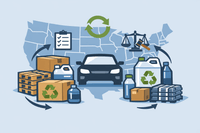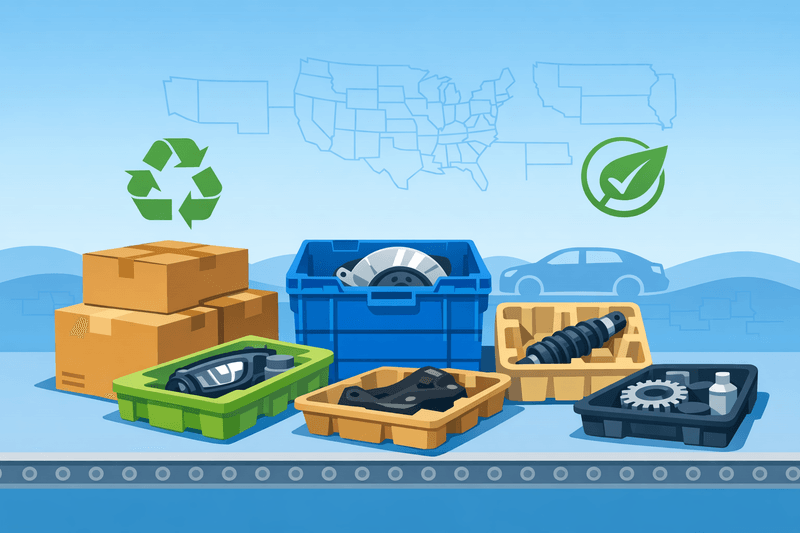
Executive summary. By 2026, U.S. packaging laws are shifting from policy to operational implementation, with extended producer responsibility (EPR) programs and material bans reshaping packaging in key states. For automotive OEMs and Tier-1 suppliers, these developments are influencing packaging materials, recyclability targets, and the economics of packaging machinery across component, battery, and finished-vehicle logistics.
1. 2026: From Isolated Rules to a Multi-State Packaging Regime
Seven U.S. states now have EPR laws for packaging: California, Colorado, Maine, Maryland, Minnesota, Oregon, and Washington, covering about one in five Americans.By mid-2025, seven U.S. states had enacted packaging EPR laws, signaling a systemic shift toward producer-funded recycling and design-for-recyclability requirements1U.S. Packaging EPR Laws Expand in 2025 | APA Engineering
While these laws do not specifically target the automotive sector, they cover many packaging formats used for aftermarket parts, dealer shipments, e-commerce, and certain B2B flows. Simultaneously, state-level bans and restrictions on difficult-to-recycle plastics are tightening rules on EPS foams, mixed laminates, and other legacy automotive packaging materials.2Phase-out of polystyrene foam
1.1 Key 2025-2027 milestones shaping design decisions
Several early implementation dates around 2026 are relevant for packaging and logistics teams:
- Oregon (Recycling Modernization Act)
- Program effective 2022; system changes start July 2025.3Department of Environmental Quality : Implementation of Oregon's Recycling Modernization Act : Recycling : State of Oregon
- PRO fee structure favors lower material use, higher recycled content, and greater recyclability.4Oregon’s Recycling Modernization Act | Portland.gov
- Colorado (HB22-1355)
- Statewide EPR program rolls out fully in 2026, following producer registration and reporting in 2025.5New statewide recycling plan paves the way for free recycling access | Colorado Department of Public Health and Environment
- Paper and packaging recycling rate is projected to rise from about 25% to 58% by 2035.Colorado projects its paper and packaging recycling rate will increase from roughly 25% to 58% by 2035 as its EPR program matures5New statewide recycling plan paves the way for free recycling access | Colorado Department of Public Health and Environment
- Maine (LD 1541)
- Program implementation begins in 2026; producers receive start-up fee invoices in July 2026.
- First producer payments in September 2027 are based on packaging placed on the Maine market in 2026.Maine's EPR for packaging requires producers to make their first annual payments in September 2027, calculated on packaging supplied in the 2026 calendar year6Extended Producer Responsibility for Packaging, Waste Management, Maine Department of Environmental Protection
- California (SB 54)
- Producers were required to join a Producer Responsibility Organization (PRO) by January 1, 2024, to avoid a sales ban.7EPR Bill - California State Senate Bill 54 Chaptered (2022) | Sustainable Packaging Coalition
- PRO must begin significant payments into the California Plastic Pollution Mitigation Fund by mid-2027.82025 SB 54 SRIA
Statewide bans on expanded polystyrene (EPS) food serviceware and other foam uses are also spreading.By late 2025, 12 U.S. states and three territories had enacted statewide bans on polystyrene foam food containers or similar EPS products2Phase-out of polystyrene foam While often aimed at consumer food packaging, these bans create broader regulatory pressure against EPS, which affects automotive dunnage, battery crating, and service-parts packaging still reliant on foam.
1.2 How much packaging is really in scope?
California's impact assessment for SB 54 illustrates why packaging is a regulatory focus.In 2021, product packaging and single-use food service ware made up about 30% of the waste Californians discarded by weight and 50% by volume, with roughly one-third of that stream composed of plastics82025 SB 54 SRIA
Most EPR laws pertain to packaging that becomes municipal solid waste-primarily residential, sometimes including small commercial accounts. For automakers, this generally includes:
- Aftermarket parts packaging and shipping materials for consumers.
- Dealer and service network packaging contributing to mixed commercial waste streams.
- Certain e-commerce shipments of accessories and parts.
Heavy-duty B2B transport packaging in closed loops (returnable totes, racks, bulk bins) faces less direct exposure, though OEMs are indirectly affected by:
- Fee modulation based on recyclability design in EPR states.
- Expanding bans or restrictions on problematic resins (e.g., EPS) that influence industrial supply options.
- Corporate climate and waste targets that now include logistics packaging.
2. Recyclability Targets and Material Substitution in Auto Packaging
Across EPR states, two mechanisms stand out: incentivizing recyclable or reusable formats and penalizing hard-to-recycle materials through higher fees or bans.
2.1 What the new targets actually say
California's SB 54 is the most detailed framework to date:
- Mandates a 25% source reduction in plastic covered material by 2032 from a 2023 baseline.
- Sets plastic recycling-rate targets rising to 65% by 2032.
- Requires all covered single-use packaging and plastic food serviceware to be recyclable or compostable by 2032 under actual collection and processing conditions.California's SB 54 requires producers to cut plastic covered packaging by 25%, achieve a 65% recycling rate for plastics, and ensure all covered packaging is recyclable or compostable by 203282025 SB 54 SRIA
Oregon, Maine, and Colorado use a different mechanism: eco-modulated fees.
- Oregon's PRO charges an average of $0.17-0.23 per pound of covered material, with adjustments for recyclability and recycled content.Oregon's packaging EPR program sets average base fees of roughly $0.17-$0.23 per pound of covered material, adjusted for recyclability and recycled content9Compliance With State Packaging Extended Producer Responsibility Laws Due by July 1, 2025 | Alerts and Articles | Insights | Ballard Spahr
- Maine ties producer fees directly to the amount and recyclability of packaging sold, rewarding lower toxicity and higher recyclability.6Extended Producer Responsibility for Packaging, Waste Management, Maine Department of Environmental Protection
For packaging engineers, these policies signal preferred material and format choices. High-fee categories-multi-material laminates, dark mixed plastics, legacy foams-become less attractive over time.
2.2 Implications for common automotive packaging formats
Automotive packaging supports varied applications:
- Returnable totes and racks for inbound parts.
- Expendable cartons and crates for overseas or complex shipments.
- Foam dunnage and blocking for painted parts, glass, lighting, and interiors.
- High-hazard packaging for lithium-ion batteries and other dangerous goods.
Expected shifts under 2026-era rules include:
- EPS and mixed-foam reductions. Multiple states now ban or restrict EPS in consumer packaging, shifting supply, perception, and fees away from foam. Automotive packaging may move toward expanded polypropylene (EPP), expanded polyethylene (EPE), molded pulp, or engineered textile solutions that are fully recyclable or reusable.2Phase-out of polystyrene foam
- Mono-material designs. Schemes such as SB 54 emphasize packaging compatible with curbside streams (corrugated, PET, HDPE, PP):
- All-PP or all-PE trays instead of mixed polymer and metal.
- Paper-only outer packs with removable, easily separated dunnage.
- Returnable systems aligned with EPR incentives. EPR typically reduces fees or exempts reusable transport packaging, especially in closed loops.10Packaging Compliance in Transition: Expert Insi Automotive supply chains with existing reusable systems can strengthen their case by quantifying avoided fees and waste.
2.3 Special case: EV battery modules and dangerous goods
Lithium-ion batteries remain subject primarily to dangerous goods transport regulations (UN 38.3, IATA DGR, ADR, IMDG).Lithium-ion batteries shipped as UN3480 or UN3481 must pass UN 38.3 testing and are classified as Class 9 dangerous goods, triggering strict performance requirements for packaging and hazard communication11Lithium-ion battery transportation
Near-term sustainability laws do not override these requirements, but they do affect material choices within compliant systems:
- Preference for reusable UN-certified crates over disposable mixed-material boxes.
- Interest in recyclable cushioning materials and modular inserts to separate hazardous and recyclable components at end of life.
- Integration of reusable outer packaging with removable inner dangerous-goods packaging for certain service parts.
3. Machinery and Line Redesign: How Compliance Flows Back to the Plant
No U.S. law directly requires automakers to replace packaging machinery. However, EPR fees, recyclability criteria, and material bans are driving changes in pack formats that influence equipment and automation decisions.
3.1 Where machinery is most exposed
Auto packaging lines experience impact first in areas such as:
- Form-fill-seal and bagging systems. Moving to mono-material PE or higher-PCR films often requires new sealing jaws, temperature controls, and tighter process management.12CalRecycle Reissues Draft SB 54 Regulations Targeting California’s Plastic Packaging EPR Program
- Carton erection and case packing. Higher recycled content and lighter board grades can affect crush strength and score integrity, calling for upgrades in erectors, tapers, and palletizing setups.
- Foam cutting and dunnage forming. Transitioning from EPS to EPP, molded pulp, or textiles may require new tools or machinery.
- Print and labeling systems. EPR and "truth in recycling" rules limit use of claims such as "recyclable," demanding closer coordination between artwork, data, and compliance systems.12CalRecycle Reissues Draft SB 54 Regulations Targeting California’s Plastic Packaging EPR Program
3.2 Designing for modularity and changeover
With shifting state rules, OEMs increasingly invest in modular, upgradable packaging systems instead of single-format assets. Common strategies include:
- Specifying changeable sealing and forming modules to run both legacy and new formats.
- Using collaborative robot case-packers for flexible carton footprints.
- Establishing test bays to validate new materials and designs without disrupting main production lines.
Such approaches require more up-front engineering but improve resilience as EPR frameworks evolve through 2028 and beyond.
4. Cost Implications: Fees, CapEx and the Emerging Business Case
Packaging EPR laws introduce recurring producer fees by packaging tonnage and material type, in addition to traditional costs.
4.1 Understanding the new fee layer
Early data from Oregon offers an initial benchmark.
Oregon's inaugural EPR fee schedule for packaging set average base fees around $345-$457 per ton (about $0.17-$0.23 per pound) for non-low-volume producers, before eco-modulation adjustments9Compliance With State Packaging Extended Producer Responsibility Laws Due by July 1, 2025 | Alerts and Articles | Insights | Ballard Spahr
Emerging patterns include:
- Higher rates for non-recyclable or hard-to-recycle plastics and composites.
- Discounts for readily recyclable mono-materials (corrugated, PET, HDPE, PP) and packaging with verified recycled content.13How new packaging laws can help fuel material innovation
- Fee exemptions or reductions for reusable packaging in closed loops.
For the automotive sector, which uses significant amounts of corrugated and plastics, these fees are significant when summed across portfolios in multiple EPR states.
4.2 Linking fees to machinery and design investments
OEMs and Tier-1s can model total compliance costs over a 5- to 10-year horizon:
- Baseline: existing materials and projected EPR fees by state.
- Redesign: investment in recyclable/reusable formats, potential machinery upgrades, and resultant fee reductions.
Industry case studies beyond automotive show that well-designed reusable systems can significantly reduce waste and emissions.One reusable-packaging case study cited in the automotive parts packaging sector reports eliminating 22,000 tonnes of cardboard waste and reducing CO₂ emissions by 18,000 tonnes-about a 59% cut versus disposable packaging14Automotive Parts Packaging Market 2025 | Reusable, ESD & Sustainable Solutions While results vary, this demonstrates the broader impact of logistics packaging decisions on both EPR costs and sustainability goals.
General Motors reports reusing or recycling nearly 97% of the waste generated across more than 90 landfill-free facilities, demonstrating the operational feasibility of high reuse and recycling rates in automotive manufacturing14Automotive Parts Packaging Market 2025 | Reusable, ESD & Sustainable Solutions This performance is increasingly relevant as packaging rises on the regulatory agenda.
5. Supply Chain Readiness and Automation Vendor Implications
Packaging rules focused on recyclability and reduction are changing expectations for automation and material-handling vendors in the automotive sector.
Key trends include:
- Flexible packaging lines. Equipment must handle a broader range of recyclable films, fiber-based materials, and reusable containers, often using digital recipe management and quick-change tooling.
- Trackable reusable assets. EPR and ESG reporting are driving adoption of RFID- and IoT-enabled containers and racks for return loop visibility.14Automotive Parts Packaging Market 2025 | Reusable, ESD & Sustainable Solutions
- EPR reporting data. PROs need material and weight data by state. Automation systems that capture weights and material codes in real time help OEMs reduce reporting workloads.
For equipment suppliers, demand is growing for retrofits enabling recyclable structures, rather than speed-only upgrades, between 2026 and 2028.
6. Risk Factors Through 2026: Compliance, Capability and Data Gaps
Automotive packaging and logistics leaders face these near-term risks:
- Regulatory divergence across states. EPR definitions of "covered packaging," "producer," material categories, and reporting vary by state, complicating nationwide programs.9Compliance With State Packaging Extended Producer Responsibility Laws Due by July 1, 2025 | Alerts and Articles | Insights | Ballard Spahr
- Changing definitions of "recyclable." California requires packaging to be collected and sorted at scale, not just technically recyclable, raising the bar for compliance.12CalRecycle Reissues Draft SB 54 Regulations Targeting California’s Plastic Packaging EPR Program
- Supplier capability gaps. Supplies of quality PCR resins, recyclable films, molded-pulp dunnage, and EPP alternatives may not meet automotive standards for cleanliness or ESD protection.
- Data and reporting readiness. EPR programs call for detailed annual reports by weight, material, and state. Automotive packaging data is often fragmented across facilities, 3PLs, and suppliers.
- Policy uncertainty and litigation. Some state EPR schemes, including Oregon's plastics laws, face legal challenges that could affect timelines.15Oregon Plastic Packaging Recycling Law on Partial Hold Following Federal Court Ruling | Alerts and Articles | Insights | Ballard Spahr
7. Opportunities: Modular Automation, Standardization and Interoperability
Despite complexity, the 2026 regulatory transition presents opportunities to optimize automotive packaging and logistics.
7.1 Standardization and portfolio simplification
- Rationalize pack SKUs across facilities and platforms to emphasize a smaller number of recyclable or reusable formats.
- Align North American packaging strategies with EU and German rules, easing global compliance.16Recycling rules tighten for automotive packaging waste | Automotive Logistics
7.2 Investments in circular logistics assets
- Expand use of modular, repairable returnable containers adaptable for diverse parts and refurbishable.17Reducing Carbon Emissions using YOYOBin Adjustable
- Work with pooling partners to increase share-and-reuse models for pallets, bins, and racks, reducing waste and EPR fees.
7.3 Interoperable automation and data
- Specify packaging lines with open data interfaces for direct EPR reporting.
- Use common coding standards (e.g., GS1 barcodes, RFID) to track packaging flows and support accurate fee allocation.
8. Actionable Next Steps for Automotive Packaging Leaders
Over the next 12-24 months, automotive packaging, logistics, and sustainability teams should:
- Map exposure: Identify outbound packaging flows (aftermarket, dealer, e-commerce, CKD/SKD kits) entering EPR states, and quantify by material.
- Classify recyclability: Benchmark pack formats against state-level criteria, such as California's SB 54, not just generic claims.
- Prioritize redesigns: Focus on high-volume, high-fee materials-EPS, mixed-polymer foams, and complex laminates; pursue mono-material and reusable alternatives.
- Engage machinery OEMs early: Share upcoming material changes with equipment suppliers to plan retrofits and trials ahead of compliance deadlines.
- Build EPR data systems: Centralize packaging specifications, weights, and sales by state to support efficient reporting.
These steps can transform EPR compliance into an opportunity for leaner, standardized, and more sustainable automotive packaging systems.
Frequently Asked Questions
What counts as a "US 2026 packaging law" for automotive companies?
No single federal law exists. Instead, automakers face a cluster of state laws reaching key milestones near 2026-notably EPR programs in Colorado, Oregon, and Maine, plus expanding EPS bans.18Colorado: Packaging EPR program set for 2026 launch - ERP Global Their combined effect signals a regulatory pivot for packaging teams.
Do EPR packaging laws apply to B2B transport packaging in automotive logistics?
Most EPR laws address packaging becoming municipal solid waste, particularly household and small business waste, though definitions vary.9Compliance With State Packaging Extended Producer Responsibility Laws Due by July 1, 2025 | Alerts and Articles | Insights | Ballard Spahr Returnable racks and industrial containers are often excluded from fees, while dealer, service-parts, and e-commerce packaging are more likely to be in scope. Regardless, B2B packaging is indirectly influenced by material bans, corporate commitments, and reporting needs.
Are automakers required to replace or upgrade packaging machinery by 2026?
Current laws do not mandate equipment changes. Obligations focus on packaging performance and recyclability.7EPR Bill - California State Senate Bill 54 Chaptered (2022) | Sustainable Packaging Coalition However, switching to compliant materials may make machinery adjustments necessary. Many OEMs are planning these investments to enable compliant formats.
How do U.S. packaging rules interact with EU and German packaging regulations for exports?
U.S. state EPR laws supplement existing EU and national packaging directives, such as the EU Packaging and Packaging Waste Directive and Germany's Packaging Act.19Packaging and packaging waste directive Automotive exporters to Europe must comply with both EU and U.S. state requirements. Harmonizing material choices and strategies may simplify long-term compliance.
What is the realistic lead time to redesign auto packaging for EPR compliance?
For high-volume automotive packaging, typical cycles are 12-36 months from assessment to rollout:
- 3-6 months for mapping, design, and material trials.
- 6-18 months for tooling changes, machinery modification, and phased deployment.
- More time if aligning with EU rules.
With many EPR programs ramping up fees and targets by 2032, early redesign efforts help minimize compliance risk and costly changes later.