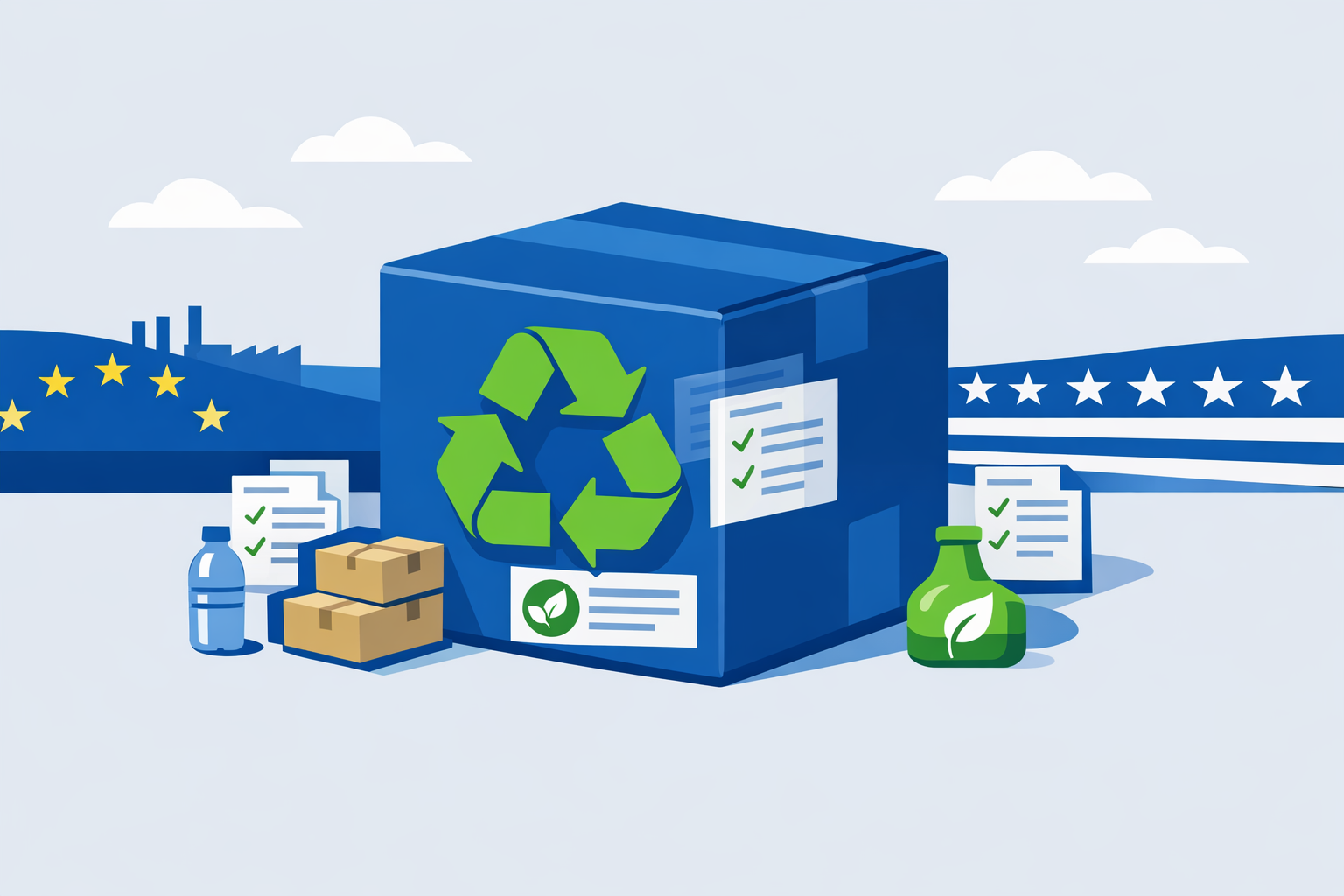
Automotive OEMs and their packaging suppliers face mounting pressure to renegotiate contracts as both the European Union and multiple US states enforce new recycled-content and recyclability mandates ahead of mid-2026 compliance deadlines. The EU's Packaging and Packaging Waste Regulation (PPWR), which applies from August 12, 2026, coincides with a wave of US state-level Extended Producer Responsibility (EPR) laws now entering active enforcement in Oregon, Colorado, and several other states - creating a trans-Atlantic regulatory alignment that is reshaping procurement strategies across the automotive supply chain.
Background
The EU formally adopted the PPWR as Regulation (EU) 2025/40[1], which entered into force on February 11, 2025, and will generally apply starting August 12, 2026. One of its most significant elements is the requirement that all packaging placed on the EU market be recyclable according to defined performance criteria, making recyclability a measurable standard assessed against EU-wide design-for-recycling criteria[2].
In the United States, seven states have active EPR laws for packaging, with programs underway: California, Colorado, Maine, Maryland, Minnesota, Oregon, and Washington. The absence of a standardized federal approach forces brands to monitor state-by-state regulatory developments continuously. For automotive firms operating across both markets, this patchwork has created urgent compliance planning demands.
Details
The PPWR introduces obligations that directly affect automotive transport and industrial packaging. Purchasing becomes the decisive lever for translating new packaging requirements into supplier specifications, contracts, and cost models, according to Automotive Logistics. Lubomir Kroupa, COO of an environmentally focused packaging firm, noted that the obligation to issue declarations of conformity is particularly relevant in the near term: "From 12 August 2026, we will have to confirm to our customers that the packaging complies with the requirements."
From August 2026, packaging weight and volume must be reduced to the necessary minimum, and unnecessary protective packaging is prohibited. Mandatory recycled-content thresholds ranging from 30% to 65% will apply to various plastic packaging types starting in 2030, but companies must already substantiate recycled-content claims through documented supply chain evidence - introducing new data management and supplier engagement obligations.
On the US side, California's SB 54 requires brand enrollment by July 1, 2025, with fee payments beginning in 2026. The law mandates a 25% reduction in plastic packaging by 2032 and full recyclability or compostability by that date. Fees in both regions are being calibrated through eco-modulation, rewarding packaging that is lightweight, recyclable, or incorporates recycled content.
Biobased polymers occupy a complex position under the new frameworks. While bio-based plastics are encouraged as a means to reduce emissions, the PPWR's focus remains on improving recycling, pushing for a balance between recycled content and bio-based materials. By February 2028, the European Commission must review bio-based plastic packaging and could allow bio-based feedstock as a substitute for post-consumer plastic waste in meeting recycled-content targets.
Vehicle makers are already signing multi-year tolling agreements with recyclers, mirroring battery-metal sourcing contracts, while closed-loop recovery of bumpers and dashboards is expanding, according to Mordor Intelligence. Automotive demand for recycled plastics is rising at a 10.12% CAGR as OEM content mandates take hold.
Outlook
The PPWR is not simply another environmental compliance exercise - it represents a structural shift in how packaging is designed, specified, sourced, and financed across automotive supply chains, with real financial implications for non-compliance. With the EU's August 2026 application date and multiple US state EPR deadlines converging in the same window, automotive procurement teams that delay contract updates risk both market-access restrictions and escalating EPR fees on non-compliant packaging formats.