Executive summary.
State-level extended producer responsibility (EPR) and recycled-content mandates are making 2026 a pivotal year for automotive packaging in the United States. OEMs and Tier 1 suppliers face binding requirements for recycled materials, comprehensive packaging data, and fee-funded stewardship. These mandates are driving rapid packaging redesign, supplier contract renegotiation, and stricter traceability across OEM supply chains.
This article outlines the key 2026 deadlines, identifies packaging formats most affected, and analyzes how EPR rules are changing supplier contracts, certification strategies, and operational planning in logistics and warehousing.
The 2026 Packaging EPR & Recycled-Content Landscape for US Auto OEMs
While the US lacks a federal packaging EPR law, state measures are forming a de facto national framework for producers shipping to multiple jurisdictions.
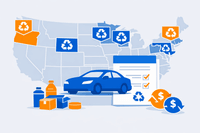
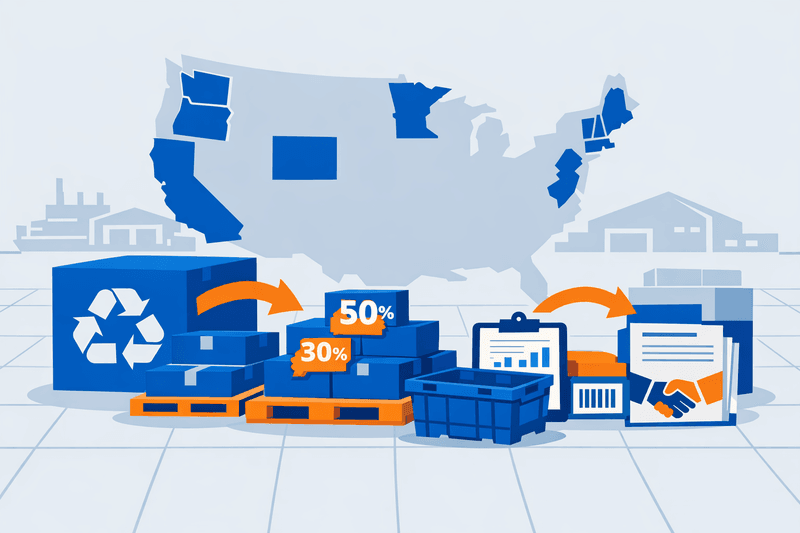
As of October 2025, seven US states-Maine, Oregon, California, Colorado, Minnesota, Maryland, and Washington-had enacted EPR laws for packaging and paper products. Simultaneously, states including California, Washington, and New Jersey have adopted minimum post-consumer recycled (PCR) content mandates for select packaging categories, such as plastic beverage containers, personal care packaging, and trash bags.
For automotive OEMs and suppliers, these state laws require packaging materials, formats, and reporting systems to comply with varying 2026 deadlines.
Key 2026 milestones affecting automotive packaging
The table below summarizes 2026 obligations relevant to automotive packaging and service parts shipped into these states.
| State | Policy type | 2026 milestone | Relevance to automotive packaging |
|---|---|---|---|
| California (SB 54 + AB 793) | Packaging EPR + PCR for plastic beverage containers | First EPR producer fees under SB 54 are due January 1, 2026; California's producer responsibility organization (Circular Action Alliance) must submit its initial program plan by June 15, 2026. Plastic beverage containers must reach at least 25% PCR from January 1, 2025, rising to 50% by 2030. | OEMs and Tier 1s placing covered packaging in California will incur EPR fees likely "eco-modulated" by recyclability and PCR. Beverage and fluids packaging for service parts is impacted by PCR minimums where in-scope. |
| Colorado (HB22-1355) | Packaging EPR | Colorado's statewide packaging EPR program begins fee obligations in 2026; producers must fund the program via dues to the designated PRO (Circular Action Alliance), with implementation of the approved program plan beginning by mid-2026. | Automotive parts and petroleum/automotive fluids packaging are explicitly included. The Lubricant Packaging Manufacturers Association (LPMA) has a separate plan for petroleum and automotive containers starting March 2026, aiming for higher collection targets by 2030. |
| Maine (LD 1541) | Packaging EPR | Maine's law sets first producer payments to the stewardship organization for 2026, with full producer reporting beginning for the 2027 data year. | OEMs or Tier 1s selling packaged parts into Maine must fund municipal recycling based on packaging weight and recyclability, requiring detailed packaging data. |
| Oregon (Plastic Pollution and Recycling Modernization Act) | Packaging EPR + eco-modulated fees | Producers must register with a PRO and submit supply reports by March 31, 2025; third-party-reviewed LCAs submitted by May 31, 2026 qualify for a 10% EPR fee reduction per SKU batch, capped at US$200,000 annually. | Packaging in Oregon is subject to fee modulation by recyclability and LCA results, directly linking design choices and cost. |
| Minnesota (Packaging Waste and Cost Reduction Act) | Packaging EPR | Producers must appoint and register with a PRO by July 1, 2026; program funding begins in 2027. | Automotive brands and aftermarket distributors selling in Minnesota must establish producer registration and packaging data systems during 2026. |
| Washington (SB 5022 PCR requirements) | PCR mandates for plastics | Washington requires plastic beverage containers to contain at least 15% PCR from 2023, rising to 25% by 2026 and 50% by 2031; additional PCR mandates apply to plastic trash bags and, from 2025, to household and personal care containers. | Automotive consumables sold in Washington, like fluids and cleaners, face increasing PCR thresholds; trash bags and consumables in aftersales operations are also affected. |
| New Jersey (Recycled Content Law, P.L. 2021, c. 391) | PCR mandates for selected packaging | Recycled-content law sets phased PCR minimums for rigid plastic containers (10% by 2024, 20% by 2027, 30% by 2030) and plastic trash bags (5-20% by 2024, rising by 2027). | Packaging for spare parts shipped to New Jersey must use more PCR polymers, especially rigid containers and trash bags used in service and warehouse operations. |
Because OEM supply chains are national, many US auto companies treat these state deadlines as de facto internal standards for all North American packaging specs. This streamlines inventory and compliance but accelerates industry-wide timelines for redesigning packaging around recycled materials and data quality.
Where Automotive Packaging Is Most Exposed
Engineered plastics and reusable transport packaging
Automotive logistics use large volumes of reusable plastic packaging-totes, trays, dunnage, and racks-to move parts between suppliers, plants, and distribution centers. These assets are now subject to closer EPR scrutiny, particularly:
- Fees applied when plastic packaging and dunnage become waste in EPR states.
- Fees "modulated" by recyclability and PCR content.
- Requirements for granular packaging material tracking.
Suppliers are offering corrugated plastic sheets and dunnage made from 100% recycled PP, and OEMs adopt these where feasible.
Additionally, European regulations such as the EU Packaging and Packaging Waste Regulation and proposed recycled-content mandates for automotive plastics are prompting global platforms to transition to packaging with higher recycled content. US packaging decisions on global platforms increasingly account for these trends.
Foam dunnage and protective systems
Foam inserts, corners, and end caps protect sensitive components in transit. EPR and related restrictions are increasing costs for certain foams and, in some cases, making them untenable:
- Multiple states, including California, Maine, and Oregon, have restricted or banned expanded polystyrene (EPS) in foodservice; California SB 54 effectively bans EPS foodware if recycling thresholds are not met.
- EPR fee structures often designate hard-to-recycle materials such as mixed or laminated foams as higher-cost categories.
In response, packaging engineering is accelerating toward:
- Molded fiber and paper-based cushioning for light or small parts.
- Mono-material polyethylene (PE) foams with established recycling.
- Reusable plastic dunnage using higher recycled content in controlled, closed-loop systems.
For large panels, glass, and high-value electronics, balancing protection performance and fee exposure has become a formal design criterion.
Primary packaging for small components and service parts
Primary packaging for small components-fasteners, sensors, gaskets, filters, lighting, and trim-contributes significant aggregate volume and weight to service parts networks.
Here, new laws most directly align with recycled-content and eco-modulation:
- Corrugated and folding cartons: Automakers now increasingly use recycled corrugated board; about 70% of corrugated packaging incorporates recycled content, with automotive packaging a key application.
- Branded consumer-facing boxes: General Motors notes that its corrugated packaging from WestRock typically uses 35-55% recycled content, and its coated-board packaging for engine filter boxes uses 100% recycled fiber in the substrate. GM's coated-board packaging for selected service parts, including engine filter packaging, is manufactured from 100% recycled fiber while associated corrugated packaging averages 35-55% recycled content.
- Packaging for accessories and aftermarket products: Research indicates Ford Motor Company reports approximately 94% recycled content in its packaging for automotive parts, highlighting rapid adoption of recycled corrugated and paper-based packaging.
Together, these trends position small-parts and service-parts packaging as likely first candidates for near-universal recycled content requirements across the North American supplier base.
How EPR and Recycled-Content Rules Are Reshaping Supplier Contracts
The evolving regulatory landscape is compelling procurement and legal teams to embed packaging compliance into contracts and RFQs. Key themes in 2024-2026 negotiations include:
1. Hard recycled-content and recyclability specifications
OEMs are shifting from broad requests (e.g., "use sustainable packaging") to specific, testable mandates:
- Minimum PCR content by packaging family (e.g., ≥30% in corrugated liners; ≥50% in rigid plastic containers in states with stricter mandates by 2030).
- Explicit phase-out dates for problematic materials (e.g., EPS, PVC, non-recyclable laminates).
- Design-for-recycling requirements-mono-materials, reduced use of dark colors, removable labels-aligned with state EPR eco-modulation rules.
Contracts increasingly reference EPR-based eco-modulation and industry-recognized recyclability design guides to reduce stranded packaging investment risk.
2. Allocation of EPR fees and cost escalators
While EPR fees are typically owed by the "producer" (brand owner or importer), supply chain cost allocation is variable.
Current contract approaches include:
- Pass-through models: OEMs pay all EPR fees but require suppliers to provide packaging optimized for fee reduction, often linked to supplier performance metrics.
- Shared-burden models: Suppliers pay EPR fees on packaging they design or apply, especially for aftermarket products they sell to OEMs.
- Indexed price clauses: Packaging unit prices adjust with verified EPR fee changes, PCR price fluctuations, or new mandates.
Well-structured contracts clearly define financial responsibility for material reclassification or regulatory changes during contract periods.
3. Data, traceability, and audit rights
EPR laws require granular annual reporting on packaging by material, weight, format, and PCR percentage. States such as Oregon, California, and Colorado expect this level of detail.
OEMs are including contract clauses that:
- Require detailed item-level bills of materials for packaging, with recycled-content breakdown.
- Mandate suppliers maintain chain-of-custody documentation from PCR resin to finished packaging.
- Grant OEMs and auditors the right to review packaging production records or perform spot verifications.
As a result, suppliers must upgrade their data systems for packaging reporting; informal tracking is insufficient for current regulatory demands.
Case Examples: Early Moves in Automotive Packaging and EPR
GM and high-recycled-content packaging for service parts
General Motors demonstrates an automaker actively shifting to recycled fiber in service-parts packaging. Partnering with WestRock, GM uses corrugated packaging with 35-55% recycled content, and select coated-board packaging, such as engine filter cartons, employs 100% recycled fiber. This approach reduces virgin fiber use and aligns with lower EPR fee bands under eco-modulation.
Automotive and petroleum packaging under Colorado's EPR law
Colorado's packaging EPR structure illustrates sector adaptation. The Lubricant Packaging Manufacturers Association (LPMA) has secured approval for a program targeting automotive and petroleum containers under the state EPR framework.
LPMA's plan, approved by Colorado regulators, is scheduled to begin implementation by March 13, 2026 and targets a 44% collection rate for automotive containers by 2030, rising further by 2035. This establishes new obligations for packaging of oils, lubricants, and related products.
Ford and high recycled-content corrugated packaging
Industry research cites Ford as an automaker using high-recycled-content corrugated packaging-reporting roughly 94% across its automotive packaging materials. One recent sector report highlights that automotive parts packaging has increasingly adopted recycled corrugated materials, with Ford Motor Company reporting 94% recycled content in its packaging materials for automotive applications. While not yet universal, this signals proximity to the upper limits for recycled corrugated content ahead of some 2030 targets.
Risk of Non-Compliance: Penalties, Market Access, and Labeling
Monetary penalties for lacking required recycled content
Several state laws specify penalties for missing recycled-content minimums:
- California AB 793: Beverage manufacturers that do not meet mandated PCR percentages must pay US$0.20 per pound of shortfall in recycled content vs. the minimum requirement.
- New Jersey and Washington: Both authorize fines and enforcement for failing to meet PCR mandates.
While primarily covering packaging in regulated product categories, these penalties establish precedents for quantifiable, enforced requirements.
EPR enforcement and producer registration
EPR states prohibit sales by covered producers who are not registered with a producer responsibility organization (PRO) and up to date on fees.
Colorado, California, Oregon, and Minnesota condition market access on producer registration with a PRO (e.g., Circular Action Alliance) and completion of annual reporting and fee obligations from 2025-2027. Missing registration or deadlines can result in penalties and lost market access.
Green claims, recycled-content labeling, and FTC scrutiny
Federal guidelines (FTC's Green Guides, 16 CFR Part 260) regulate recycled-content marketing claims on packaging. The Green Guides require unqualified recycled-content claims only when the entire package is made from recycled material, and marketers must substantiate claimed percentages and types of recycled content. Overstating recycled content carries enforcement risk independent of state EPR compliance, prompting OEMs to seek third-party claim validation.
Certifications, LCAs, and Third-Party Audits: The New Validation Stack
To support EPR compliance, green claims, and regulatory readiness, packaging teams are adopting standard validation approaches.
Life cycle assessment (LCA) as a fee and design tool
Oregon's EPR program allows producers to lower fees via LCAs covering 16 environmental categories, incentivizing LCA adoption in packaging design and cost management. California and Colorado also reference LCA in plans, signaling likely expansion.
Implications for automotive packaging include:
- LCA models must address complex reuse (e.g., racks, totes) and reverse logistics.
- Material shifts (e.g., from EPS to fiber or higher-PCR plastics) require validation for both carbon and damage rates.
Third-party recycled-content validation
Key certification schemes supporting verifiable recycled-content claims include:
- ISO 14021: Defines requirements for self-declared environmental claims with accurate documentation for recycled content.
- UL 2809: Provides an Environmental Claim Validation Procedure for recycled content, used for industrial and automotive components and packaging. UL 2809 is widely used to validate recycled-content claims, including for industrial and automotive components and associated packaging, by independently verifying the percentage and type of recycled material in a product.
- TÜV SÜD and others: Offer recycled-content certification for a range of automotive goods and packaging.
OEM specifications increasingly require certified PCR inputs or valid third-party recycled-content certificates for packaging and dunnage.
Digital traceability and OEM supply chain integration
Data collected for EPR and certification is being integrated into broader supply chain systems:
- Packaging bills of materials and PCR data support Scope 3 greenhouse gas accounting.
- Traceability aligns with digital product passport concepts, leading to richer QR- or RFID-linked data on packaging.
- Centralized master data enables OEMs to standardize packaging specifications across regions, reducing non-compliance risk.
Actionable Roadmap for Packaging and Supply Chain Teams
For packaging engineers, sustainability managers, and supply chain leadership, 2026 deadlines require a proactive, structured approach.
1. Map regulatory exposure by lane and SKU
- Identify all shipments into EPR and PCR states (CA, CO, OR, ME, MN, WA, NJ, etc.) across OE and aftermarket flows.
- Catalogue packaging types-primary, secondary, transport-by typical SKU.
- Flag overlaps with regulated categories such as beverage containers or trash bags used in operations.
2. Prioritize redesign for high-volume, high-fee packaging
- Target high-volume corrugated and plastic containers for early conversion to greater PCR content and recyclability.
- Eliminate or reduce materials that generate high EPR fees or face bans (e.g., EPS, PVC, irrecoverable laminates).
- Standardize packaging designs to a compliant structure, minimizing regional variants.
3. Build EPR- and PCR-ready clauses into new supplier contracts
- Require minimum recycled content and recyclability by packaging family.
- Mandate full, auditable packaging data (weights, materials, PCR percentages) at part/SKU level.
- Clearly allocate EPR fees, reporting support, and regulatory change responsibilities within contracts.
4. Invest in certification and LCA capabilities
- Select a recycled-content validation scheme (e.g., UL 2809, TÜV SÜD) for critical packaging formats.
- Develop LCA capacity to support Oregon and future eco-modulation, leveraging standard models for packaging families.
5. Integrate packaging compliance into operations
- Update logistics and plant instructions to segregate and capture key packaging streams for EPR targets.
- Train teams to recognize compliant packaging and escalate discrepancies.
Frequently Asked Questions
How does EPR differ from traditional recycling obligations for automotive packaging?
EPR transfers end-of-life packaging responsibility from municipalities to producers, usually the brand owner or importer. Under EPR, automotive OEMs and suppliers must fund collection and recycling via fees, report detailed packaging data, and design packaging to meet recycling and recycled-content targets. Previously, recycling obligations focused on local waste management; EPR directly links packaging design and materials to performance metrics and costs.
Do reusable racks and totes fall under packaging EPR requirements?
Most states treat long-life reusable transport items separately from one-way consumer packaging, but these can still count as "packaging and paper" if they become waste in EPR states. Even when fees are minimal for true reusables, producers must track material types and may need to report assets.
How should automotive companies handle suppliers that cannot disclose recycled-content data?
Suppliers unable to provide verified data create compliance and financial risk. OEMs may classify such packaging as "worst case" for fees, restrict use to non-EPR states, or phase out these suppliers. Contracts should make data disclosure a business requirement.
Are recycled-content mandates likely to expand beyond bottles and trash bags into all automotive packaging?
Current US PCR mandates target specific product types, but regulatory trends indicate broader coverage and higher thresholds may follow. With eco-modulated EPR fee structures encouraging high PCR content and recyclability, most automotive packaging is being redesigned with future recycled-content requirements in mind.
What practical steps can aftermarket distributors take in 2026 to stay ahead of EPR regulations?
Distributors should ensure brands are PRO-registered in EPR states and contracts specify the producer role. Standardize packaging specifications for higher PCR and recyclability, request packaging data from suppliers, and align warehousing to support segregation and recycling. Early adoption of OEM standards and formats ensures compliance across the chain.