OEM procurement teams have long managed supplier contracts as straightforward commercial instruments. By 2026, those same documents are becoming compliance frameworks - and the clock is running out.
The convergence of European and American regulatory pressure on automotive packaging is reshaping how original equipment manufacturers write supplier agreements, select materials, and structure end-of-life responsibilities. Industry bodies and packaging specialists across both regions report that harmonized requirements for recycled-content levels, labeling, and waste accountability are compressing into a single practical demand: suppliers must meet both frameworks simultaneously or risk losing future contracts.
For packaging engineers, procurement leads, and supply chain directors managing cross-continental automotive programs, the implications extend well beyond material substitution. They reach into contract architecture, supplier auditing, lifecycle assessment (LCA) methodology, and reporting infrastructure.
The Regulatory Backdrop: Two Frameworks, One Supply Chain
EU: PPWR Sets the Compliance Floor
The EU's Packaging and Packaging Waste Regulation[1] - formally Regulation (EU) 2025/40, known as the PPWR - is the primary catalyst for contract-level change. The PPWR entered into force on 11 February 2025 and will generally apply from 12 August 2026, replacing the 1994 Packaging and Packaging Waste Directive with a directly enforceable, uniform regulation across all EU member states.
Unlike its predecessor directive, which allowed significant national discretion and produced inconsistent outcomes across the single market, the PPWR applies directly and uniformly across all EU markets, eliminating the regulatory fragmentation that previously let suppliers manage compliance country by country.
The regulation's requirements for the automotive sector are substantial and phased:
- From August 12, 2026: Declarations of conformity become mandatory for all packaging placed on the EU market; packaging design and substance restriction rules are enforceable; industrial packaging must meet recyclability requirements
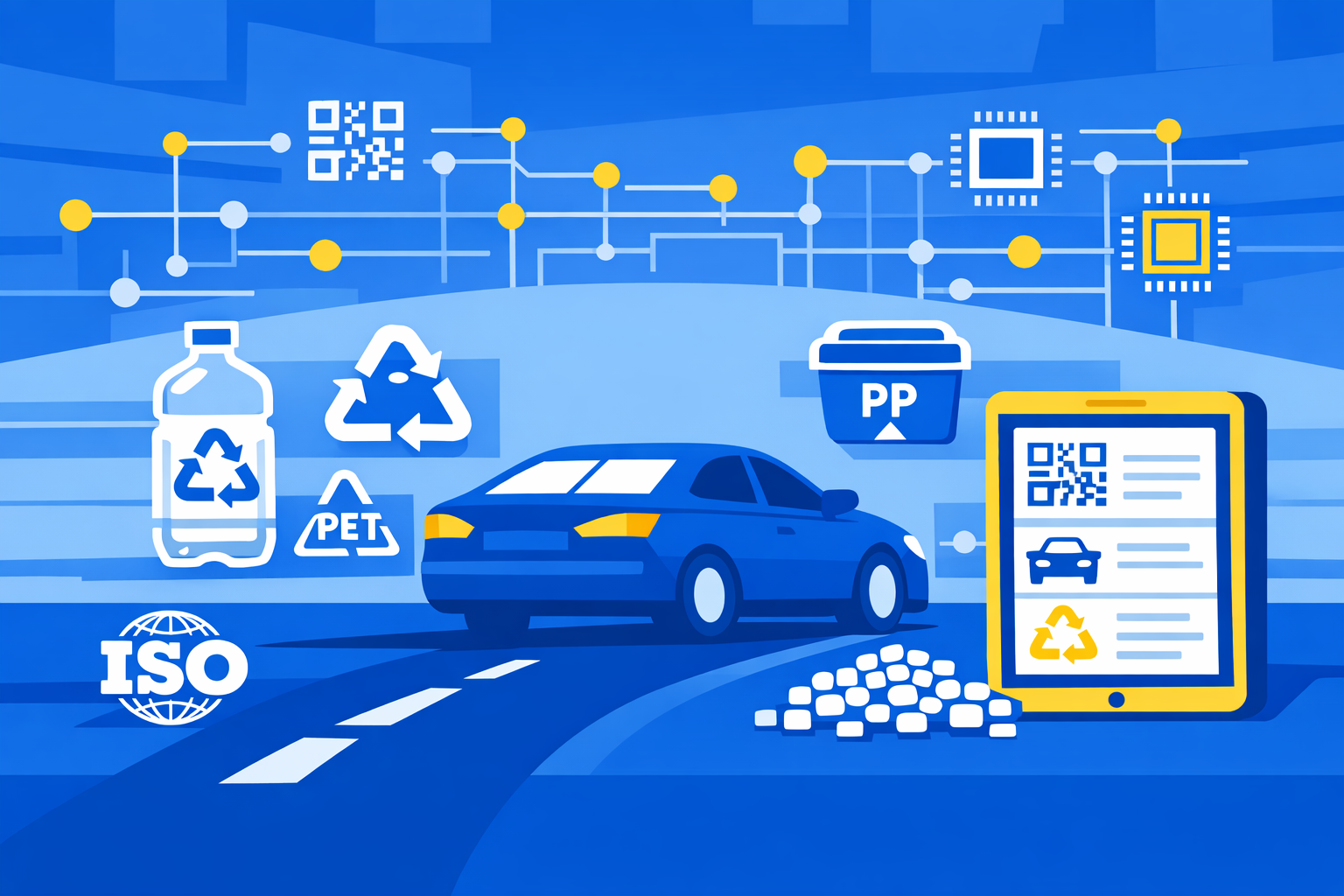
- From 2027: Digital identifiers (e.g., QR codes) must link to structured environmental and recyclability data
- From August 2028: Harmonized labeling applies uniformly across EU member states, replacing fragmented national systems
- From January 2030: Minimum recycled content thresholds apply to plastic packaging categories, ranging between 30% and 65% depending on the packaging type, with verification required through mass-balance accounting or third-party certification schemes such as RecyClass or EuCertPlast
A critical operational point: recyclability design criteria, labeling standards, and documentation obligations apply earlier than recycled content thresholds and reuse targets. Businesses that delay action until the 2030 content mandates approach will already be non-compliant on documentation and design grounds.
The PPWR also extends its reach to non-EU companies. For US-based automotive suppliers shipping packaged components into European assembly plants, selling into the EU market is sufficient to trigger PPWR obligations regardless of where the packaging manufacturer is based.
US: A Fragmented but Tightening State-Level Landscape
The US context is structurally different. No federal packaging EPR framework equivalent to the PPWR exists. Instead, seven US states - including Maine, Oregon, Colorado, California, Minnesota, Maryland, and Washington - have passed packaging-focused EPR laws, each at different stages of implementation.
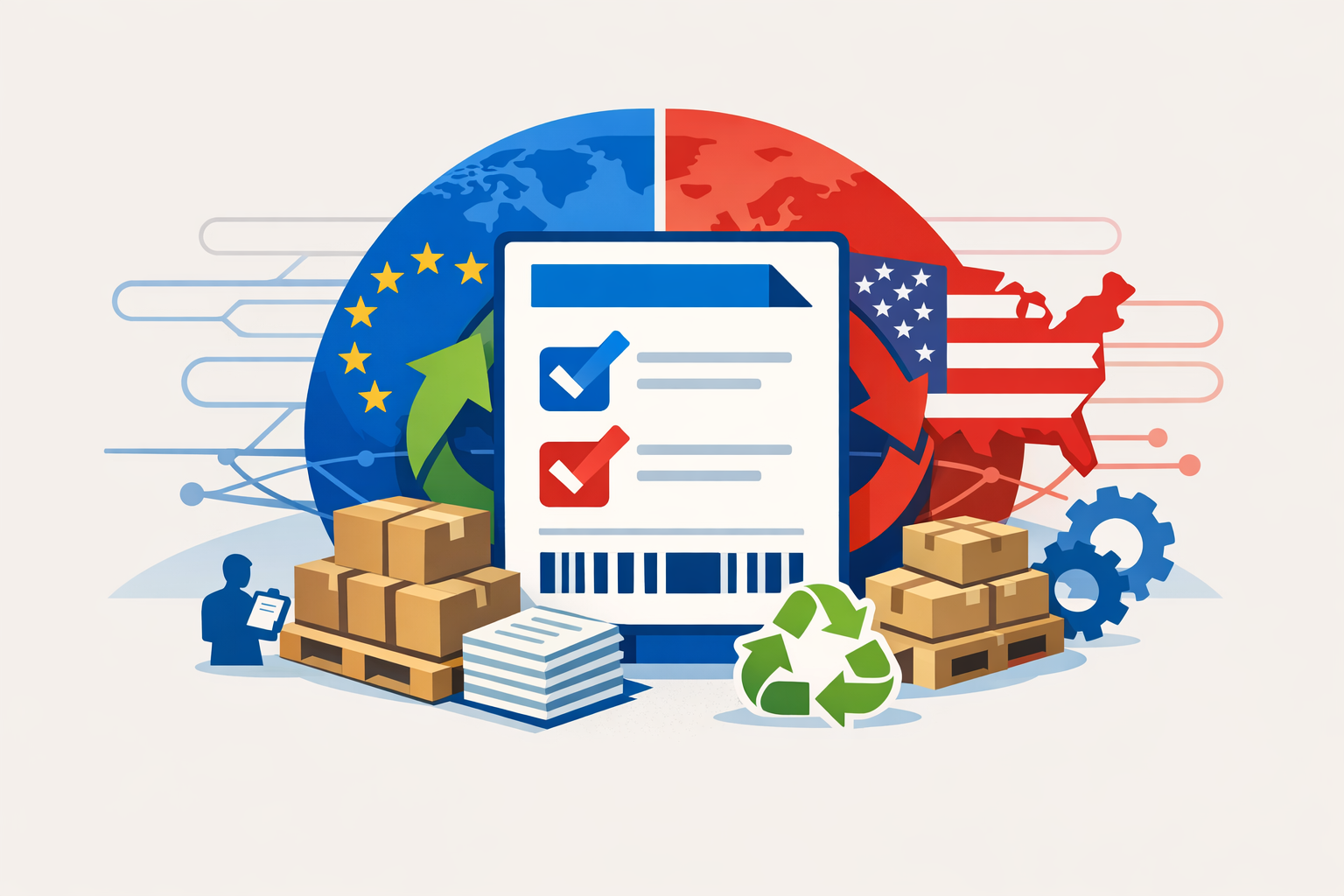
The contrast matters for automotive supply chains operating across both markets. As one recent analysis noted, the EU approach is centralized and harmonized with a single regulation applying across member states, while the US system remains fragmented[2], with packaging requirements developing at the state level. Companies operating in both markets must manage two parallel systems - one unified and prescriptive, one evolving and decentralized.
In 2026, several US state programs shift from framework-building into active enforcement. In Colorado and Oregon, producer supply reports using CY 2025 data are due May 31, 2026, with EPR fee invoices expected in January and July 2026. California's program, governed by SB 54, is advancing through revised rulemaking, with producer invoices expected in August 2026. Maryland requires producer registration by July 1, 2026.
Fees across US state programs are increasingly eco-modulated: lower for readily recyclable materials and higher for hard-to-recycle plastics[3]. This structure creates a direct financial incentive for automotive suppliers to prioritize recycled-content, recyclable formats in their packaging designs - mirroring the EPR fee modulation embedded in the PPWR.
What Convergence Means for OEM Contracts
The practical effect of dual regulatory pressure is straightforward: OEM contract language once silent on packaging sustainability is being rewritten. Industry insiders anticipate that 2026 and post-2026 supplier agreement templates will increasingly include:
- Minimum post-consumer recycled (PCR) content thresholds by packaging material category
- Explicit definitions of acceptable recycled materials, including whether chemically recycled content verified through mass-balance certification qualifies
- Packaging waste management responsibilities and cost allocation between OEM and tier supplier
- Compliance documentation requirements - declarations of conformity, recyclability assessments, and recycled content verification
- Audit rights and penalty clauses for non-conformance with applicable PPWR or state EPR obligations
The purchasing function has become the decisive lever. As one automotive logistics specialist observed[4], purchasing departments must now translate new packaging requirements into supplier specifications, contracts, and cost models - a function that previously sat primarily with sustainability or engineering teams.
These obligations extend into the deeper supply chain. Automotive manufacturers are incorporating data management systems[5] to make their supply chains more compliance-ready, with some now requiring verified documentation from Tier 2 and Tier 3 suppliers before shipment. The PPWR reinforces this: suppliers must provide manufacturers with all information and documentation to demonstrate compliance, and manufacturers must maintain technical documentation for a minimum of five years, or ten years for reusable packaging.
Compliance Timeline at a Glance
The following table maps key regulatory milestones that automotive packaging procurement teams should track across both EU and US frameworks.
| Date / Deadline | Jurisdiction | Key Obligation | Impact on OEMs/Suppliers |
|---|---|---|---|
| Feb 11, 2025 | EU | PPWR enters into force | Compliance planning must begin |
| Aug 12, 2026 | EU | PPWR general application; declarations of conformity mandatory | All automotive transport packaging on EU market must comply; supplier documentation required |
| Mid-2026 | US (CA, CO, OR, ME, MN, MD, WA) | State EPR fees, supply reporting, PRO registrations activated | Tier suppliers shipping into covered states must register, report, and pay EPR fees |
| Aug 2028 | EU | Harmonized labeling requirements apply | Standardized material composition labels and waste-sorting instructions required |
| 2027-2028 | EU | Digital identifiers (QR codes) mandatory; design-for-recycling criteria adopted | Packaging specs must embed traceability data |
| Jan 1, 2030 | EU | Mandatory minimum recycled content (30-65% by category); recyclability grades enforced | Recycled material sourcing must be secured; mass-balance verification required |
| 2030 | US (CO) | Minimum PCR content targets for plastics, glass, metal, and paper | Suppliers serving Colorado market must meet material-specific thresholds |
| 2030-2040 | EU | Escalating recyclability and reuse targets; stricter design criteria from 2038 | Long-term packaging redesign programs required |
Note: Compliance should be treated as a multi-year phased transition, not a single August 2026 event. Recyclability design criteria and documentation obligations are enforceable before recycled content thresholds apply.
Material and Specification Implications
The convergence of standards is already influencing material selection decisions at the specification stage, before contracts are signed. Tier suppliers and packaging manufacturers report growing interest in:
- High-durability recycled-content films for interior and exterior component packaging, including those verified for protection of sensitive electronic modules
- Advanced biopolymer blends as potential alternatives to virgin plastics, though the European Commission must review the environmental performance of bio-based packaging by February 2028 before allowing bio-based content to substitute for post-consumer waste in meeting recycled content targets
- Reusable plastic containers and crates, which benefit from preferential treatment under PPWR and reduce single-use packaging volumes that attract higher EPR fees
A critical technical challenge persists for automotive-specific packaging: maintaining protective performance while integrating recycled content. Packaging for precision mechanical parts and electronic components must pass standardized testing protocols verifying that recycled-content materials do not compromise protection during transport. This is driving more rigorous LCA programs and standardized performance testing - both of which OEMs are beginning to require as contract deliverables rather than optional supplier activities.
The EU increasingly recognizes chemically recycled materials if they meet mass-balance certification standards, opening an additional sourcing pathway for automotive packaging suppliers unable to source sufficient mechanical recyclate at scale.
Six Steps for Procurement and Packaging Teams
The following actions reflect compliance priorities aligned with both PPWR and US state EPR requirements as of April 2026:
1. Audit your full packaging portfolio by geography. Map every packaging material and format against the markets served. Identify which materials are placed on the EU market and which US states trigger EPR obligations. Flag non-compliant materials before the next contract renewal cycle.
2. Demand supplier documentation now - not at contract renewal. Require packaging suppliers to provide EU declarations of conformity, recyclability assessments, and verified recycled content data. Generic compliance certificates do not satisfy PPWR requirements; documentation must reference specific harmonized standards and recyclability assessment methods.
3. Revise OEM contract templates with explicit compliance clauses. Insert minimum PCR content thresholds by material category, acceptable recycled material definitions, packaging waste management responsibilities, audit rights, and penalty clauses for non-conformance. Reference both EU and applicable US state obligations.
4. Commission standardized lifecycle assessments. LCA data supports compliance documentation, informs material selection, and provides evidence for EPR fee optimization under eco-modulated fee structures on both sides of the Atlantic.
5. Build traceability and reporting infrastructure. Consolidate packaging data - material composition, weight, recycled content levels, supplier documentation status - across plants, suppliers, and markets. Prepare systems for digital labeling requirements effective from 2027 in the EU.
6. Plan for phased compliance, not a single deadline. The 2026 application dates are starting points. Schedule design reviews against the EU's 2028 labeling mandates, 2030 recycled content thresholds, and recyclability performance grades. Monitor US state EPR rules annually as programs transition from registration to active enforcement.
Outlook: What to Watch in H2 2026
The industry will closely track how OEMs translate regulatory convergence into concrete contract templates. Several factors will determine the pace of change:
- EU implementing acts due by August 2026 that will define specific labeling pictograms and recycled content calculation methodologies - the technical details that translate policy targets into measurable specifications
- US federal-level activity, including the Federal Trade Commission's pending review of its Green Guides governing recyclability claims, which could eventually layer a national standard over the existing state-level patchwork
- Legal challenges to state EPR laws, including active litigation in Oregon and a preliminary injunction that temporarily paused enforcement against certain plaintiffs, which may affect the timeline and scope of some US state programs
For procurement and packaging engineering teams, the practical near-term priority is clear: documentation and design obligations effective from August 2026 cannot wait for the 2030 recycled content mandates to be finalized. Suppliers not already preparing risk non-conformance notifications, contract penalties, and in the EU, potential loss of market access.
The convergence is not complete, and the two frameworks are not identical. But the direction of travel is consistent on both continents - toward more recycled content, more transparent documentation, and more explicit responsibility for packaging waste across the automotive supply chain. OEMs that embed these requirements into their 2026 contract cycles will be better positioned than those waiting for a single unified global standard that has not yet arrived.
Related coverage: EU and North America Establish Interim Automotive Packaging Recycled-Content Benchmarks | Global Auto Packaging Standards Nearing Convergence: What OEMs Need to Know for 2026 Contracts | US Auto Packaging EPR Rules Spur Recycled Content Strategy Shift