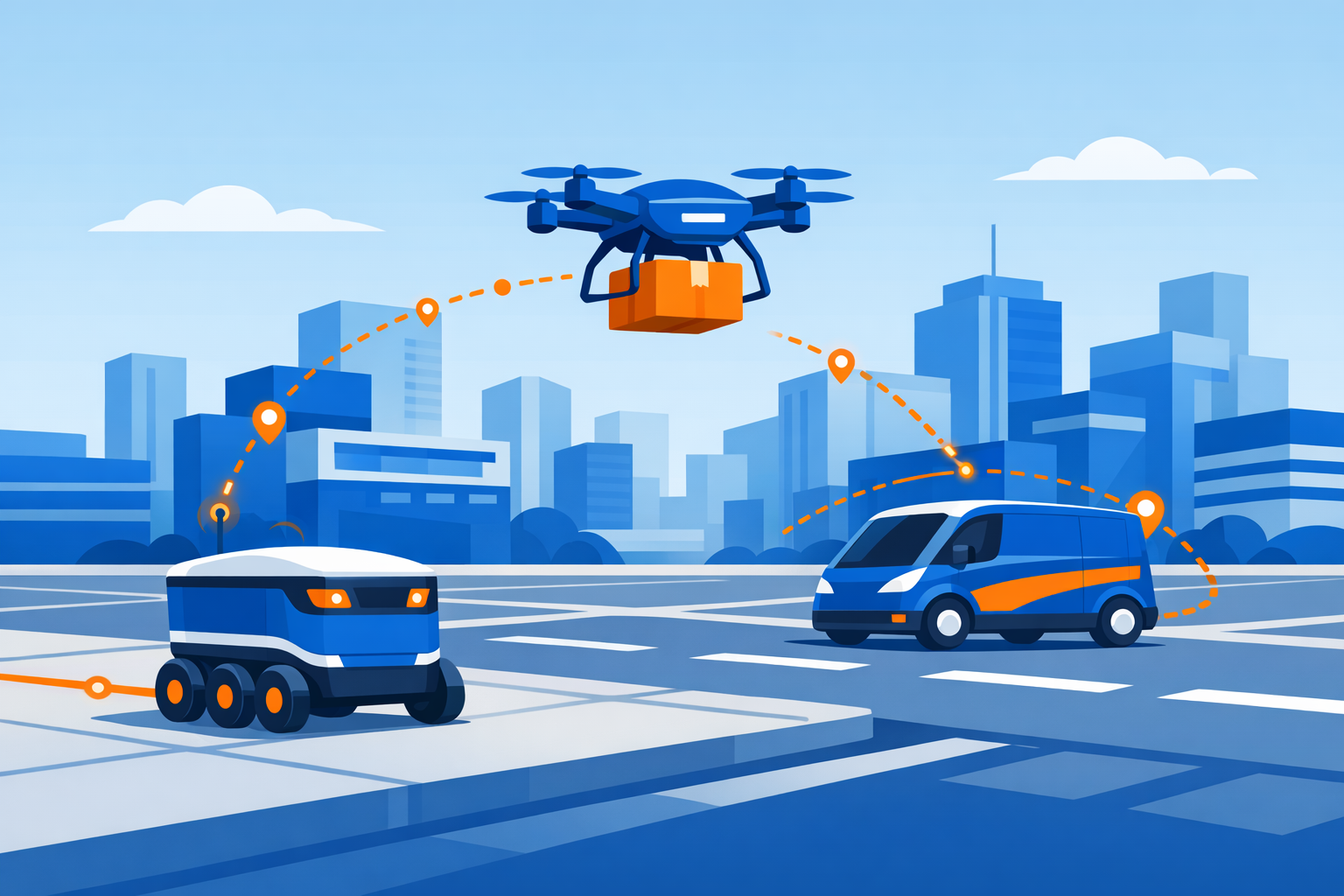
Artificial intelligence and automation are driving a structural shift in last-mile delivery, as rising e-commerce volumes, labor shortages, and cost pressures compel retailers and logistics operators to deploy dynamic routing, robotics, and autonomous vehicles at scale.
The global last-mile delivery market is valued at approximately $201 billion in 2025 and is projected to grow at a 12% compound annual growth rate through 2029, according to eMarketer. The segment now represents both the most expensive and most strategically important phase of e-commerce fulfillment. Against that backdrop, nearly half of retailers-49%-are leveraging AI-driven automation to improve delivery speed and reduce costs, according to Metapack.
Background
Last-mile delivery has long been the most operationally complex and cost-intensive leg of the supply chain. Failed or missed deliveries can account for 20-30% of total last-mile costs, according to logistics platform nuVizz. Simultaneously, transportation and warehousing employment costs in the U.S. rose 19.2% between 2020 and 2024, according to the U.S. Bureau of Labor Statistics, intensifying pressure to automate.
The convergence of machine learning, real-time data integration, and affordable robotics hardware has accelerated the transition from manual, static systems to intelligent, adaptive networks. AI systems now analyze traffic patterns, weather, delivery volumes, and customer preferences simultaneously to recalculate routes dynamically-a capability that was computationally impractical at commercial scale just a few years ago.
Details
At the autonomous delivery end of the spectrum, market momentum is building rapidly. The global autonomous last-mile delivery market was estimated at $1.3 billion in 2025 and is expected to reach $11.5 billion by 2035, growing at a compound annual rate of 24.5%, according to Global Market Insights. In the drone segment specifically, the delivery drones market is projected to grow from $1.08 billion in 2025 to $4.40 billion by 2030, according to eMarketer.
Major retailers are moving beyond pilots. Walmart now offers drone delivery in five U.S. states-Arkansas, Florida, Georgia, North Carolina, and Texas-with over 150,000 successful deliveries since 2021. Amazon is investing $4 billion to triple its rural delivery network, while Costco now handles 85% of its U.S. e-commerce shipments internally. On the ground robotics side, Starship Technologies has completed over 6 million deliveries across more than 80 cities worldwide as of 2025, operating primarily on university and corporate campuses.
AI-powered route intelligence is also delivering measurable results at the carrier level. Canadian logistics startup UniUni, using machine learning algorithms to optimize routing in real time, reduced delivery times for e-commerce retailer Shein from 10-14 days to four-five days across North America. As of 2025, UniUni's network handles more than 200,000 packages per day and secured a CAD$20 million Series B funding round to fund U.S. expansion into Los Angeles, New York, Chicago, Dallas, and Miami.
Despite deployment progress, regulatory fragmentation remains a persistent constraint. Autonomous vehicles are currently governed by a patchwork of state-by-state requirements in the U.S., varying on permitting, safety reporting standards, and commercial operation rules, according to the Eno Center for Transportation. In the U.S., more than 20 states permit autonomous trucking operations, but without a federal framework, seamless interstate operations remain elusive, according to S&P Global Automotive. Proposed legislation, including the AMERICA DRIVES Act and the Autonomous Vehicle Acceleration Act of 2025, aims to create a federal Level 4/5 framework, but passage remains uncertain.
Workforce displacement concerns are also shaping the policy debate. Senator Josh Hawley (R-MO) drafted legislation requiring safety drivers in autonomous driving system vehicles, citing concerns over labor ramifications. According to the UPCEA, automation across the transport sector could eliminate 4.5 million U.S. jobs and result in $168 billion in annual wage losses. Industry analysts and logistics operators broadly acknowledge the need for managed workforce transition programs, including retraining for fleet management and maintenance roles.
Data interoperability presents a parallel challenge. As AI platforms require access to real-time logistics data across carrier networks, inventory systems, and urban infrastructure, companies face growing complexity in integrating disparate platforms while managing data privacy and cybersecurity obligations.
Outlook
Going into 2026, stakeholders are watching for the potential inclusion of autonomous vehicle language in U.S. surface transportation reauthorization, with bipartisan legislative work underway in the House Energy and Commerce Committee, according to the Eno Center for Transportation. Separately, NHTSA is expected to continue rulemaking under its new AV framework, regardless of whether federal legislation advances. The window between regulatory clarity and commercial pressure continues to narrow-operators that delay technology integration risk structural cost disadvantages as competitors lock in AI-optimized networks at scale.