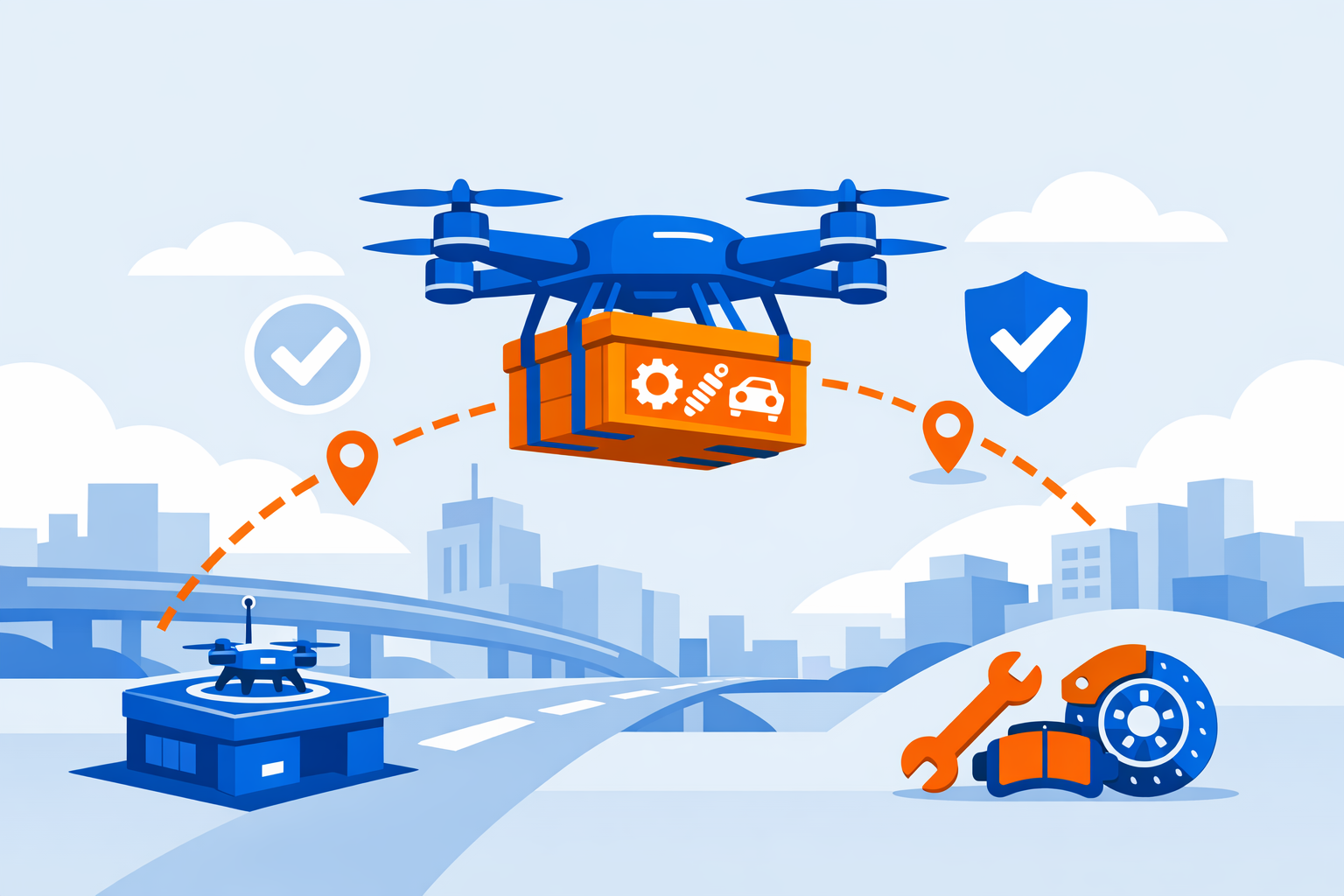
Regulatory momentum on both sides of the Atlantic is turning drone-based spare-parts delivery from a limited experiment into a viable last-mile logistics channel for automotive distributors and dealer networks. In July 2025, a state-backed consortium in Michigan launched one of the first commercial pilots dedicated to delivering car parts by air, while regulators in the United States, Europe, and Canada advanced rule changes that could normalize beyond visual line of sight (BVLOS) operations within two years.
Background
For years, BVLOS drone operations-flights in which the aircraft travels outside the direct visual range of its pilot-have been constrained by case-by-case waiver systems that industry groups described as slow and unpredictable. The exemption-and-waiver framework under Part 107 proved cumbersome, requiring operators to navigate complex regulations and lengthy application processes for limited, individually approved BVLOS flights.
For automotive after-sales and repair networks, where parts delays translate directly into vehicle downtime and lost workshop revenue, the regulatory bottleneck has been a material constraint. By flying parts over traffic instead of through it, drone logistics addresses persistent dealership challenges: late or missing components that slow repairs and erode customer satisfaction.
The drone package delivery market is estimated at USD 0.97 billion in 2025 and is expected to reach USD 4.78 billion by 2030 at a CAGR of 37.57%. Regulatory liberalization-especially BVLOS approvals-is converging with battery advances and rising service expectations to transform pilot programs into revenue-generating networks.
Regulatory Milestones
In the United States, the FAA published its long-awaited Notice of Proposed Rulemaking for a dedicated BVLOS framework-referred to as Part 108-on August 7, 2025. Part 108 is the FAA's proposed rule for routine, at-scale BVLOS drone operations. The public comment window closed on October 6, 2025. The final rule is expected in spring 2026, with implementation likely six to twelve months later, replacing the per-flight waiver system with a standardized framework covering operations up to 1,320 pounds.
Once an operator obtains approval for an "operational area" under Part 108, routine flights within that area would proceed without per-flight permission-a structural shift that supply chain operators say could substantially reduce time-to-delivery and planning complexity.
In Europe, EASA has established a comprehensive, risk-based regulatory framework harmonized across member states, including the "U-Space" set of services and procedures designed to ensure safe and efficient drone traffic management. BVLOS operations fall within EASA's "Specific" category and require operators to complete a Specific Operations Risk Assessment (SORA) and obtain authorization from their national aviation authority. SORA v2.5, updated in 2025, simplifies the risk assessment process with clearer templates and improved safety matrices, helping operators produce compliant assessments faster.
In Canada, new regulations effective April 1, 2025, permit routine BVLOS without a Special Flight Operations Certificate in low-risk conditions-drones at or below 150 kg operating in uncontrolled airspace over sparse populations.
Pilot Programs and Industry Activity
In Detroit, blueflite, Jack Demmer Ford, Centrepolis Accelerator, Airspace Link, and DroneUp joined forces in July 2025 to launch a drone delivery initiative focused on transporting automotive parts by air. The project is backed by a $740,000 grant from Michigan's Advanced Air Mobility Activation Fund. The goal is to test autonomous drones delivering high-demand car parts within a 12-mile radius of Jack Demmer Ford locations.
In the United Kingdom, GSF Car Parts is trialing a drone delivery service aimed at improving how it serves car-repairer customers who often need parts quickly to return vehicles to service. The company currently operates van fleets for local workshops and views aerial delivery as a complementary channel for time-critical runs.
BVLOS operations require specific approvals and sophisticated technologies to ensure safety, including reliable communication systems and advanced detect-and-avoid capabilities. These requirements remain one of the primary technical and certification hurdles for operators seeking approval in populated urban corridors.
Outlook
Publication of the FAA's final Part 108 rule is expected in spring 2026, with implementation likely in late 2026 to early 2027 as operators build compliance systems. For automotive supply chains, industry analysts note that the Detroit pilot should generate critical operational data to inform policy, accelerate adoption, and serve as a blueprint for scaling drone logistics across the sector. Commercial-scale autonomous drone delivery is on track to launch by 2028 in key markets as regulators including the FAA and EASA advance BVLOS frameworks amid growing pilot successes and safety validations.