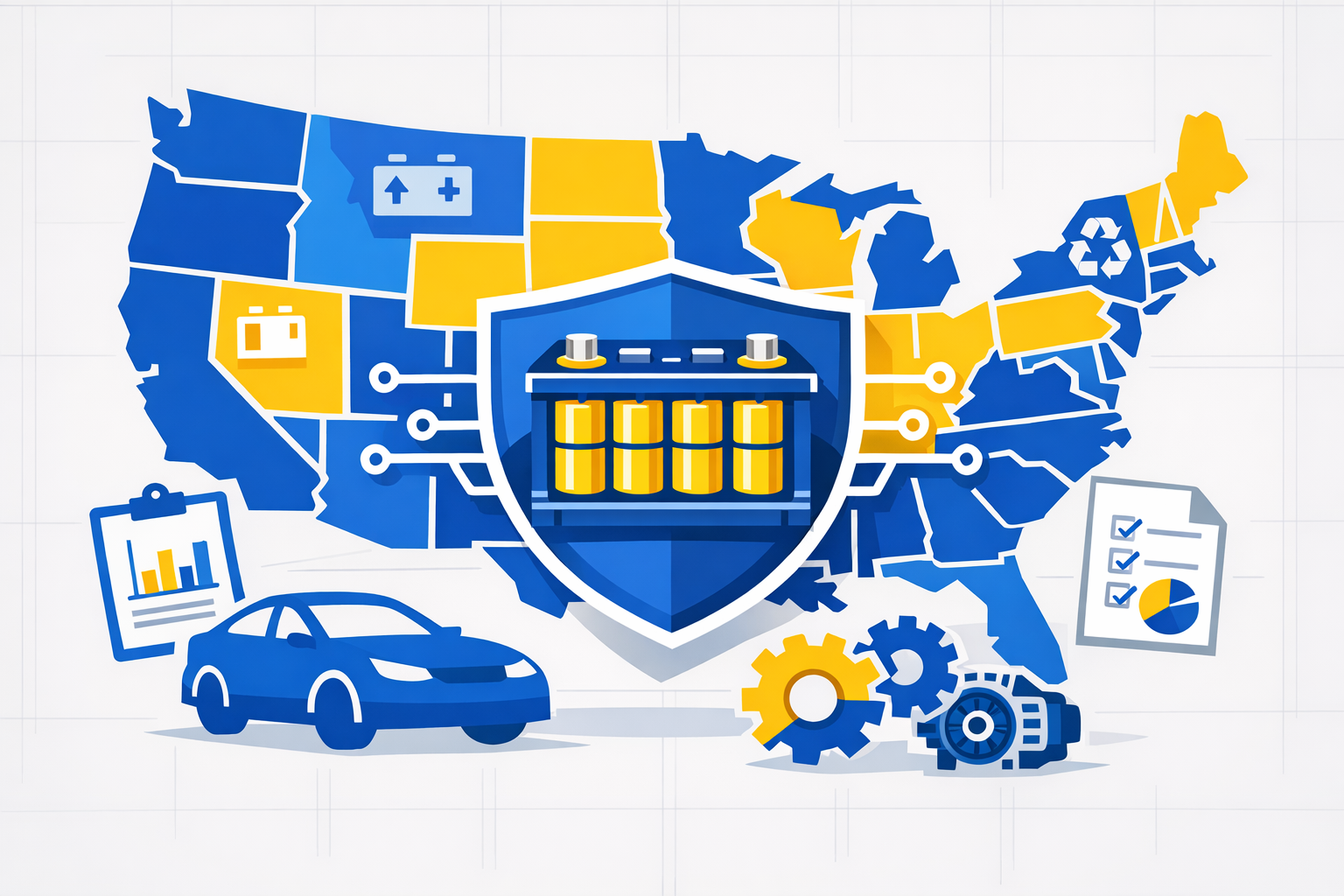
Auto parts manufacturers operating across the United States face a fragmented and fast-approaching compliance landscape as multiple states enact distinct battery stewardship laws taking full effect between 2027 and 2028. With no federal framework to harmonize requirements, suppliers must navigate diverging take-back mandates, reporting obligations, and disposal bans that differ markedly by jurisdiction-while large-format electric vehicle batteries remain excluded from several state programs, leaving a critical gap in end-of-life management.
Background
Extended producer responsibility has become the dominant regulatory model for battery waste in the United States. As of early 2026, the regulatory landscape governing batteries had fractured into a complex patchwork of standards varying across states, according to the Automotive Recyclers Association. Congress has never passed a federal law mandating EV battery recycling, leaving states to advance individual frameworks that differ substantially in scope, chemistry coverage, and enforcement mechanisms.
The approaching deadlines are the culmination of legislative activity that accelerated sharply from 2023 onward. In 2023, Washington passed SB 5144, establishing a battery stewardship program requiring battery producers to operate a statewide collection and recycling system. The EPA is also developing battery collection best practices under the Bipartisan Infrastructure Law, which allocated $25 million for voluntary labeling guidelines and collection infrastructure to be finalized by September 2026.
Details
The 2027-2028 compliance wave spans a wide arc of states with materially different requirements. Under Washington's SB 5144, producers of covered batteries must be members of a Battery Stewardship Organization, with disposal bans for portable batteries taking effect January 1, 2027; collection sites begin accepting portable batteries July 1, 2027. California's Responsible Battery Act requires producers of covered batteries to participate in a CalRecycle-approved stewardship plan no later than April 1, 2027, while California's SB 1215 separately requires annual reporting from manufacturers of battery-embedded devices to CalRecycle beginning July 1, 2027, including battery chemistry, recycled material content, and retailer data.
New Jersey has taken the most direct approach to EV propulsion batteries. Starting January 8, 2027, covered battery collection and disposal restrictions take effect in New Jersey, including a ban on unauthorized disposal of covered batteries as solid waste. Producer battery management plans are due to the New Jersey Department of Environmental Protection approximately 180 days after it adopts program regulations, likely in summer 2027.
In the Midwest, Illinois imposes a disposal ban for all portable and medium-format batteries after January 1, 2028, while Nebraska's Safe Battery Collection and Recycling Act of 2025 requires producers to join a Battery Stewardship Organization and comply with a disposal ban as of January 1, 2028. Colorado's Battery Stewardship Act of 2025 requires producers selling batteries in the state to participate in and finance a battery stewardship organization on and after August 1, 2027.
Definitional inconsistencies across these laws pose a particular operational challenge for auto parts suppliers. In Washington, large-format vehicle battery collection is not mandated until 2029, meaning hybrid and EV batteries remain under Universal Waste Rules in the interim, with the dismantler financially responsible for downstream recycling. California's Responsible Battery Act explicitly excludes batteries contained in motor vehicles from the definition of "covered batteries". In New York, EV batteries exceeding roughly 25 pounds fall outside the state's stewardship program and default to hazardous waste regulations under 6 NYCRR Part 370, leaving recyclers to bear the full cost and regulatory burden.
Compliance carries tangible cost pressure. Non-compliance penalties can be severe, with businesses in states such as New York facing civil penalties of up to $5,000 for violating battery recycling requirements. State compliance costs can include one-time plan review fees-Colorado sets this at $50,000-plus ongoing annual administrative fees paid by Battery Stewardship Organizations.
In response to industry pressure, the Suppliers Partnership for the Environment commissioned Call2Recycle in early 2025 to research and recommend program options and OEM readiness practices for regulated and non-regulated EV battery take-back programs across the automotive value chain.
Outlook
Federal action remains limited and uncoordinated with state timelines. The EPA announced plans to establish a distinct regulatory category for lithium batteries separate from existing universal waste guidelines, with proposed guidance expected in mid-2025, though no final rule has been issued. Without federal preemption, industry groups are pressing for harmonized data reporting standards and unified BSO membership frameworks that can satisfy multiple state regimes simultaneously. Auto parts suppliers should audit battery chemistries across their product lines, engage stewardship organizations early, and update supplier contracts to address take-back and labeling obligations before 2027 deadlines begin to close.