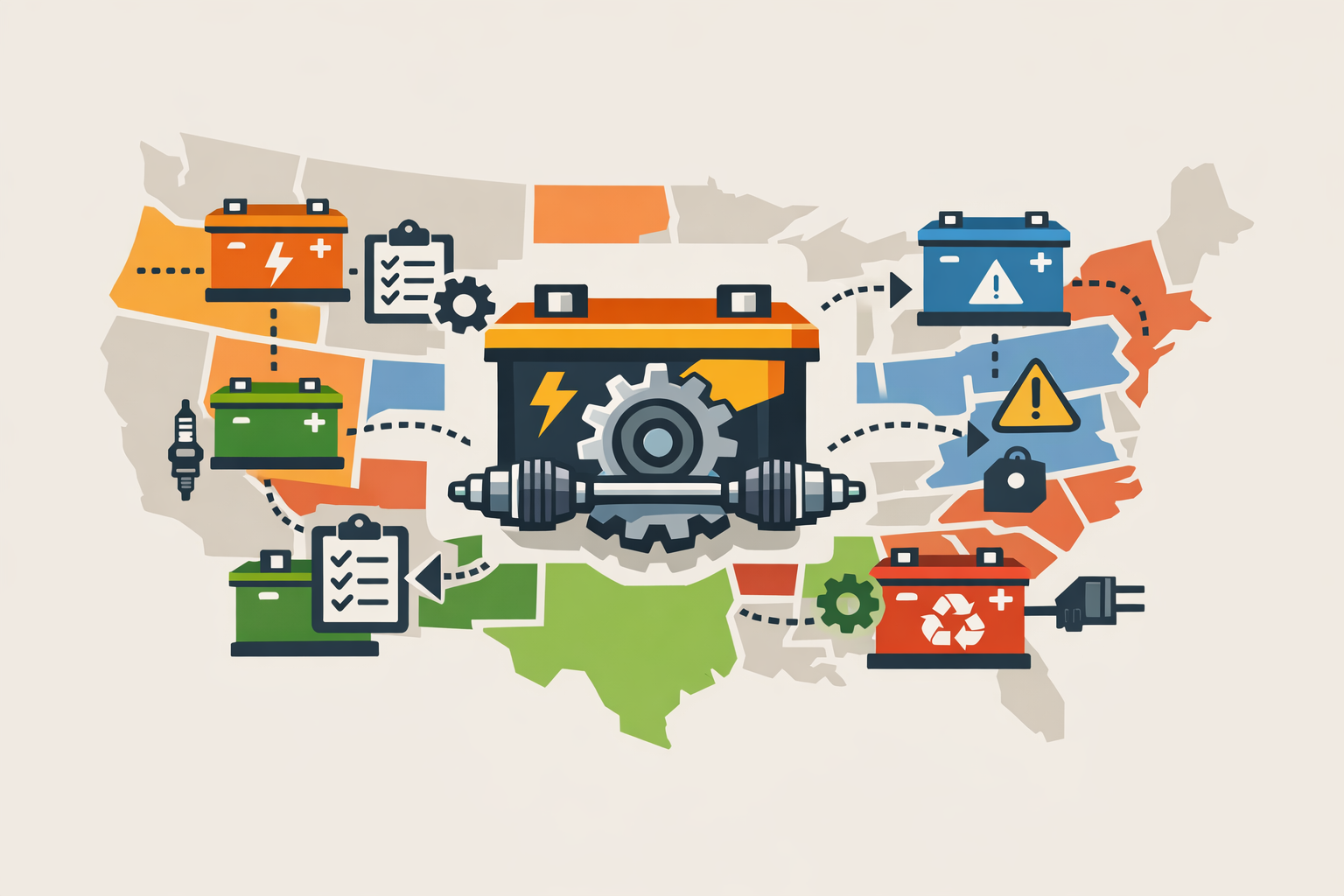
Auto parts suppliers operating across multiple U.S. states face a fragmented extended producer responsibility (EPR) landscape as at least six states have enacted divergent battery stewardship laws with compliance deadlines staggered between 2027 and 2028, forcing Tier-1 and Tier-2 suppliers to navigate inconsistent collection, reporting, and labeling mandates with no federal framework to unify them.
Background
Battery EPR laws have now passed in nine U.S. states and jurisdictions - California, Colorado, Connecticut, Illinois, Nebraska, New Jersey, Vermont, Washington, and the District of Columbia - while several others have active legislation pending, according to battery recycling firm Cirba Solutions. The surge in state-level rulemaking accelerated after the District of Columbia became an early mover, implementing a battery disposal ban in January 2022. Absent a federal standard, each state has designed its own producer responsibility model, defining "covered batteries" differently, setting distinct collection targets, and applying varying penalties for noncompliance.
The EPA has acknowledged the regulatory fragmentation. Throughout 2025, the agency hosted a series of focused conversations toward the development of a national EPR framework covering all battery types, according to the agency's website, but no federal rule has been finalized.
Details
The compliance picture for auto parts suppliers varies materially by state. In Washington, the Department of Ecology adopted its battery stewardship administrative rules (Chapter 173-905 WAC) effective January 16, 2026, requiring producers to enroll in a Battery Stewardship Organization (BSO). Collection sites must begin accepting portable batteries by July 1, 2027, while large-format vehicle batteries remain under Universal Waste rules until 2029, according to the department's website. Washington's rules mandate that battery markings be "permanent, clearly visible, and legible," with producer brand labeling required on all covered batteries by January 1, 2028.
California's Responsible Battery Act (AB 2440) requires producers to participate in a CalRecycle-approved stewardship plan no later than April 1, 2027, and sets a minimum recycling efficiency rate of 60% for rechargeable batteries and 70% for primary batteries. Motor vehicle propulsion batteries are explicitly excluded from the program's scope. Separately, manufacturers of battery-embedded electronic products must submit annual reports to CalRecycle beginning July 1, 2027, detailing unit volumes, battery chemistry, and recycled material content.
Illinois takes a stricter stance on medium-format batteries. After January 1, 2028, Illinois prohibits disposal of all portable and medium-format batteries under the Battery Stewardship Act. Connecticut's 2025 act requires producers to join a Battery Stewardship Organization by January 1, 2027, while retailers face a sales ban on non-compliant battery products as of July 1, 2028. Nebraska's Safe Battery Collection and Recycling Act of 2025 similarly imposes a disposal ban effective January 1, 2028.
Colorado's SB 25-163, passed by the legislature in May 2025, requires battery producers to join and fund a stewardship organization that submits a plan to the Colorado Department of Public Health and Environment by July 1, 2027. Beginning January 1, 2028, producers and retailers must ensure batteries sold in Colorado carry labels with chemistry and collection information. A full landfill disposal ban takes effect in 2030.
For auto parts makers, the operational burden is compounded by definitional inconsistencies. States diverge on which battery formats trigger producer obligations: Washington distinguishes portable, medium-format, and large-format tiers with different deadlines for each, while Illinois and Nebraska group portable and medium-format batteries under a single 2028 ban. Non-compliance penalties can reach $5,000 per violation in states such as New York, according to compliance data from Green Li-ion. Tracing compliance across multi-tier supply chains can be costly, time-consuming, and technically difficult, according to supply chain risk analysts.
Outlook
The EPA continues work on a national EPR framework, but no binding federal rule is expected before the 2027 state deadlines take effect. Companies managing operations across multiple states will need to maintain state-specific BSO memberships, separate collection and reporting systems, and differentiated product labeling - unless cross-state harmonization efforts yield results. Several additional states have active battery EPR legislation in progress, according to Cirba Solutions, suggesting the compliance map will continue to expand as suppliers work to meet the first wave of 2027 deadlines.