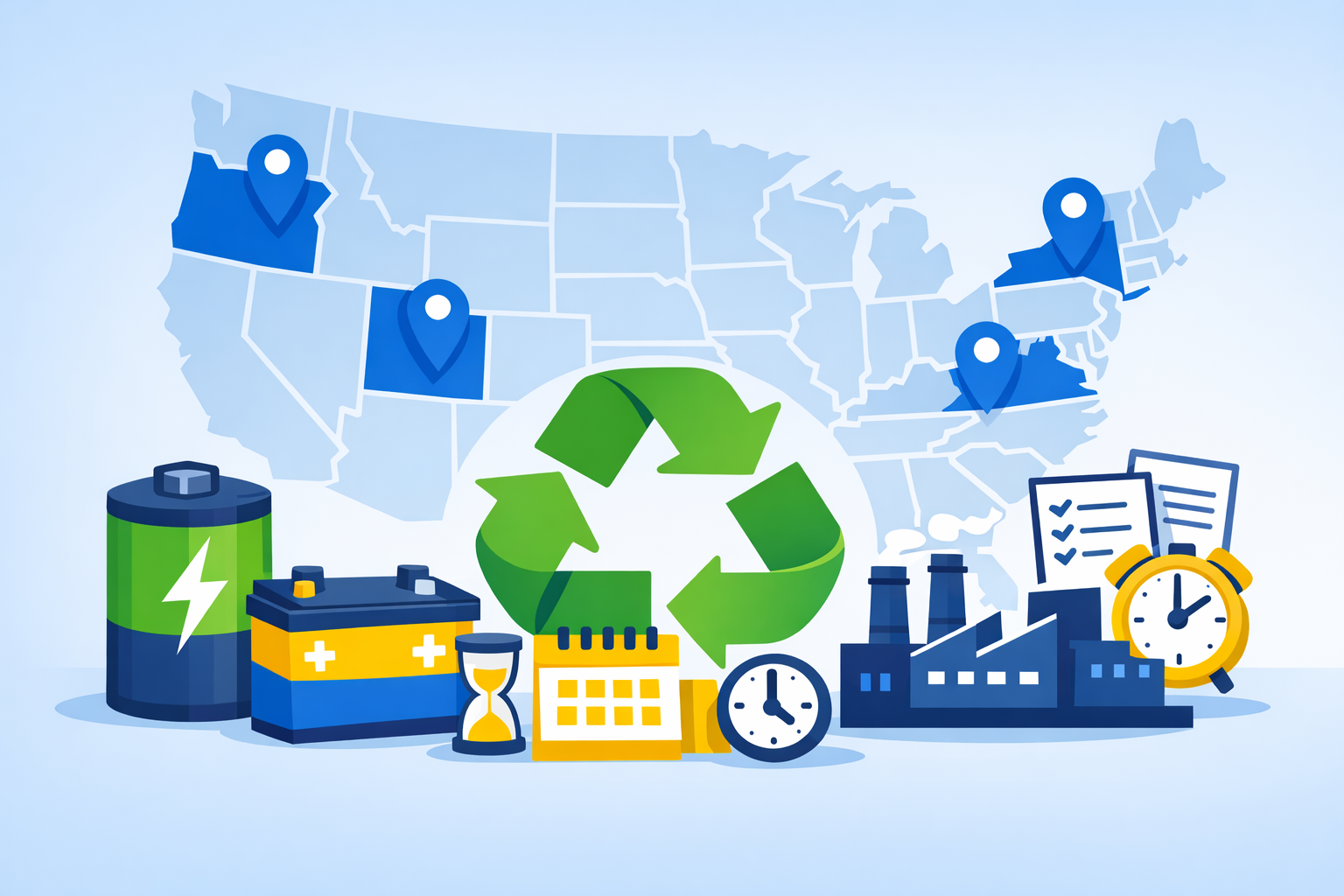
At least six U.S. states have enacted distinct battery extended producer responsibility (EPR) laws with enforcement dates concentrated in 2027 and 2028, creating a fragmented compliance landscape for automotive parts manufacturers and their supply chains. The laws impose varying registration, labeling, take-back, and disposal-ban requirements on battery producers-with no federal framework to harmonize them. Auto parts suppliers distributing lithium-ion cells, battery packs, and battery-containing products across multiple states face the prospect of meeting different obligations in each jurisdiction simultaneously.
Background
The wave of state-level battery stewardship legislation accelerated after 2022 as legislators sought to reduce hazardous battery waste in landfills, expand recycling infrastructure, and formalize circular-economy pathways for lithium-ion and other rechargeable chemistries. Connecticut, Colorado, Nebraska, and Illinois are among the states implementing comparable producer responsibility frameworks.
Battery stewardship programs require manufacturers to finance and operate collection and recycling systems for their products. Under these frameworks, producers-including brand owners, importers of record, and distributors-must join and fund nonprofit Battery Stewardship Organizations (BSOs) that design, operate, and report on statewide collection networks. Non-compliance penalties can be severe: in New York, businesses face civil penalties up to $5,000 for violating battery recycling requirements.
At the federal level, no unified EPR program exists for batteries. However, federal agencies are addressing EV battery challenges separately. The EPA announced plans to separate lithium batteries from current universal waste guidelines, establishing a distinct regulatory category tailored to lithium battery characteristics, with proposed guidance expected in mid-2025.
Details
The 2027-2028 compliance window is dense with overlapping state-specific triggers. California's Responsible Battery Recycling Act requires producers of covered batteries sold or offered for sale in the state to participate in a stewardship plan approved by CalRecycle no later than April 1, 2027. Beginning July 1, 2027, manufacturers must also submit annual reports to CalRecycle noting the estimated number of covered devices sold in the state, the chemistry of batteries in those devices, and a baseline estimate of recycled materials contained in the devices.
In Washington, the law prohibits retailers from selling or distributing covered portable batteries or battery-containing products beginning July 1, 2027, unless the producer participates in an approved plan. The law also outlines marking requirements for covered products-markings must be "permanent, clearly visible, and legible"-and by January 1, 2028, must include the producer's brand.
Colorado's SB 25-163, signed into law in 2025, follows a similar structure. On and after August 1, 2027, a producer selling or distributing certain batteries or battery-containing products in or into Colorado must participate in and finance a battery stewardship organization that has submitted a plan to the state's executive director. On and after January 1, 2028, the act prohibits producers or retailers from selling or distributing certain batteries in the state unless those batteries carry labels that include information to ensure proper collection and recycling.
Connecticut and Nebraska add further deadlines. Under Connecticut's 2025 Act, producers of covered batteries and battery-containing products sold or offered for sale in the state must join a Battery Stewardship Organization by January 1, 2027. Under Nebraska's Safe Battery Collection and Recycling Act of 2025, producers must join a BSO, and as of January 1, 2028, must comply with the battery disposal ban. Illinois adds a parallel obligation: after January 1, 2028, a disposal ban takes effect for all portable and medium-format batteries in the state.
Labeling requirements across states are not uniform. Washington requires producer brand identification on batteries by 2028, while California mandates chemistry disclosure in annual regulatory reports rather than on the battery itself. For auto parts producers selling battery-containing products across all these markets, maintaining distinct labeling variants and reporting cadences for each state adds significant operational complexity.
The auto parts sector faces an additional complication: while portable battery collection begins in 2027, large-format vehicle battery collection is not mandated until 2029 in Washington. Until then, hybrid and EV batteries in Washington remain under Universal Waste Rules, meaning the dismantler is financially responsible for downstream recycling. Aftermarket and retrofit segments-where older vehicle fleets turn over batteries outside OEM take-back channels-remain particularly exposed, as stewardship fee structures and take-back obligations for replacement packs vary by state.
| State | Legislation | Key 2027-2028 Deadline | Core Obligation |
|---|---|---|---|
| California | Responsible Battery Recycling Act (AB 2440) | April 1, 2027 | Join CalRecycle-approved stewardship plan |
| Washington | SB 5144 | July 1, 2027 (portable) / Jan 1, 2028 (labeling) | BSO membership; producer brand marking |
| Colorado | SB 25-163 | Aug 1, 2027 (producers) / Jan 1, 2028 (labeling) | Finance stewardship org; mandatory labeling |
| Connecticut | 2025 Battery Stewardship Act | January 1, 2027 | Join approved Battery Stewardship Organization |
| Illinois | Battery Stewardship Act | January 1, 2028 (disposal ban) | Approved stewardship plan; portable/medium battery disposal ban |
| Nebraska | Safe Battery Collection and Recycling Act (2025) | January 1, 2028 | BSO membership; battery disposal ban |
Outlook
Industry practitioners are responding by conducting internal gap analyses, prioritizing high-risk product lines, and engaging state regulators to clarify fee structures, reporting cadences, and exemption criteria. Supply chain mapping remains the largest challenge, as most companies lack visibility beyond tier-two suppliers. The absence of a harmonized federal standard means the compliance burden will remain uneven until states converge on common definitions for battery formats, labeling standards, and stewardship fee calculations-a process that regulators and industry groups have not yet formally initiated at the national level.