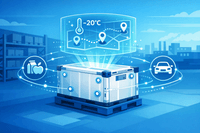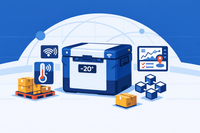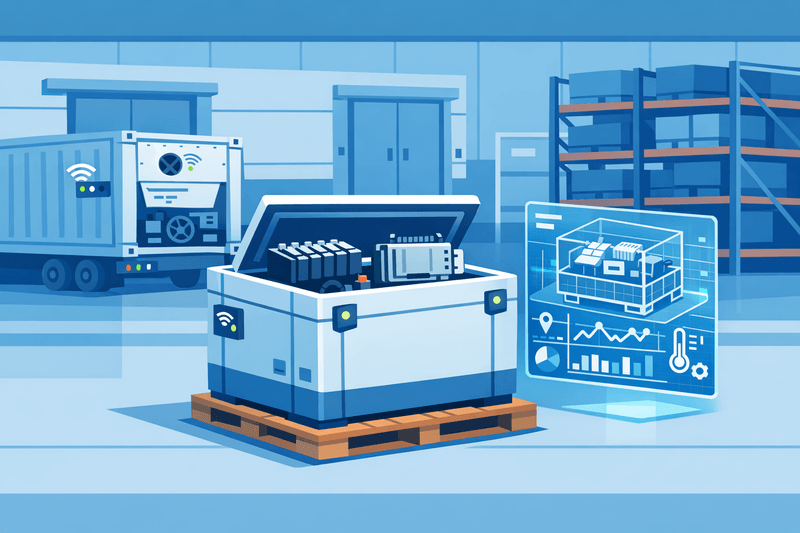
The rapid electrification of vehicles and increasing use of high-value electronics are bringing automotive spare-parts networks into the realm of cold-chain logistics. Real-time IoT monitoring, phase-change material (PCM) insulation, and digital twins are converging to manage risk, reduce spoilage, and improve transport efficiency across regional hubs and cross-docks.
This article examines how these technologies are deployed in 2026, their impact on warehouse and packaging design, and how supply chain leaders are structuring investments and pilots for temperature-sensitive spare parts.
1. Why Cold-Chain Is Becoming Strategic for Automotive Spare Parts
Automotive spare-part portfolios increasingly feature components with strict environmental tolerances. These include:
- Battery modules, packs, and energy-storage systems (ESS)
- Power electronics (inverters, DC-DC converters, onboard chargers)
- ADAS/AV sensors and camera modules
- High-density control units and infotainment systems
- Specialty lubricants, adhesives, and sealants with defined temperature ranges
Many OEM and supplier manuals now specify controlled storage bands for lithium-ion modules to limit degradation and enhance safety. Industry guidance for EV battery modules commonly recommends warehouse storage temperatures in the roughly 15-25 °C band to slow degradation and maintain safety margins.
The cold-chain sector is expanding rapidly. The global cold chain storage and logistics market was valued at about USD 287.7 billion in 2024 and is projected to reach around USD 1.27 trillion by 2034. Automotive spare-parts volumes are currently a small portion but are increasing with greater electrification and electronics integration.
Packaging and supply chain teams now face new questions:
- Which components require true cold-chain handling versus ambient control?
- What blend of fixed refrigeration, PCM-based passive systems, and hybrid containers is optimal by lane?
- How can IoT and digital twins manage risk while preventing over-engineering?
The following sections outline how real-time sensing, advanced insulation, and virtual modeling address these challenges.
2. Real-Time IoT Visibility in Automotive Cold Chains
2.1 Sensor Architectures for Warehouses and Cross-Docks
Modern cold-chain IoT platforms rely on dense wireless sensor networks located in:
- Cold rooms and climate-controlled zones in regional distribution centers (RDCs)
- PCM-insulated pallet boxes and totes
- Reefer trailers, hybrid containers, and last-mile vehicles
Common monitored parameters:
- Air and product-proximate temperature
- Relative humidity
- Door open/close status
- Vibration and shock (for battery or electronics shipments)
- Location and dwell time
Modern IoT cold-chain platforms now sample temperature as frequently as every 60 seconds and humidity every few minutes, while also logging door-open events in real time. Continuous telemetry streams have replaced manual probing and data-logger downloads.
Key design considerations for spare-parts environments:
- Ruggedization: Sensors must operate reliably from sub-zero conditions to hot loading bays.
- Battery life: Multi-year operation reduces maintenance needs.
- Wireless propagation: Antenna placement and gateway density must account for metal racking and insulated panels.
2.2 From Alarms to Predictive Analytics
Traditional cold-chain monitoring depended on threshold alarms. By 2026, analytics capabilities are focusing on prediction and prescription:
- Trend-based alerts: Algorithms flag unusual warming curves before thresholds are breached.
- Asset health scoring: Aggregated sensor data produces health scores for refrigerated assets, PCM containers, and batteries.
- Lane-level risk models: Temperature excursions are mapped to route, season, carrier, and loading data, improving decision making.
Automotive use cases include:
- Rerouting EV battery modules from congested cross-docks to available cold facilities
- Triggering PCM plate recharge instructions when thermal autonomy drops below target
- Automatically generating compliance logs for components requiring UN 38.3 or OEM-specific handling
Key data and event types for automotive cold-chain IoT:
- Telemetry: temperature, humidity, shock, vibration, tilt, energy use
- Events: door open/close, dock arrival/departure, unit power-on/off, manual overrides
- Metadata: part number, batch/serial, SoC targets for battery shipments, packaging configuration, carrier and lane identifiers
3. PCM-Based Insulation: Extending Thermal Autonomy and Reducing Energy Use
3.1 PCM's Role in Spare-Parts Distribution
Phase-change materials are used to stabilize temperatures in insulated shipping. Phase change materials are widely used in cold-chain logistics to hold products at a narrow temperature band by absorbing or releasing latent heat during melting and solidification.
PCM is particularly suitable for:
- Battery modules and packs needing to maintain a set temperature during cross-docking and temporary storage
- High-value electronics shipped in mixed-mode networks
- Regional depots exposed to seasonal or diurnal temperature swings
Benefits versus fully active refrigeration include:
- Lower energy use per pallet or tote
- Extended safe dwell times during handling or unforeseen delays
- Reduced reliance on specialized reefer vehicles ("turn any truck into a refrigerated fleet")
3.2 Design Considerations for PCM-Insulated Automotive Packaging
Key factors for engineers include:
- Phase-change temperature: Must align with the component's safe range (e.g., 15-25 °C for many EV modules), balancing margins and capacity.
- Thermal autonomy: Maintains specification under worst-case ambient conditions, considering load pattern, PCM pre-conditioning, and door-open cycles.
- Mechanical robustness: Containers should withstand warehouse handling, AS/RS systems, and shock during line-side kitting.
- Reconditioning workflow: Covers PCM plate freezing or charging at hubs, including time, energy, and labor needs.
Hybrid containers that combine PCM, active cooling, and IoT sensors support modular deployment on standard trailers or ambient trucks. This allows high-value, temperature-sensitive pallets to ship alongside ambient loads while maintaining required conditions.
3.3 Network Placement of PCM
PCM-based systems work best in:
- Feeder flows between battery plants, assembly sites, and regional depots
- Cross-docks with variable dwell times
- Service-part distribution to dealers in areas with wide temperature fluctuations
These systems reduce reliance on full-time mechanical refrigeration and maintain compliance-especially when combined with real-time IoT monitoring and exception handling.
4. Digital Twins: Virtualizing the Cold Chain from Supplier to Service Center
4.1 From Telemetry to Virtual Replicas
Digital twins use IoT data for simulation and scenario planning. In logistics, a digital twin integrates:
- Structural models of facilities, routes, and equipment
- Live feeds from WMS/TMS/OMS and IoT platforms
- Simulation engines for on-demand what-if scenarios
A recent supply chain digital twin implementation reported a 57% improvement in order-to-delivery forecasting accuracy and a 20% reduction in inventory allocation logistics costs. While this example is from retail, similar benefits are targeted for temperature-sensitive automotive parts.
Sensor data adds environmental context, enabling digital twins to:
- Estimate residual thermal autonomy for PCM-equipped containers
- Predict risk of out-of-spec exposure on routes and schedules
- Optimize dock assignments and staging based on environmental needs, beyond capacity alone
4.2 Scenario Planning for Network Design and Risk Management
Key use cases include:
- Routing what-if: Compare multi-stop and direct lanes under various seasonal conditions to identify risky exposure times.
- Inventory placement: Test depot locations for batteries and electronics, weighing service time against cold-capacity needs.
- Asset right-sizing: Determine the optimal mix of reefers, hybrids, and ambient vehicles per scenario.
- Contingency planning: Pre-calculate recovery actions when telemetry signals excursions.
Digital twins enhance collaboration between packaging and logistics teams. Packaging can simulate PCM setups affecting pallet counts and dwell time, while logistics evaluates the associated transport cost and service effects.
5. Regulatory, Data Sovereignty, and Cybersecurity Considerations
5.1 Data Protection in Connected Cold Chains
Cold-chain IoT generates extensive time-stamped data, including location and, occasionally, personnel identifiers. In Europe, GDPR and digital sovereignty guide architecture decisions.
Trends include:
- Using EU-hosted or sovereign cloud platforms for data storage and analytics
- Separating personal data (driver identifiers) from technical telemetry
- Employing data minimization, such as using coarse location data for analytics except during compliance periods
Operators transporting temperature-sensitive parts alongside health goods in shared networks face additional localization requirements, often leading to regional data lakes and federated analytics models.
5.2 Cybersecurity for IoT-Enabled Warehouses and Fleets
As cold-chain assets join industrial IoT, they become part of the operational technology (OT) attack surface. Industrial IoT operators increasingly reference ISO/IEC 27001 alongside the ISA/IEC 62443 series as complementary frameworks for securing connected operational technology.
Implications for automotive cold chains include:
- Network segmentation: Isolating IoT sensor networks from corporate IT and vehicle systems
- Secure device lifecycle: Hardening sensors and gateways, ensuring secure boot, credential management, and remote patching
- Access management: Limited and role-based access to digital-twin dashboards and analytics platforms
- Auditability: Tamper-evident temperature and control logs for regulatory and warranty needs
Implement cybersecurity measures early in IoT and digital-twin projects, as retrofitting security is often costly and disruptive.
6. Investment Signals and ROI for OEMs and Tier Suppliers
6.1 Where the Business Case Is Strongest
The best ROI often appears where:
- High part value and failure cost-such as traction batteries, ESS modules, ADAS sensors, and safety-critical ECUs
- Tight environmental specifications-narrow allowable storage/transport bands and warranty implications
- Volatile or long transit lanes-including cross-border flows and extreme climate routes
Value drivers:
- Avoided scrap and rework from environmental excursions
- Reduced warranty exposure and downtime
- Lower energy costs via optimized PCM and hybrid system use
- Productivity gains from automated documentation and exception handling
6.2 Hardware and System Integration Priorities
Investments focus on three pillars:
- Hardware standards: Choosing sensors rated for required conditions and open protocols to avoid vendor lock-in
- Interoperability: Ensuring IoT and digital-twin systems integrate with WMS, OMS, and TMS platforms
- Model reusability: Developing digital-twin models expandable to other sensitive categories
Lifecycle costs-including hardware, connectivity, subscription fees, PCM container investments, energy, maintenance, and internal model upkeep-are under close scrutiny.
6.3 Comparing Modernization Approaches
| Aspect | Traditional Refrigerated Network | IoT-Enabled Refrigeration | IoT + PCM + Digital Twin Ecosystem |
|---|---|---|---|
| Monitoring granularity | Manual checks or data loggers | Continuous telemetry | Full telemetry with predictive analytics |
| Response model | Reactive | Near-real-time alarms | Proactive and scenario-driven |
| Energy profile | High, continuous cooling | Optimized, compressor-centric | Mixed: active + PCM, route-aware control |
| Packaging flexibility | Limited (reefers, fixed cold rooms) | Similar to traditional | High: modular PCM and hybrid containers |
| Network design | Static lanes/capacity assumptions | Incremental optimization | Simulation and what-if planning |
| Primary use case fit | Food, pharma | High-value perishables | Temperature-sensitive auto parts |
Most organizations proceed from left to right, starting with IoT visibility, followed by upgraded packaging, and later adopting digital-twin capabilities.
7. Implementation Roadmap: From Pilot to Scale
To minimize risk and avoid fragmented deployments, automotive supply chain leaders are using phased programs.
1. Baseline and Criticality Assessment
- Map components by environmental criticality
- Quantify historical losses and risks linked to environmental exposure
- Assess current monitoring and data quality across networks
2. Targeted IoT Pilots
- Equip high-risk lanes with multi-parameter sensors
- Integrate telemetry with control towers or dashboards
- Define clear success metrics (excursions, traceability, response time)
3. PCM Packaging Trials
- Pilot PCM containers for select battery/electronics SKUs
- Test autonomy under realistic handling and climates
- Compare against traditional solutions in energy and performance
4. Digital Twin Proof-of-Concept
- Build a model of a regional network covering sensitive parts
- Calibrate with historical and real-time IoT data
- Run scenario analyses on routing and packaging choices
5. Scale-Up and Standardization
- Codify standards for sensors, packaging, and data models
- Extend to more regions and part types
- Align cybersecurity, data-sovereignty, and audit requirements
Governance is essential. Multi-functional steering ensures pilot lessons feed into group standards.
Frequently Asked Questions
What types of automotive spare parts truly require cold-chain conditions?
Not all parts with electronics or batteries need full cold-chain treatment. Priority is given to:
- High-energy battery modules/packs with specified storage bands
- Safety-critical ECUs and ADAS/AV sensors with strict environmental specs
- Specialty chemicals (adhesives, sealants) sensitive to temperature
Other electronics usually require ambient-controlled warehousing (15-30 °C, humidity control) and shock/condensation protection. Criteria should be based on component datasheets and warranty risks.
How does PCM insulation differ from a reefer trailer?
Reefer trailers provide continuous temperature control through mechanical cooling, while PCM containers maintain temperature using stored latent heat.
Key differences:
- PCM containers hold a consistent temperature without constant power, provided they are properly conditioned prior to transit.
- Useful for power gaps (yard dwell, cross-docks, last mile) and for ambient mixed loads.
- Reefer units consume more energy and require specialized vehicles.
Hybrid approaches are common-PCM containers inside reefers or on ambient vehicles, monitored by IoT for compliance.
What data infrastructure supports IoT and digital twins in cold-chain networks?
A standard stack includes:
- Edge gateways for sensor data aggregation
- Secure connectivity to a central cloud or on-prem system
- Integration with WMS, TMS, and OMS software for context
- Data lake/warehouse for historical analysis
- Simulation engine for digital-twin modeling
Early definition of data governance-ownership, retention, and access-is crucial, especially in multi-party ecosystems.
How can teams quantify ROI for cold-chain IoT and PCM pilots?
ROI analysis should include avoided losses, operational efficiencies, and compliance improvements:
- Reduced scrap, rework, or requalification
- Lower energy costs via optimized refrigeration and PCM management
- Decreased effort for inspections and documentation
- Reduced risk of fines, recalls, or warranty claims
Pilots should use historical baselines and track seasonal changes.
How do cybersecurity and GDPR affect cold-chain IoT projects?
Frameworks such as ISO/IEC 27001 and ISA/IEC 62443 guide security for industrial networks. These ensure that IoT devices and digital-twin systems do not introduce vulnerabilities.
GDPR impacts any personal data tied to cold-chain telemetry. Mitigations include pseudonymization, robust access controls, and using EU-sovereign cloud platforms for sensitive data.
Conclusions and Next Steps for Automotive Supply Chain Leaders
Cold-chain modernization for automotive spare parts is becoming a systemic requirement. Battery electrification and electronics-heavy vehicles are making temperature-sensitive logistics fundamental to spare-parts management.
For 2026-2027, packaging, logistics, and supply chain teams should:
- Segment parts by criticality and align storage with datasheets and safety analyses
- Deploy targeted IoT monitoring on highest-risk lanes to create real-world profiles
- Pilot PCM containers for batteries and high-value electronics where needed
- Invest in scalable digital twins that can expand network-wide
- Incorporate cybersecurity and data-sovereignty into each technology decision
Aligning IoT, PCM, and digital-twin strategies will enable automotive supply chains to deliver resilient, efficient, and future-ready cold-chain capabilities for next-generation temperature-sensitive spare parts.