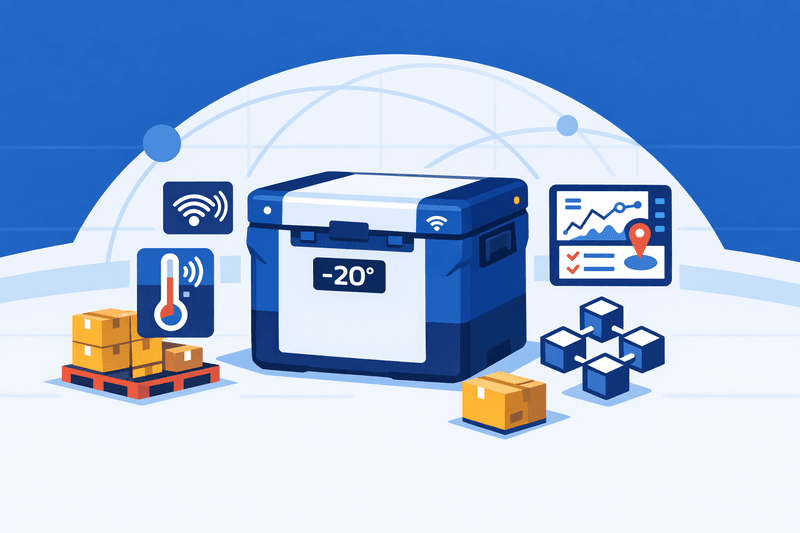
Pharmaceutical cold chain logistics is evolving from episodic monitoring and single-use packaging to an integrated system of smart, reusable, and highly engineered temperature-controlled solutions. Real-time IoT tracking, reusable containers, advanced insulation, and end-to-end digital traceability are combining to reduce product loss, enhance compliance, and redefine standards for pharmaceutical logistics and related cold chains.
Market Momentum: Why Cold Chain Packaging Is in Focus
Pharmaceutical cold chain is now a key growth driver in pharma logistics, fueled by biologics, vaccines, and personalized therapies.
The global pharma cold chain logistics market was estimated at around USD 18.2 billion in 2023 and is forecast to reach roughly USD 41.5 billion by 2033, reflecting a CAGR of about 8.6%1Pharma Cold Chain Logistics Companies: 2025–2026 Insights - Packaging Web Wire. This growth is directly increasing demand for high-performing cold chain packaging.
Several structural drivers are shifting packaging requirements:
- Over 30% of global pharmaceutical products require cold-chain handling, with biologics and vaccines expanding this share2Pharma cold chain logistics industry trends and strategies 2025 - tempk
- Biopharma pipelines are increasingly dominated by temperature-sensitive modalities, such as monoclonal antibodies, cell and gene therapies, and mRNA vaccines.3Proceedings of the Eastern Asia Society for Transportation Studies, Vol.15, 2025
- Around 20% of temperature-sensitive healthcare products are still degraded or damaged during distribution due to inadequate cold-chain management4Cold Chain Pharmaceuticals: Real-Time Monitoring for 2025 Success - tempk
- Cold chain failures contribute to over USD 35 billion in annual pharmaceutical losses globally5How IoT & Real-Time Monitoring Are Redefining Pharma Cold Chain Logistics
These trends are driving three main expectations among pharma logistics and supply chain leaders:
- Higher integrity: tighter temperature controls and validated performance across diverse routes
- Higher visibility: real-time monitoring of condition and location throughout the supply chain
- Greater sustainability and efficiency: reduced material waste, optimized cube utilization, and improved total cost of ownership
Real-Time IoT Monitoring as the New Baseline
Temperature data loggers have long been used in cold chain packaging, but the industry is now moving toward continuous, connected IoT monitoring instead of post-shipment downloads.6Temperature data logger
Adoption Levels and Performance Impact
Cold chain logistics is rapidly digitalizing:
- About 68% of cold chain companies have integrated IoT sensors for real-time temperature monitoring, up from 52% in 20217Cold Chain Logistics Industry: ZipDo Education Reports 2026
- Pharmaceutical firms are now the largest adopters of cold chain monitoring equipment, with more than 65% of top global pharma companies using real-time solutions8Cold Chain Monitoring Equipment for Transportation Market Size | Growth Forecast To 2035
- Improved real-time visibility can reduce product loss and disruptions by up to 30% in high-value temperature-sensitive chains.Real-time supply chain visibility has been shown to cut product loss and logistics disruptions by nearly 30% in sectors like pharmaceuticals5How IoT & Real-Time Monitoring Are Redefining Pharma Cold Chain Logistics
For packaging and logistics teams, these changes mean:
- Shipment-level control: Real-time telemetry enables proactive management in transit rather than post-delivery reviews
- Automated alerting: Integrated IoT platforms notify teams if temperatures drift, doors open unexpectedly, or if shocks exceed thresholds, allowing mid-route interventions9Pharma Cold Chain Logistics Tracking in 2025 – Smart Monitoring & Compliance - tempk
- Detailed analytics: High-frequency data supports route benchmarking, carrier assessments, and targeted pack-out optimization9Pharma Cold Chain Logistics Tracking in 2025 – Smart Monitoring & Compliance - tempk
Design Considerations for IoT-Enabled Packaging
Integrating real-time monitoring into pharmaceutical packaging creates operational challenges:
- Device strategy: choosing between reusable loggers embedded in containers and disposable trackers on parcels
- Connectivity: selecting cellular, LPWAN, or hybrid approaches to maintain coverage across modes and routes10Real-time Monitoring Solutions For Cold Chain Market Demand Analysis & Growth Forecast [2024–2034]
- Power management: optimizing sampling and transmission frequency to balance data needs and battery life, especially for long or frozen shipments
- Systems integration: linking IoT data with quality systems, WMS, TMS, and serialization databases
For many, hardware is less of a constraint than the ability to manage alert volumes and extract actionable insights. Surveys show many cold chain managers feel overwhelmed by alerts and lack dedicated analytics staff.11Sensors for Cold Chain Monitoring Market 2025
Reusable Cold Chain Packaging: Economics and Sustainability
Reusable thermal packaging is shifting from niche pilots to mainstream adoption in pharmaceutical cold chain logistics.
Environmental and Cost Performance
Life cycle assessments consistently show reusable containers outperform single-use EPS or PUR shippers in environmental impact when sufficiently reused:
- A comparative LCA showed reusable Credo Cube shippers generated fewer environmental impacts at high shipping volumes.12Study: Reusable cold chain pharma packs 'greener' than single use | Packaging World
- A major clinical program adopting a reusable rental model reported over 50% cost savings per shipper, including return logistics13Case Study: Transitioning To Rental Packaging For Sustainable Clinical Operations - ThermoSafe
Cost effectiveness relies on network design, including:
- Shipping lane density and return logistics
- Availability of refurbishment and sanitization hubs
- Asset management practices (loss rates, wear, dwell time)
Design Features of Modern Reusable Systems
New reusable pharmaceutical packaging systems often feature:
- Durable insulated shells: EPP, PUR, or composites14Pharmaceutical Cold Chain Packaging Strategies for 2025 - tempk
- Advanced thermal cores: PCMs tailored for specific temperature ranges (e.g., 2-8°C, below -20°C)
- Integrated identification: RFID or NFC tags for tracking and reconciliation15Case study: Reusable packaging
- IoT modules: For location and condition monitoring
Effective reusable programs include:
- SOPs defining asset ownership, responsibility, and refurbishment
- Rental or pooling models to distribute capex and centralize management
- Data-driven optimization of turnaround times and inventories
Advanced Insulation and Temperature Controlled Packaging Formats
Thermal performance standards are rising, driven by longer supply routes and ultra-low temperature biologics.
Materials Innovation: VIPs, PCMs, and Hybrid Systems
Innovative insulation materials support longer hold times and efficient designs:
- VIP systems with PCMs can maintain 2-8°C for up to 144 hours in passive shippers16Top 5 Cold Chain Packaging for Pharmaceutical Shipping | Mercury
- PCM-based containers show stable 2-8°C for up to 72 hours across temperature ranges17Improving Performance of Cold-Chain Insulated Container with Phase Change Material: An Experimental Investigation
- VIPs achieve lower thermal conductivity (0.0015-0.0025 W/m·K) compared to foam plastics, enabling thinner walls and improved payload space18Cold Chain
These materials are now used in parcel shippers, pallet shippers, and temperature-controlled pallets for air freight.
Comparing Packaging Approaches
| Packaging approach | Typical use cases | Indicative thermal performance* | Capex / Opex profile | Sustainability considerations |
|---|---|---|---|---|
| Single-use EPS/PUR shipper | Clinical samples, small batch shipments | 24-96 h at 2-8°C depending on design19Case Study - Pharmaceuticals 01 - Coolpac | Low capex per unit; higher per-shipment material cost | High packaging waste; landfill pressure; simple ops |
| Reusable EPP/PUR shipper with PCM | Routine commercial distribution, lanes with returns | 48-120 h at 2-8°C or frozen ranges | Higher upfront capex; lower cost at scale13Case Study: Transitioning To Rental Packaging For Sustainable Clinical Operations - ThermoSafe | Lower material footprint per shipment; requires reverse logistics |
| VIP + PCM passive container | Long-haul air/sea, high-value biologics | Up to 144 h at 2-8°C passiveAdvanced VIP-PCM systems can sustain narrow temperature bands for up to six days without external power16Top 5 Cold Chain Packaging for Pharmaceutical Shipping | Mercury | Premium capex; optimized freight via higher payload ratio |
| Active temperature-controlled container | Ultra-long routes, deep frozen therapies | Continuous control; capable of -20°C to below -70°C ranges20Cold chain | Highest capex; rental and service fees; energy costs | Lower single-use waste; higher energy footprint |
*Performance varies by supplier, configuration, and ambient profile; qualification data should guide final selection.
Packaging engineers increasingly deploy hybrid portfolios, combining reusable VIP-based systems for high-volume lanes with cost-effective single-use or rental solutions for lower-volume routes.
End-to-End Digital Traceability and Regulatory Drivers
Traceability requirements are advancing from batch-level records to item-level visibility and condition history.
Evolving Regulatory Landscape
Regulators are raising expectations for temperature control, documentation, and traceability:
- EU GDP guideline 2013/C 343/01 requires temperature mapping and continuous monitoring for warehouses and transport equipment21EN 8.3.2013 Official Journal of the European Uni
- FDA cGMP (21 CFR Part 211) mandates appropriate temperature and humidity conditions, with documented controls.
- Serialization frameworks like the US DSCSA and EU FMD enforce identification and verification of prescription medicines, supporting item-level condition histories.22DSCSA Serialization
These drivers necessitate investments in interoperable data standards, event capture across all nodes, and integration of packaging, logistics, and quality systems.
Blockchain and Tamper-Evident Data
To ensure data integrity and trust across parties, some organizations are adopting distributed ledger solutions:
- Surveys show about 22% of cold chain organizations use blockchain-style technology to track pharmaceuticals, reducing recall time by around 40%7Cold Chain Logistics Industry: ZipDo Education Reports 2026
- Pilot projects that combine IoT sensors and distributed ledgers report up to 80% reductions in audit preparation time for temperature-sensitive shipments11Sensors for Cold Chain Monitoring Market 2025
Research and case studies indicate blockchain-based platforms can provide:
- Immutable audit trails for regulators and quality functions23Cold Supply Chain Planning including Smart Contracts: An Intelligent Blockchain-based approach
- Automated verification of custody changes
- Conditional smart contracts administering product release or rejection based on temperature history
Interoperability is a persistent challenge, as stakeholders often deploy incompatible platforms.24Cold Chain Monitoring Equipment for Transportation Market Standardization is therefore central to industry governance efforts.
Cross-Sector Implications: Food, Biotech, and Beyond
Modernization of pharmaceutical cold chain packaging is relevant for other temperature-controlled sectors as well.
Food and Perishable Supply Chains
Technologies pioneered in pharma are migrating to food and beverage logistics:
- Smartphone-based traceability systems (RFID and cloud databases) are being piloted in food chains for real-time visibility25Smartphone-Based Food Traceability System Using NoSQL Database
- Blockchain-based food logistics demonstrate how immutable records and temperature logs can support safety and transparency26BioTrak: A Blockchain-based Platform for Food Chain Logistics Traceability
Food packaging operations can use pharma-grade solutions-such as VIP-PCM systems or IoT-enabled reusable crates-for high-value perishables prone to costly spoilage.
Biotech and Clinical Supply
Biotech pipelines, particularly cell and gene therapies, require extreme cold chain performance:
- Many therapies must be maintained at -80°C to -150°C with strict excursion limits9Pharma Cold Chain Logistics Tracking in 2025 – Smart Monitoring & Compliance - tempk
- Passive VIP-PCM solutions often complement, not replace, active systems, especially for last-mile and backup deliveries
Design principles proven in pharma-reusability, real-time IoT, and digital traceability-are setting the standard for biotech cold chain upgrades.
Implementation Considerations for Packaging and Supply Chain Teams
Scaling from pilots to broad deployment calls for coordination across engineering, quality, procurement, and logistics.
Key factors include:
- Total cost of ownership (TCO): evaluating single-use versus reusable systems for packaging, freight, reverse logistics, refurbishment, and write-offs
- Lane segmentation: aligning packaging designs with lane risk, shipment value, and service targets
- Validation and qualification: ensuring new formats meet regulatory requirements for stability data, mapping, and documentation
- Data integration: establishing IoT and traceability data flows in QMS, ERP, WMS, and TMS systems
- Cybersecurity and governance: controlling access to shipment condition data, particularly with blockchain or multi-tenant platforms11Sensors for Cold Chain Monitoring Market 2025
Many companies are adopting phased roadmaps, starting with high-value, high-risk lanes and expanding after proving ROI and compliance benefits.
Actionable Conclusions and Next Steps
Pharmaceutical cold chain packaging is coalescing around four pillars: advanced insulation, reusable assets, real-time IoT, and verifiable traceability.
Packaging and supply chain leaders should:
- Map risk and value: identify routes and products where cold chain failure would be most costly or critical
- Pilot IoT and reusable systems: integrate real-time monitoring with reusable containers on select lanes to quantify benefits
- Update validation frameworks: incorporate real-time data into dynamic qualification and improvement cycles
- Monitor regulatory and standards updates: participate in pilots that advance interoperable traceability
- Encourage cross-sector learning: observe adaptations between pharma, food, and biotech to accelerate knowledge transfer
Systematic alignment of packaging design, digital infrastructure, and regulatory strategy positions organizations to reduce loss, assure compliance, and meet the demand for sustainable, resilient cold chain logistics.
Frequently Asked Questions
How is the growth of biologics changing pharmaceutical cold chain packaging requirements?
Growth in biologics, vaccines, and cell and gene therapies increases the proportion of products requiring strict temperature control and shorter stability windows.Estimates suggest that a substantial share of biopharmaceutical products-up to several tens of percent-now require cold chain handling from production to administration3Proceedings of the Eastern Asia Society for Transportation Studies, Vol.15, 2025. Packaging must support narrower temperature ranges, longer hold times, and greater resilience, often at frozen or ultra-low temperatures.
What is the business case for investing in reusable cold chain packaging?
Reusable systems can lower per-shipment costs and environmental impact on suitable lanes with efficient reverse logistics. Case studies and LCAs show reusable shippers outperform single-use EPS/PUR at modest reuse rates, and large operations have achieved savings greater than 50% per shipper after adopting rental-based programs.12Study: Reusable cold chain pharma packs 'greener' than single use | Packaging World The business case centers on lower TCO, reduced excursion risk, and improved sustainability metrics.
How do regulations like EU GDP and FDA cGMP influence packaging choices?
EU GDP and FDA cGMP require medicines to be stored and transported in conditions that maintain quality, which includes validated temperature control, mapping, and monitoring.EU GDP guideline 2013/C 343/01 explicitly calls for temperature mapping and continuous monitoring of storage areas and transport equipment for medicinal products21EN 8.3.2013 Official Journal of the European Uni. Packaging designs increasingly feature validated insulation, integrated monitoring, and documentation to prove compliance through distribution.
Where does blockchain add value in pharmaceutical cold chain logistics?
Blockchain and distributed ledger technologies provide tamper-evident records of temperature, location, and custody transfers, supporting regulatory compliance, facilitating investigations, and enabling targeted recalls. Adoption is growing, with organizations reporting faster recall execution; interoperability and data governance remain key industry challenges.7Cold Chain Logistics Industry: ZipDo Education Reports 2026
How can packaging teams prioritize which technologies to adopt first?
A practical approach is to map lanes, improve passive thermal design, then introduce real-time IoT monitoring for high-risk shipments, and deploy digital traceability tools like serialization databases or blockchain as warranted by regulation and business needs. Organizations often begin with pilot programs using clear KPIs-such as reduced excursions, avoided loss, and shorter audits-before broader implementation.