A Michigan pilot program delivering automotive components by drone to Ford dealerships has emerged as one of the first real-world tests of aerial last-mile logistics in the U.S. auto sector, as federal regulators advance a standardized framework that could allow drone operators to fly commercially without line-of-sight restrictions. The convergence of industry-led pilots and regulatory action is drawing attention from supply chain directors and dealer network operators nationwide.
Regulatory Background
For years, commercial drone delivery in the United States has been constrained by the FAA's Part 107 rules, which limit operations to within visual line of sight (VLOS) of a remote pilot. Beyond visual line of sight (BVLOS) operations require individual waivers or special exemptions-a case-by-case approach that has slowed scalable deployment across logistics networks.
A significant shift is now underway. On August 7, 2025, the FAA released a Notice of Proposed Rulemaking (NPRM) introducing Part 108, a new regulatory structure specifically designed for BVLOS drone operations. U.S. Department of Transportation Secretary Sean Duffy announced the long-awaited NPRM, which would create a standardized framework enabling commercial drone operators to fly beyond visual line of sight without individual waivers. The NPRM follows a June 5, 2025, executive order titled "Unleashing American Drone Dominance," which directed the FAA to publish a final BVLOS rule within 240 days.
The FAA received over 3,000 public comments after the 60-day comment period closed on October 6, 2025. The 700-plus page proposal represents the most significant development in commercial drone regulation since Part 107 was introduced in 2016. Under the executive order timeline, a final rule is expected by approximately March-April 2026.
Michigan Auto Parts Pilot Takes Shape
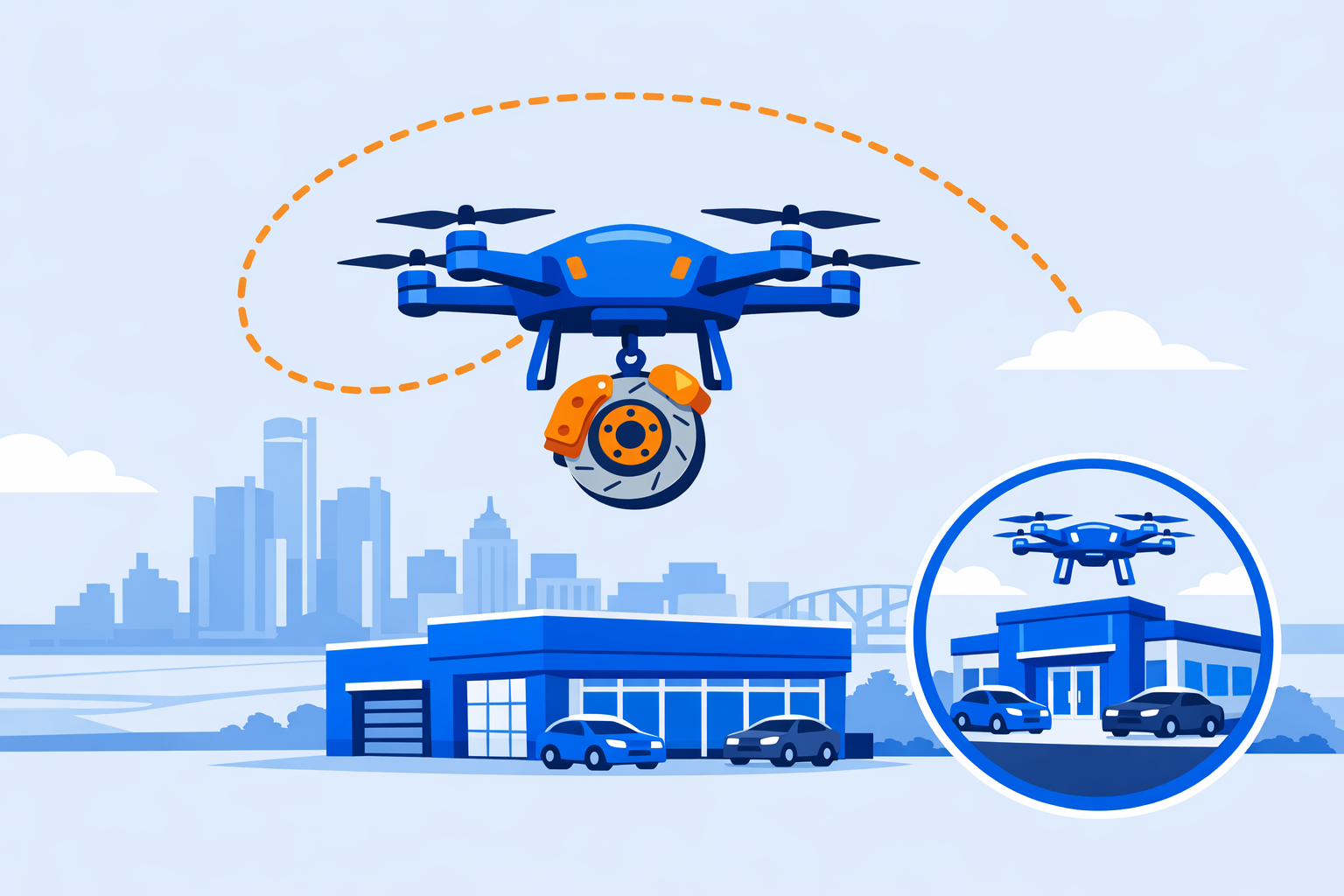
Against that regulatory backdrop, a state-backed program in Southeast Michigan is testing whether drones can meet the urgent, time-sensitive demands of automotive parts logistics. The program, led by drone company blueflite, focuses on delivering parts by air to Ford dealerships and is backed by a $740,000 grant from Michigan's Advanced Air Mobility (AAM) Activation Fund.
Partners include Jack Demmer Ford, Centrepolis Accelerator, Airspace Link, and DroneUp. The goal is to test autonomous drones delivering high-demand parts within a 12-mile radius of Jack Demmer Ford locations, flying over traffic rather than through it to address longstanding inefficiencies in dealership logistics.
Drone flights will operate in the metro Detroit area, contributing to the expanding Ann Arbor-Detroit drone corridor. Governor Gretchen Whitmer's Executive Directive 2025-4 reinforces this direction, positioning Michigan as a national leader in deploying uncrewed aircraft systems for commercial and government use.
The program targets a persistent pain point in dealer service operations: parts delays that extend vehicle repair times and disrupt shop throughput. The project is expected to generate critical operational insights to inform policy, accelerate industry adoption, and serve as a blueprint for scaling drone logistics across the automotive sector.
Efficiency and Sustainability Metrics
Research into drone-based last-mile delivery points to material gains in speed, cost, and carbon footprint compared with conventional van or truck delivery. According to a 2025 lifecycle analysis published in the journal Drones, UAV delivery promises to reduce last-mile emissions by up to 71% compared to truck delivery. Autonomous drones can consume significantly less energy than standard delivery vehicles, with estimates projecting 94% less energy per parcel.
On the economics side, drone delivery is expected to offer cost savings of up to 70% for light packages compared with truck deliveries. A 2025 peer-reviewed study modeling drone-truck parallel systems found that the collaborative model achieves an approximately 20% reduction in carbon emissions and a 20-30% cost reduction relative to a conventional fuel truck fleet.
The spoke-and-hub deployment model-in which drones are dispatched from a central distribution point to dealer locations or repair shops within a defined radius-is the configuration most directly applicable to automotive parts networks. The economics suggest a potential cost per package as low as one to two dollars once multi-drone operations reach scale. The global drone package delivery market is valued at approximately $1.08 billion in 2025 and is forecast to reach $4.40 billion by 2030, advancing at a compound annual growth rate of 32.44%.
Outlook
The FAA faces the task of reviewing and responding to extensive public comments, with a final rule expected by approximately March-April 2026 under the executive order timeline. Industry observers note that finalizing Part 108 would remove the single largest barrier to scaling drone logistics in automotive spare-parts channels, enabling operators to run routine corridor flights without per-mission waiver approvals. The Michigan pilot stands as one of the first real-world drone delivery programs in the auto industry, and supply chain leaders will be watching its operational data closely as a precedent for broader dealer-network deployment across the United States.