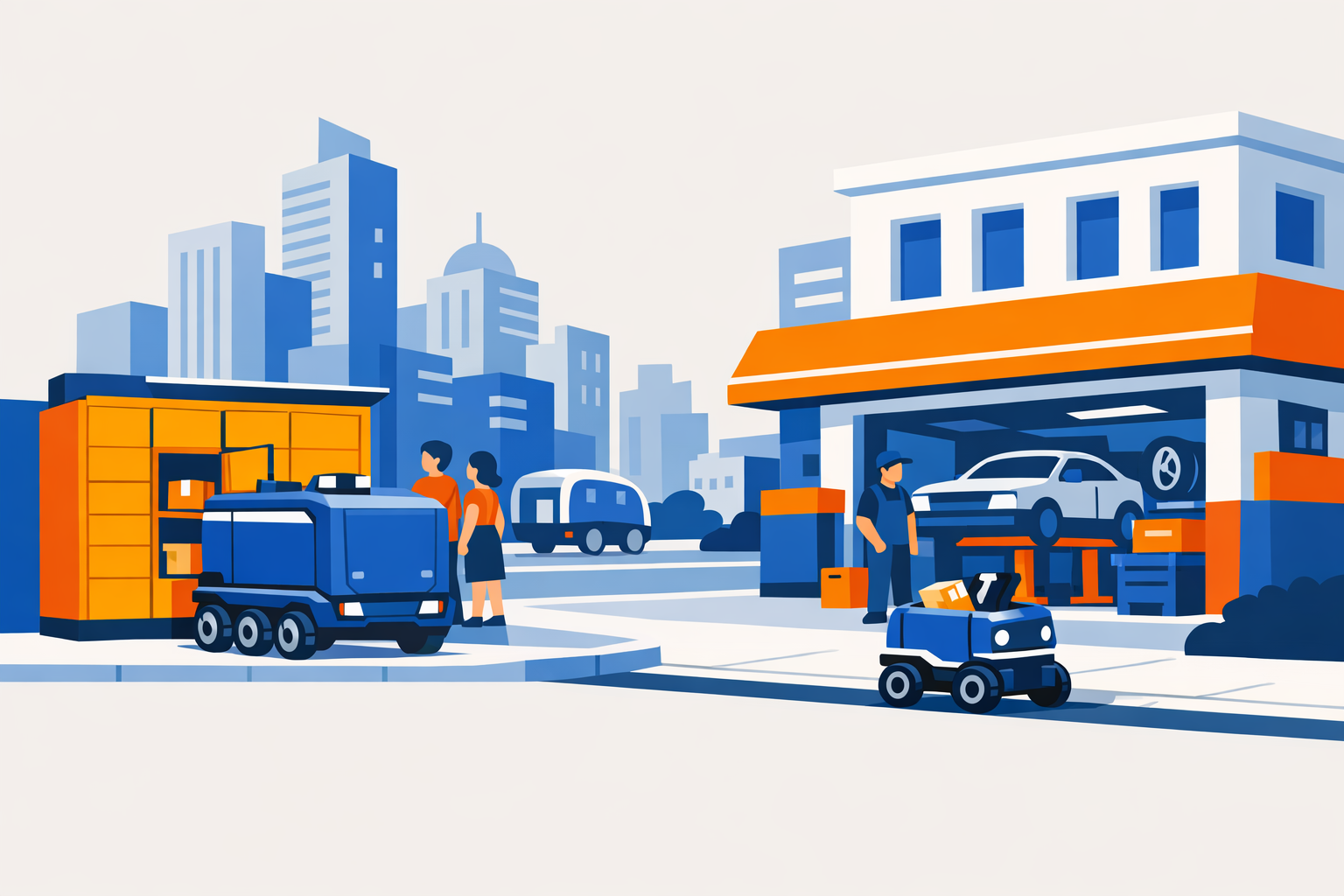
Autonomous delivery robots are moving beyond food and parcel delivery into automotive aftersales logistics. Pilot programs in dense urban markets signal a shift in how spare parts reach workshops and service centers in constrained city environments.
The growing adoption of delivery robots is a strategic response to mounting last-mile logistics pressures - a segment widely recognized as the most cost-intensive part of the supply chain, accounting for up to 28% of total transportation costs. For automotive aftersales operators, where parts availability directly affects vehicle downtime and workshop throughput, that cost burden has become a catalyst for robotic deployment.
Background
Between 2018 and 2025, autonomous delivery robots evolved from a novelty into a legitimate logistics category. A decade ago, only a handful of pilot programs existed. Today, robots operate in more than 80 cities across North America, Europe, and Asia, according to public company filings and municipal mobility registries.
Singapore has emerged as a key testbed. As a city-state of 5.9 million people with limited land area, Singapore has positioned itself as a robotics innovation hub and policy benchmark - a role backed by substantial government funding. The National Robotics Programme (NRP), a $635 million initiative (2022-2025) managed by the Economic Development Board (EDB), targets robotics deployment in construction, logistics, healthcare, and food and beverage sectors while funding R&D and providing adoption incentives for SMEs.
Self-driving ground robots now deliver in business and housing estates, with Singapore's regulatory sandboxes and dedicated testbed zones - such as one-north and Punggol Digital District - fueling uptake.
Details
The Singapore market has produced one of the most closely watched urban robotic delivery deployments. FedEx is working with QuikBot Technologies to introduce autonomous delivery robots across select commercial buildings, marking its first deployment of such technology in the country. The rollout follows a successful six-month pilot at South Beach Tower and Mapletree Business City, where the robots are now fully operational. Additional commercial clusters are expected to join the network by the end of 2025.
QuikBot's system comprises a long-distance autonomous robot called the "QuikFox," which stores goods in smart lockers, and a smaller robot, the "QuikCat," that handles shorter distances to complete final-destination drop-offs. According to QuikBot founder Alan Ng, the platform can deliver packages 30% faster and with 20% fewer emissions than conventional methods, according to claims reported by Fortune.
Ng identified labor scarcity as a primary driver: "We simply don't have enough manpower," he said, particularly in wealthier economies like Singapore, Japan, and Korea. QuikBot has begun scaling globally, currently expanding to Japan and the UAE, with plans to enter other Asia-Pacific cities including Hong Kong, Sydney, Melbourne, Incheon, and Seoul.
The ROI case for robotic deployment in parts logistics is strengthening. The Asia-Pacific service-robotics market was valued at approximately US$15.5 billion in early 2025 and is forecast to reach US$34.1 billion by 2030, according to Mordor Intelligence. The same report pegs average payback on autonomous mobile robots at under 2.5 years - a threshold drawing in mid-sized distributors.
Regulatory conditions, however, remain uneven. Pedestrian safety, infrastructure limitations, and unpredictable sidewalk conditions pose key challenges for operators seeking to scale. In the United States, low-speed, lightweight robot designs help navigate compliance, and purpose-built pods have received targeted regulatory exemptions, but sidewalk accessibility and right-of-way remain flashpoints. In Philadelphia, a City Council member stated, "If we are going to give these vehicles permission to drive on our sidewalks, then I think we need to regulate that a little bit more" - illustrating the political friction urban deployments increasingly encounter.
On the labor question, investors view the sector as a long-term complement to human delivery networks rather than a wholesale replacement. Hybrid models - where robots handle short loops and humans manage complex deliveries - are becoming standard. The global delivery robots market is projected to grow from approximately US$0.80 billion in 2025 to US$3.24 billion by 2030, at a compound annual growth rate of around 32.4%, according to market analyst estimates.
Outlook
Autonomous delivery robots have reached a new level of maturity. No longer experimental pilots or novelty applications, these systems are becoming a foundational layer of modern logistics infrastructure, accelerated by adaptive autonomy, real-time orchestration, and scalable compute. For automotive aftersales supply chains in land-constrained cities, Singapore's commercial and operational signals indicate that robotic last-mile delivery is transitioning from pilot to repeatable model. The next phase will depend heavily on whether municipalities develop clearer frameworks for sidewalk access and operational licensing before fleet scale outpaces policy.