The European Union is advancing its Digital Product Passport (DPP) framework into automotive packaging materials, imposing new data-verification and traceability obligations on vehicle manufacturers and their supply chains under two converging regulations - the Ecodesign for Sustainable Products Regulation (ESPR) and the Packaging and Packaging Waste Regulation (PPWR). With a central EU DPP registry set to launch in mid-2026 and mandatory battery passport requirements taking effect in February 2027, automotive OEMs and tier-one suppliers face an accelerating compliance timeline that demands structural changes to how packaging material data is collected, verified, and shared.
Background
The ESPR entered into force in July 2024, laying the groundwork for product-specific standards during 2025-2026.[1] In April 2025, the European Commission adopted its first ESPR Working Plan for 2025-2030, setting out priority product groups for future requirements. Separately, Regulation (EU) 2025/40, the Packaging and Packaging Waste Regulation, entered into force on 11 February 2025 and will generally apply from 12 August 2026, according to the European Commission. The two frameworks are directly linked: if a packaged product already carries a Digital Product Passport under Regulation (EU) 2024/1781 or other legislation, that same DPP must also provide the packaging-related information required by the PPWR.
The automotive sector sits at the intersection of nearly every major trend driving DPP adoption - electrification demands battery transparency, the circular economy requires improved end-of-life vehicle processing, and increasingly complex global supply chains need robust traceability. As the ESPR framework expands, the automotive industry faces some of the most comprehensive DPP obligations of any sector.
Details
The immediate compliance pressure centers on packaging registry infrastructure. The EU DPP Central Registry, maintained by the European Commission, is required to be operational before 19 July 2026, according to the ESPR text. The registry's launch gives manufacturers approximately seven months to begin registering product data before the February 2027 battery passport compliance deadline.
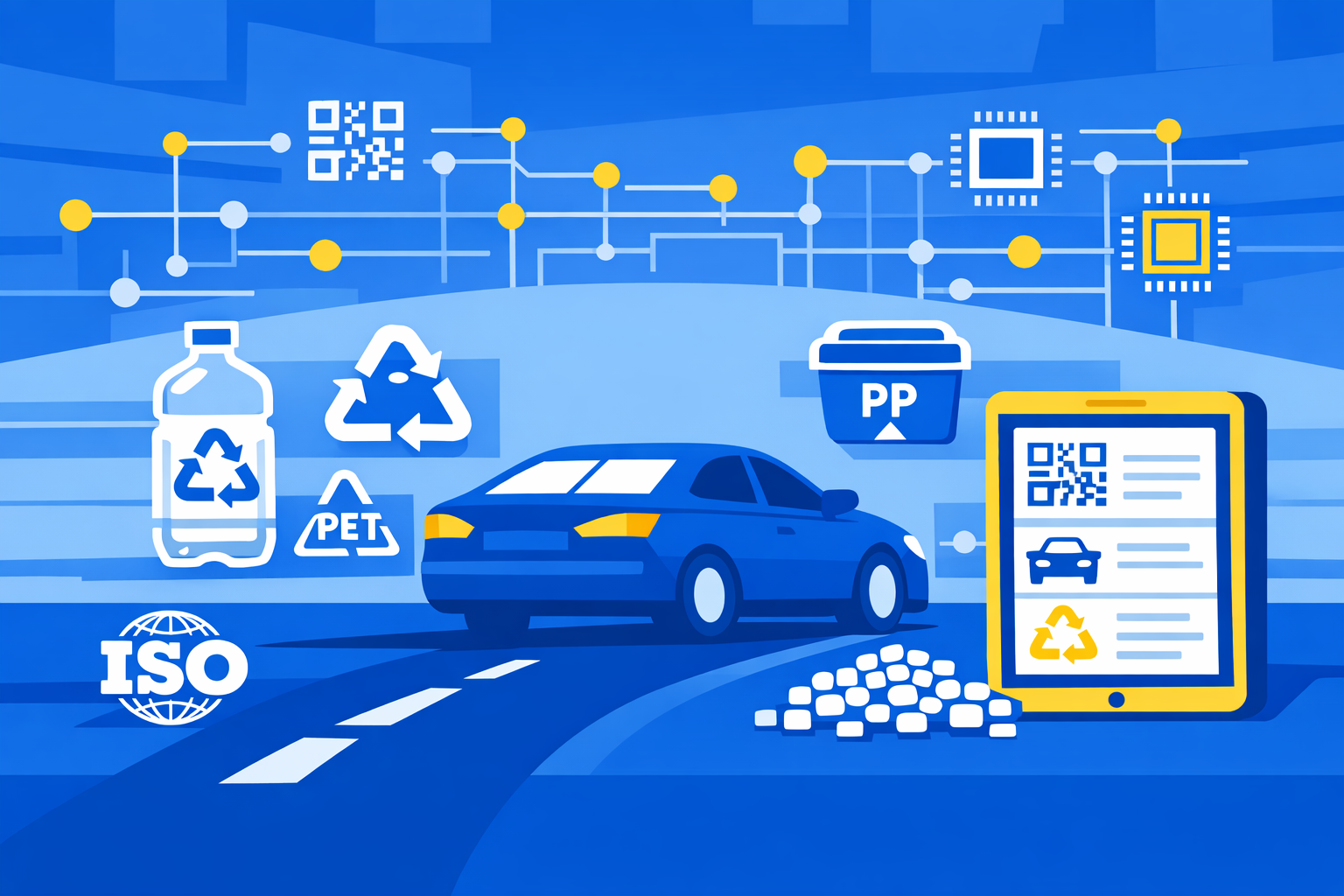
Under the combined ESPR and PPWR obligations, packaging producers and brand owners in the automotive supply chain must capture and digitize structured material data. Required information includes composition of packaging materials - plastics, paper, inks, and adhesives - origin and sourcing of raw materials, recycled content and recyclability performance, and environmental impact indicators including carbon data. This information will be linked to packaging through digital identifiers such as QR codes or RFID tags, enabling downstream users to access verified data.
For recycled-plastics content specifically, the PPWR sets escalating mandates. Under Regulation (EU) 2025/40, plastic packaging must include mandatory post-consumer recycled (PCR) content, with increasing targets for 2030 and 2040, according to the European Commission. Under the DPP, a recycled-content claim must be a documented, auditable percentage - not a marketing assertion.
The battery passport, piloted under Regulation (EU) 2023/1542, mandates digital data requirements for certain battery types from 18 February 2027. This serves as the model automotive packaging data standards are expected to follow. BASF, BMW, CATL, Henkel, Siemens, and Volkswagen Group co-founded the Path.Era consortium, a digital battery passport system designed to collect lifecycle data and streamline compliance reporting, according to Manufacturing Digital. George Kazantis, Vice President of Automotive Components at Henkel, stated: "The transparency we create for the battery industry with DBPs is just as relevant for other industries. For us, the Path.Era battery passport is the blueprint for the future of DPPs."
On the certification pathway for DPP service providers, in April 2025 the European Commission launched a public consultation on the first delegated act setting out requirements that providers must meet to become certified. In August 2025, the Commission published a final summary report that will form the basis for the upcoming delegated act.
Supply chain readiness remains uneven. Companies need systems capable of collecting, validating, and sharing detailed material data across multiple supplier tiers. Smaller suppliers may face particular challenges meeting new data requirements, while larger manufacturers are already investing in digital infrastructure to integrate with customer and regulatory systems. A typical automotive or electronics manufacturer sources from 500 to 5,000 direct suppliers across 30 to 50 countries, compounding data-capture complexity. Supply chain traceability data preparation typically requires 12 to 18 months.
The industry-led Catena-X data ecosystem is emerging as a principal interoperability platform. As the EU and other regions mandate Digital Product Passports by 2027, Catena-X provides an open, standardized, vendor-agnostic foundation connecting manufacturers, suppliers, and service providers in a secure dataspace - allowing companies to generate and share verifiable product data across tiers while reducing compliance costs.
Outlook
Between 2028 and 2030, the passport requirement is expected to extend to additional sectors, potentially including packaging and plastics, chemicals, machinery, furniture, and other consumer goods.[2] For automotive transport packaging specifically, industry analysts describe the August 2026 PPWR application date as a preparation milestone rather than a final compliance event. The PPWR mandates a data carrier on packaging from 2028 and a Declaration of Conformity from 2026, both of which interoperate naturally with DPP infrastructure. For manufacturers already preparing DPPs for products under the ESPR, extending the same data model to packaging avoids duplicate work. The European Commission is expected to release additional delegated acts defining sector-specific DPP data fields through 2027 and 2028, with the ISO/IEC Joint Technical Committee 5 on Digital Product Passports, announced on 20 April 2026, expected to deliver the global standards framework from 2028, according to Fiegenbaum Solutions.