A single vehicle produced for the global market can contain more than 150 kilograms of plastic. Plastic demand in cars represents roughly 10% of total plastic demand in the EU, placing automotive third behind only packaging and building and construction. Yet more than 80% of plastics reaching end-of-life in automotive currently end up landfilled or incinerated.
That figure is now at the center of two diverging regulatory projects: a patchwork of US state-level certification and Extended Producer Responsibility (EPR) programs pushing recycled-content mandates into the supply chain, and the European Union's Digital Product Passport (DPP) framework reshaping what material traceability means for every component in a vehicle. For automakers, tier suppliers, and packaging partners sourcing across both markets, the regulatory distance between Brussels and Sacramento is narrowing - but the road is far from straight.
The US Landscape: State-Led Momentum Without a Federal Floor
The United States has no unified federal framework for recycled-content mandates in automotive plastics. Instead, manufacturers are navigating an expanding patchwork of state-level rules with varying scope, thresholds, and timelines.
As of mid-2025, five states have passed laws requiring post-consumer recycled (PCR) content in plastic packaging. Seven states now have Extended Producer Responsibility legislation for packaging in place, according to the Sustainable Packaging Coalition. California, Oregon, Colorado, Minnesota, Maine, Maryland, and Washington lead the field.
Most state laws focus on packaging rather than durable automotive interior components. However, the mechanisms being built - supplier certification requirements, PRO reporting, eco-modulated fee structures - are directly relevant to interior material procurement as regulatory scope expands.
The APR PCR Certification Program, or similar third-party certification, is required for aspects of compliance in several states. This affects stakeholders across the PCR supply chain: reclaimers need third-party certification on PCR pellet and flake, packaging manufacturers need PCR certification on final packaging, and brand companies are ultimately held responsible for compliance.
The American Chemistry Council has flagged a critical alignment opportunity. EU requirements are driving development of tools and data sources - including the automotive industry's International Material Data System (IMDS) - that could inform North American regulations. Leveraging this investment would benefit the automotive industry and durable plastics suppliers by driving consistency for global companies.
State-level momentum is real, but so is the risk of regulatory fragmentation. A Tier 1 supplier managing eight state registrations, each with different recycled-content thresholds and reporting formats, faces an administrative burden that centralized EU regulation does not impose.
The EU Framework: DPP and the End-of-Life Vehicles Regulation
The EU's regulatory architecture for automotive plastics rests on two interlocking pillars: the Ecodesign for Sustainable Products Regulation (ESPR), which introduces the Digital Product Passport, and the newly agreed End-of-Life Vehicles Regulation (ELVR).
The Digital Product Passport
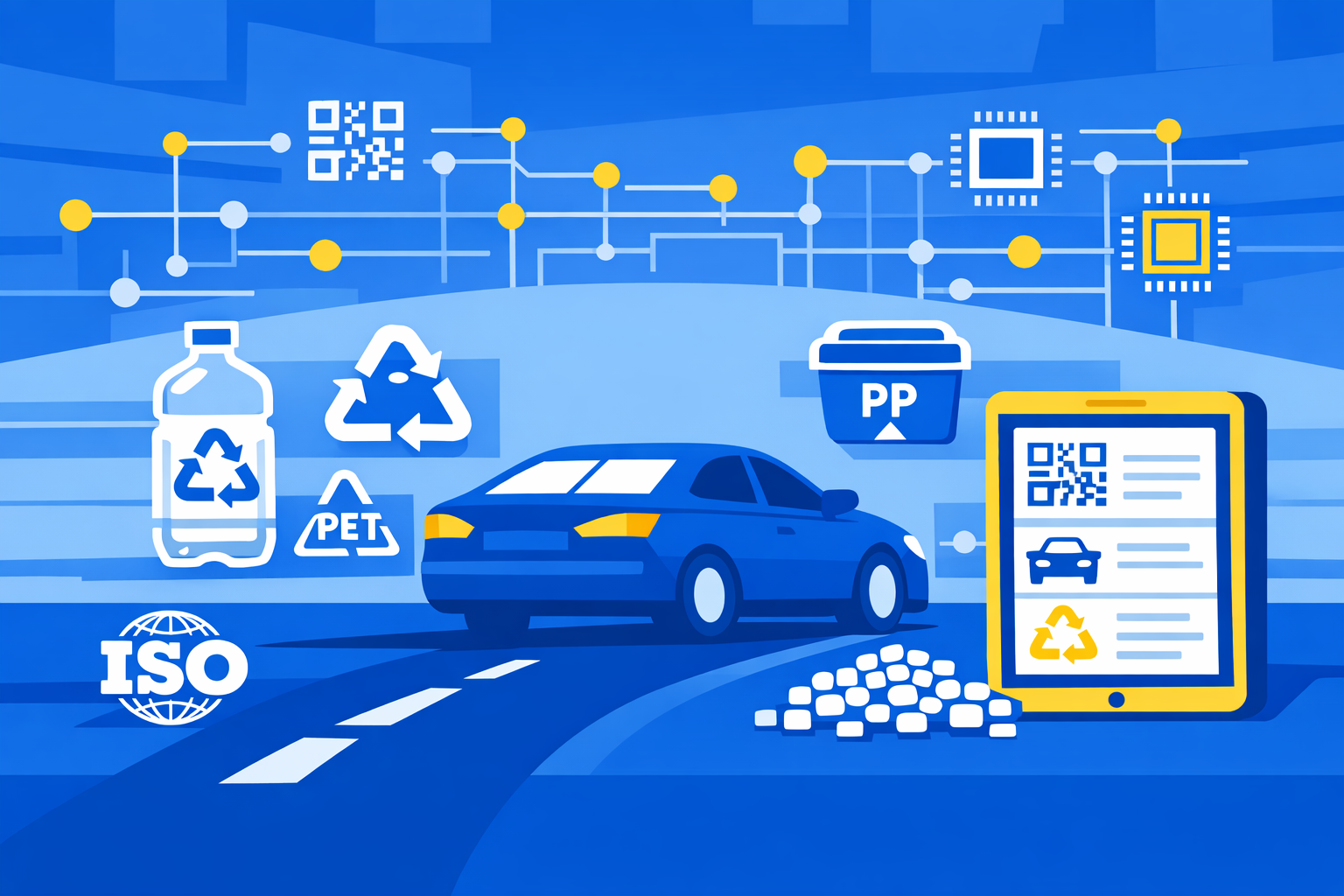
The Ecodesign Regulation came into force in July 2024, paving the way for product-specific standards during 2025-2026. A product's digital passport is a "digital identity card" accompanying every product, component, or material marketed in the EU. Using a data carrier such as a QR code, barcode, or electronic tag, it stores data on the product's origin, materials and manufacturing processes, use and maintenance, and end-of-life management.
For automotive interior materials specifically, starting in mid-2025 manufacturers must embed detailed material data into components through mandatory digital product passports. These passports list polymer types following ISO 1043, additives and fillers, joining methods, and end-of-life handling instructions. This level of traceability helps improve sorting and recycling automation, supports circular supply chains, and aids regulatory audits.
The DPP serves as a digital reference system for products and components, containing data on composition, origin, environmental footprint, repair and upgrade paths, recyclability, and end-of-life instructions. It enables value-chain traceability, supports regulatory enforcement, and enhances consumer transparency.
Battery passports represent the most immediate hard deadline: in February 2027, the digital passport requirement takes effect for industrial, automotive, and portable batteries placed on the market. Automotive interior plastics and related components are expected to follow under product-specific delegated acts, with chemicals, plastics, lubricants, paints, and detergents potentially included in later phases due to their environmental risk.
The End-of-Life Vehicles Regulation (ELVR)
In December 2025, EU co-legislators reached a provisional agreement on the ELVR - Europe's first mandatory recycled-content targets for plastic in vehicles. The plastic used in each new vehicle type must contain a minimum of 15% recycled plastic within six years of the rules' entry into force, and 25% within ten years. Of these targets, 20% must be achieved by including plastics recycled from end-of-life vehicles or from parts and components removed during the use phase - a "closed loop" requirement.
Rules on recycled content apply to both vehicles manufactured in the EU and those imported from outside it - a provision with direct implications for US, Korean, and Japanese OEMs assembling vehicles for European sale.
"Recycled content mandates are expected to be met primarily through recycled polyolefins, supported by the wider availability of suitable waste feedstocks compared with other polymers used in the automotive sector," according to ICIS Plastic Recycling Analyst Mia McLachlan. ICIS previously estimated that 0.5 to 0.6 million tonnes of recycled polyolefins would be required by 2040, with the majority supplied by recycled polypropylene, a key polymer in automotive components.
For interior applications, certain components - mono-material polypropylene interior parts, for example - present more straightforward challenges for introducing recycled content.[1] Mixed-material assemblies such as dashboards, door trims, and headliners combining foams, adhesives, and multiple polymer types pose a harder problem for both certification and DPP data completeness.
Compliance Pathways: What Firms Must Track
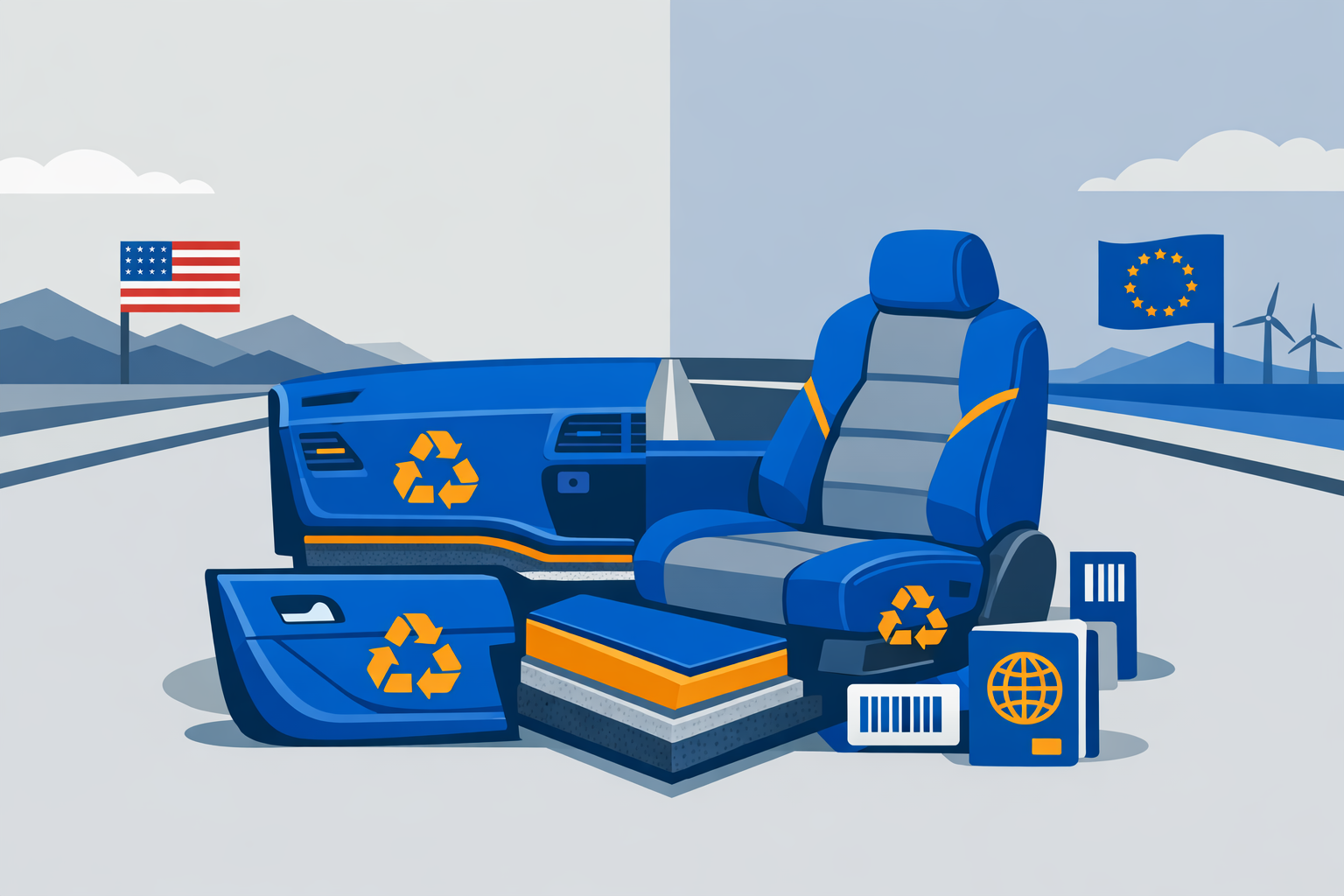
The table below summarizes the key structural differences procurement and regulatory affairs teams must manage simultaneously.
| Dimension | US State Frameworks | EU ELVR + DPP Framework |
|---|---|---|
| Governing instrument | State-level EPR laws & PCR mandates (CA, OR, CO, MN, WA, ME, MD) | End-of-Life Vehicles Regulation + ESPR / DPP |
| Recycled content target | Varies; typically 15-25% PCR for packaging plastics | 15% per vehicle type (6 yrs); 25% at 10 yrs |
| Closed-loop requirement | Not universally mandated; eco-modulated fees incentivize it | 20% of recycled content from ELV closed-loop streams |
| Traceability tool | APR PCR Certification / SCS Global / ISO 14021 | Digital Product Passport - machine-readable, lifecycle-linked |
| Data format standard | Supplier declarations, audit docs; no unified digital format | GS1 Digital Link / JSON-LD; interoperable with EU customs & ECHA |
| Interior plastics scope | Primarily packaging; durable automotive interiors not yet widely covered | All plastic components in vehicle type; ISO 1043 polymer labeling |
| Penalty mechanism | Eco-modulated PRO fees; fines vary by state | Market access denial; CE marking at risk; member-state penalties |
| Key near-term deadline | CA/OR packaging data reporting by mid-2026; MN full plan by 2028 | Battery DPP mandatory Feb 2027; ELVR phased 2030-2036 |
Key deadline alert: EU battery passports become mandatory from February 2027, while automotive-specific DPP delegated acts are expected through the ESPR working plan from 2027-2030. US OEMs and tier suppliers selling into both markets should begin data architecture investments now - not at the point of mandate.
The compliance asymmetry creates specific risk points:
- Supplier qualification gaps: A supplier certified under APR PCR norms may lack DPP-compatible data schemas, and vice versa. Dual-qualification audits add time and cost to procurement cycles.
- Data integrity across tiers: OEMs use product lifecycle management (PLM) systems with recyclability assessment tools, while manufacturing execution systems (MES) link polymer data for each batch to digital passports. This setup enables clear material tracking through the process. Tier 2 and Tier 3 suppliers lacking these systems represent the weakest link in traceability chains.
- Mid-model-cycle supply disruption: Recycled-content specifications embedded in parts drawings can become bottlenecks if certified PCR resin supply tightens. As imported recycled plastic has become cheaper over the past year, some companies are shifting toward imported recycled plastic over domestically recycled material - a trend that complicates closed-loop ELV compliance.
Supply Chain Implications: Procurement Cycle Pressure
The practical impact on procurement cycles is already visible. Stakeholders across the automotive supply chain must collaborate to enable adoption of these plastics at larger scale. Key challenges include material availability, variable material properties in some cases, and costs.[2]
Leading OEMs are acting ahead of mandate. Stellantis plans to use 40% recycled content in vehicle plastics by 2030, partnering with European recyclers to source post-consumer polypropylene and polyamide compounds. The company is focusing on non-visible structural parts like battery trays and underbody shields, with full traceability and compliance. Volkswagen and BMW are incorporating bio-based polymers into vehicle interiors, meeting EU emissions standards without compromising performance or design integrity.
For tier suppliers and packaging partners, the message from the American Chemistry Council is clear: automotive OEMs should include recycled content standards as part of their material certification process, informed by market analysis to define segments that place premium value on recycled content. Such standards should provide allowances for certain additives and other trace chemicals in durable goods that can be recycled, creating a policy "on-ramp" for durable automotive plastics recycling.
The complexity of multi-material assemblies adds further pressure. Recycling automotive components is often complicated by multi-material construction - seats, doors, instrument panels, and headliners that include adhesives, webs, foams, and other materials. Certification of recycled content in such assemblies requires disaggregated data that most current supplier documentation systems do not automatically generate.
For broader context on how EU rules are reshaping packaging across automotive logistics, see earlier coverage of EU and North American interim recycled-content benchmarks and how US auto EPR rules are driving recycled content strategy shifts.
Five Steps to Cross-Border Compliance Readiness
Step 1 - Map your plastics inventory against both regulatory frameworks Conduct a component-level audit of all interior and exterior plastic parts, categorizing by polymer type (ISO 1043), recycled content percentage, and post-consumer vs. post-industrial source. Flag every component sold into both US and EU markets.
Step 2 - Qualify suppliers to dual-certification standards Require recycled-content certification under both APR PCR Certification or ISO 14021 for US compliance, and traceability data compatible with EU DPP data schemas. Insert audit-cycle clauses and certification-lapse provisions into supplier contracts before the next program award.
Step 3 - Build a data architecture that feeds both regimes Implement a PLM or MES system that captures batch-level polymer data and can export to both US state PRO reporting portals and EU DPP-compatible formats (GS1 Digital Link / JSON-LD). When built on structured data standards like GS1 Digital Link, DPPs streamline information management and reporting across international supply chains.
Step 4 - Assess warranty and liability exposure Recycled-content claims tied to component specifications create warranty risk if certified content becomes unavailable mid-model cycle. Legal review of supplier contracts should address supply-disruption remedies and specification tolerances for recycled content variability.
Step 5 - Monitor harmonization developments Track IMDS updates and USTR-EC bilateral developments that could align testing or mutual recognition of certification bodies. Early adoption of harmonized data formats reduces future re-platforming costs - particularly as EU data interoperability requirements under the DPP give manufacturers, recyclers, market surveillance authorities, and consumers access to critical sustainability and product information, with interoperability essential across EU digital systems including customs databases and ECHA.
Forward Outlook: Will Harmonization Close the Gap?
Divergence today does not mean permanent divergence. Several structural forces point toward eventual convergence:
- The IMDS already serves as a shared material data platform for OEMs across North America and Europe. Expanding its scope to carry DPP-compatible recycled-content data would significantly reduce double-entry costs.
- The EU ELVR's import neutrality provision - applying the same recycled-content standards to vehicles assembled outside the EU - creates a direct commercial incentive for US OEMs to build DPP capability regardless of state-level mandates.
- The digital product passport will ensure value-chain traceability after a product has been placed on the market. This could boost voluntary deployment of traceability solutions, stimulating market development and promoting sustainable trade beyond EU borders.
The more immediate risk is that compliance becomes a competitive differentiator before it becomes a legal floor. OEMs and suppliers that invest in data infrastructure and dual-certified supply chains now will face lower switching costs and shorter time-to-compliance when mandates tighten. Those waiting for a unified standard may find themselves managing emergency re-qualification at the worst possible point in a model cycle.
The paths may be diverging today. But they are heading toward the same destination.