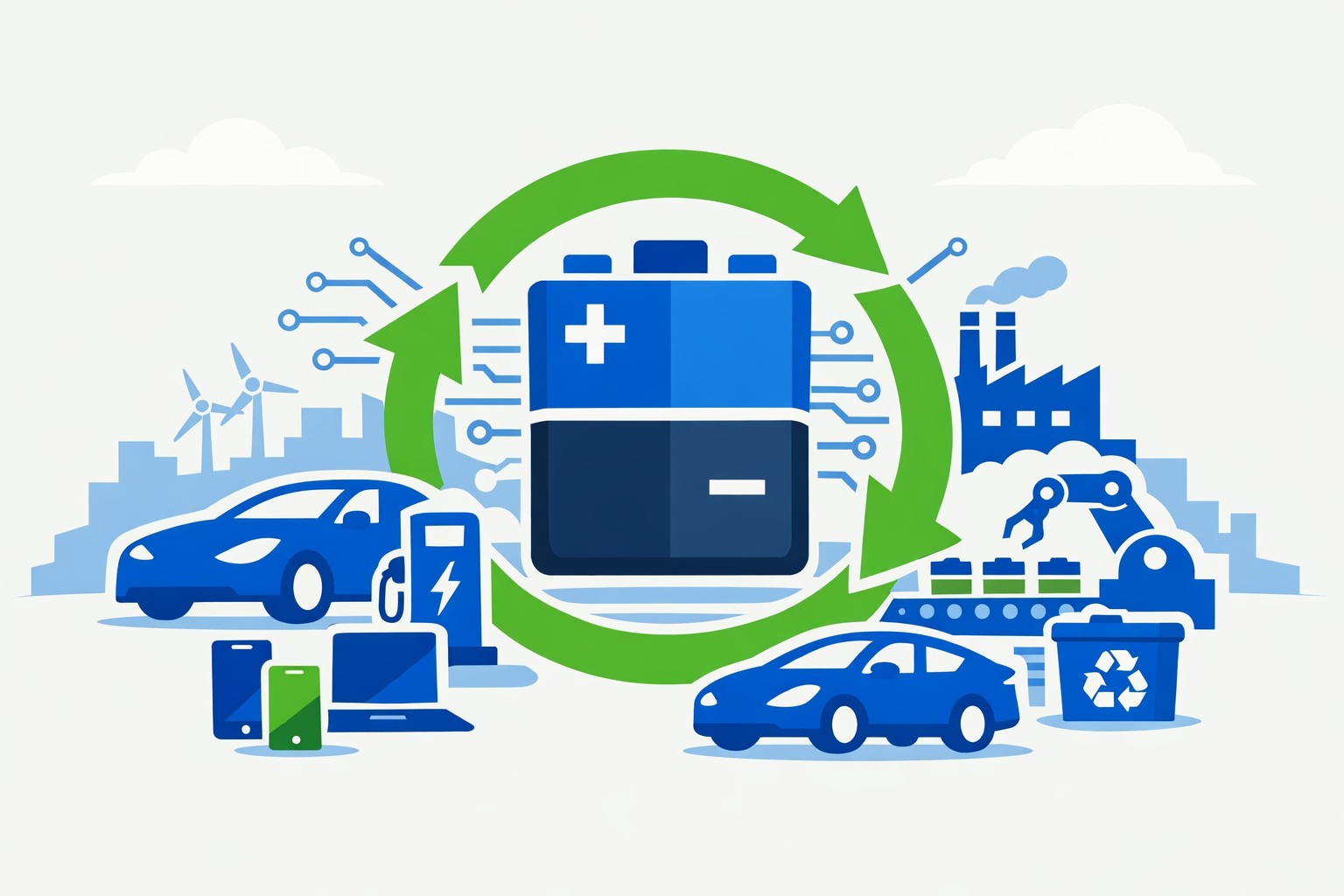
The U.S. Environmental Protection Agency is developing a national extended producer responsibility (EPR) framework for all battery types-spanning consumer, automotive, and electric vehicle chemistries-in a move set to reshape how manufacturers, recyclers, and supply chain operators manage end-of-life battery materials.
Mandated under the Bipartisan Infrastructure Law, the framework covers all battery chemistries, including lithium-based, nickel-metal hydride, and alkaline, and applies to small, mid-format, and large-format batteries used in EVs, hybrid vehicles, energy storage systems, and industrial applications. The initiative is being developed jointly with the U.S. Department of Energy (DOE) and is expected to be published in summer 2026, accompanied by a formal Report to Congress.
Background
The federal effort responds to a growing and fragmented landscape of state-level battery recycling laws. Ten states and Washington, D.C. have passed EPR laws specifically for portable and rechargeable batteries, according to EPA's Battery Collection Best Practices Report to Congress. States have moved at varying paces and with differing requirements: in December 2023, New Jersey became the first state to create a framework specifically for collecting and recycling EV and hybrid vehicle batteries, making manufacturers responsible for battery stewardship under a formal plan.
In 2025, the pace of state-level legislation accelerated. Nebraska, Colorado, and Connecticut each passed new EPR legislation in 2025 for certain batteries and battery-containing products, requiring covered producers and retailers to join and fund battery stewardship organizations, according to legal analysts at Hunton Andrews Kurth. Illinois also enacted a statewide EPR program for portable and mid-format batteries, taking effect January 1, 2026.
The scale of the underlying problem is significant. According to EPA data cited in its July 2025 webinar, one EPA report found 64 waste facilities that experienced 245 fires from 2013 to 2020, with over 50 percent of materials recovery facilities reporting fires caused by batteries improperly placed in curbside recycling bins.
Framework Details
The EPA and DOE launched the EPR framework development process on April 7, 2025, with a kickoff virtual conversation covering guiding principles and elements applicable to all battery formats. Subsequent working sessions followed: on July 17, 2025, EPA and DOE hosted a focused session on small and mid-format battery recycling goals, performance measures, and reporting requirements. On June 17, 2025, EPA held a separate session on expanding end-of-life management for large-format batteries, including recycling and refurbishing.
For purposes of the large-format track, EPA defines large-format batteries as rechargeable batteries over 25 pounds, typically used in electric, hybrid, and internal combustion engine vehicles, motive equipment, and stationary energy storage systems.
According to EPA, the framework is not intended to serve as model legislation for states but rather to provide a high-level reference on design, collection, reporting, and regulatory considerations that could inform battery EPR programs. The initiative will not displace existing state EPR programs, but will instead provide current best practices to support state program design and promote consistency across jurisdictions, according to legal analysts tracking the development.
The Bipartisan Infrastructure Law requires the framework to address battery recycling goals, cost structures for mandatory recycling, reporting requirements, product design, collection models, and transportation of collected materials. The framework also targets domestic supply chain resilience: EPA states it will support U.S. goals of reducing dependence on foreign energy sources by increasing the recycling and recovery of critical minerals.
On the federal investment side, the DOE's Battery Materials Processing and Battery Manufacturing and Recycling Grant Program, under Section 40207 of the Infrastructure Investment and Jobs Act, announced a third funding round of up to $500 million in August 2025, with individual awards anticipated to range from $50 million to $200 million and a required 50 percent cost share from recipients.
Despite growing activity, collection gaps persist. Fewer than 15 percent of U.S. lithium-ion batteries are currently recycled, due to inconsistent collection systems and limited recycling infrastructure, according to the Environmental and Energy Study Institute.
Outlook
EPA expects to publish the completed EPR framework and submit its accompanying Report to Congress in summer 2026. Program specialists from California, Illinois, and New York participated in an EPA webinar in February 2026, sharing implementation experiences that EPA described as reflecting a range of collection and enforcement approaches across early-adopter state programs.
For automakers and battery manufacturers, the framework's publication will serve as a key reference point for aligning internal compliance programs, even as individual state obligations continue to evolve on separate timelines. Supply chain and operations teams managing EV battery end-of-life logistics should monitor the forthcoming Report to Congress for EPA's formal next-step commitments.