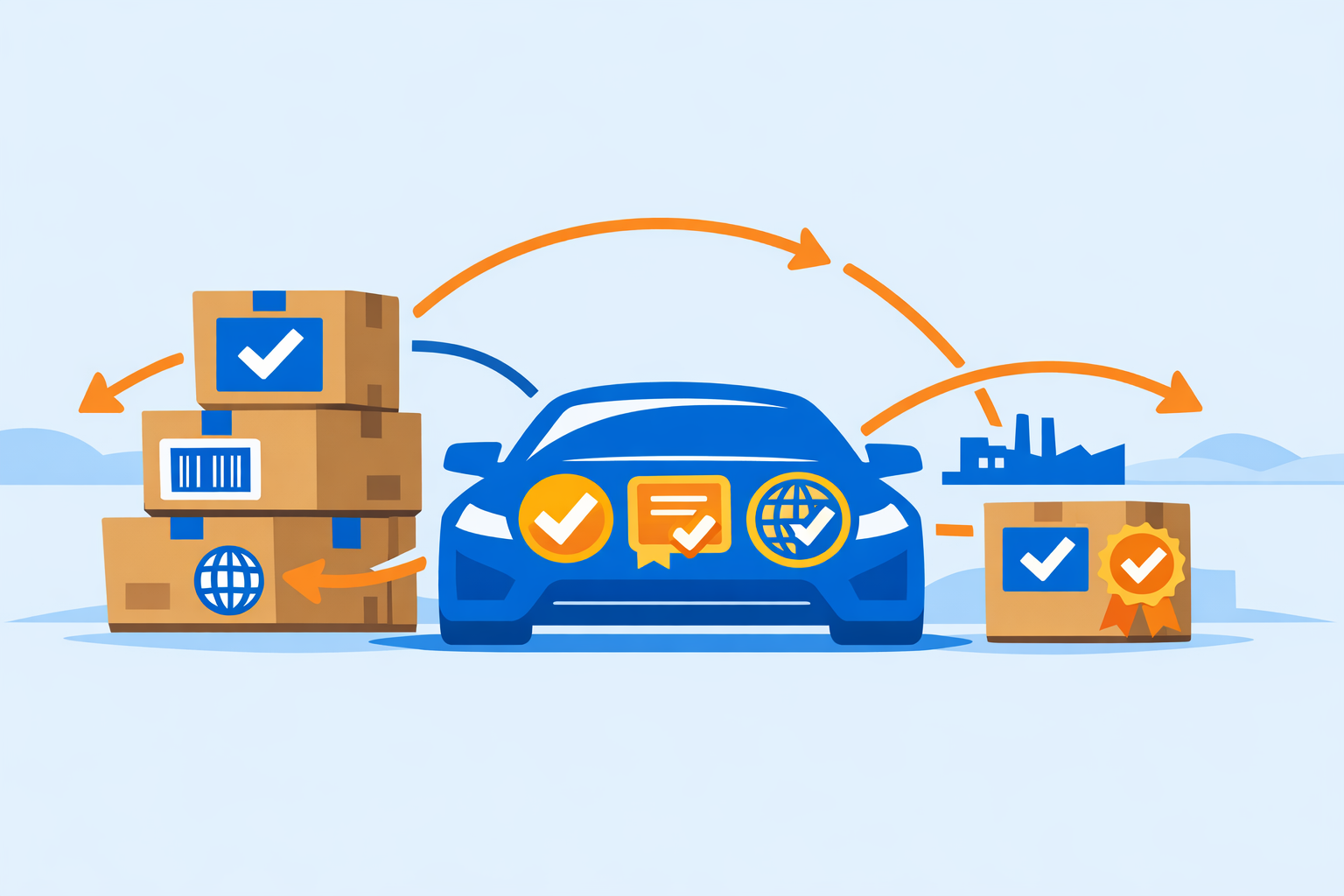
Automotive OEMs and their suppliers face mounting pressure to embed ethical sourcing disclosures directly into packaging labels and supplier contracts, as tightening cross-border regulations and consumer expectations for supply chain transparency converge across major markets.
The shift is driven by a combination of legislative mandates, ESG frameworks, and demand for third-party certification marks on packaging - forces collectively rewriting how the automotive sector governs labeling across its global supply tiers.
Background
The automotive supply chain ranks among the most complex in global manufacturing, spanning thousands of companies across more than 70 countries, according to the Automotive Industry Action Group (AIAG). AIAG's membership comprises more than 4,000 companies in over 70 countries, all subject to varying national labeling and sourcing disclosure rules.
Regulatory pressure has escalated significantly. The EU's Corporate Sustainability Due Diligence Directive (CSDDD) and the US Uyghur Forced Labor Prevention Act mandate that companies identify and mitigate forced labor and unethical sourcing risks throughout their supply chains, according to sourcing compliance platform Ivalua. These requirements increasingly extend to packaging documentation and label content, particularly for components made with minerals such as cobalt, tin, tantalum, tungsten, and gold.
Suppliers of automotive components are now expected to declare compliance with Dodd-Frank Act Section 1502 regarding tin, tantalum, tungsten, and gold sourcing origin. These disclosures are migrating onto shipping labels and packaging specifications as procurement teams seek audit-ready documentation.
The global automotive labeling market is projected to expand from USD 9.53 billion in 2025 to USD 17.24 billion by 2035, a CAGR of 6.11%, driven by increasing vehicle production, stricter safety labeling regulations, and rapid electric vehicle adoption.
Details
Cross-border labeling compliance remains a central operational challenge. Each country's regulatory framework reflects a balance between international harmonization and domestic priorities, creating a landscape where seemingly identical products require distinctly different labeling approaches across borders. For automotive suppliers servicing customers across North America, Europe, and Asia simultaneously, this means maintaining multiple classification systems and label formats - multiplying both compliance costs and error risk.
Loftware's annual labeling and packaging report found that 85% of companies have experienced business losses due to non-compliance. 58% of surveyed companies reported significant fines or penalties, underscoring the importance of regulatory compliance in labeling.
Industry standards bodies are updating frameworks to reflect the expanded scope of disclosure requirements. AIAG's Automotive Industry Guiding Principles set expectations for business ethics, working conditions, human rights, health and safety, environmental leadership, and supply chain due diligence across all supplier tiers. The revised Guiding Principles now include sections on circularity, carbon neutrality, animal welfare, biodiversity, land use, and deforestation - all categories that may generate labeling claims or supplier contract conditions.
On the certification side, organizations are engaging with external partners such as industry groups, NGOs, and certification bodies to validate sustainability claims through third-party certifications including Fair Trade, FSC, and ISO 20400. The global ethical label market was valued at USD 1,082.66 billion in 2025 and is anticipated to reach USD 2,096.16 billion by 2035, growing at a CAGR of 6.83%, reflecting rising demand for certified sourcing transparency across industries, including industrial and automotive segments.
IATF 16949 Rules 6th Edition took effect in January 2025, introducing stricter audit requirements and oversight mechanisms for automotive packaging label suppliers at Tier 1 and Tier 2 levels. Common rejection reasons for non-compliant automotive labels include barcode quality failures, incorrect data format, wrong label size, and missing required fields.
To ensure ethical practices and legal compliance in supply chain operations, AIAG advises incorporating specific conditions into supplier contracts that mandate adherence to human rights standards and enforce rigorous due diligence to prevent forced labor violations.
Outlook
Stricter regulations, including the EU Corporate Sustainability Due Diligence Directive and the US Uyghur Forced Labor Prevention Act, require companies to identify and mitigate supply chain risks - a compliance burden that packaging and labeling teams will need to operationalize at the product level. Suppliers that fail to align label content and contract language with evolving disclosure standards risk shipment rejections, regulatory penalties, and reputational damage in markets where ethical sourcing verification is becoming a procurement prerequisite.
Industry bodies are expected to issue additional cross-border harmonization guidance through 2026, as automotive OEMs and their packaging suppliers work to reconcile regional divergences in ethical sourcing disclosure requirements within standardized label frameworks.