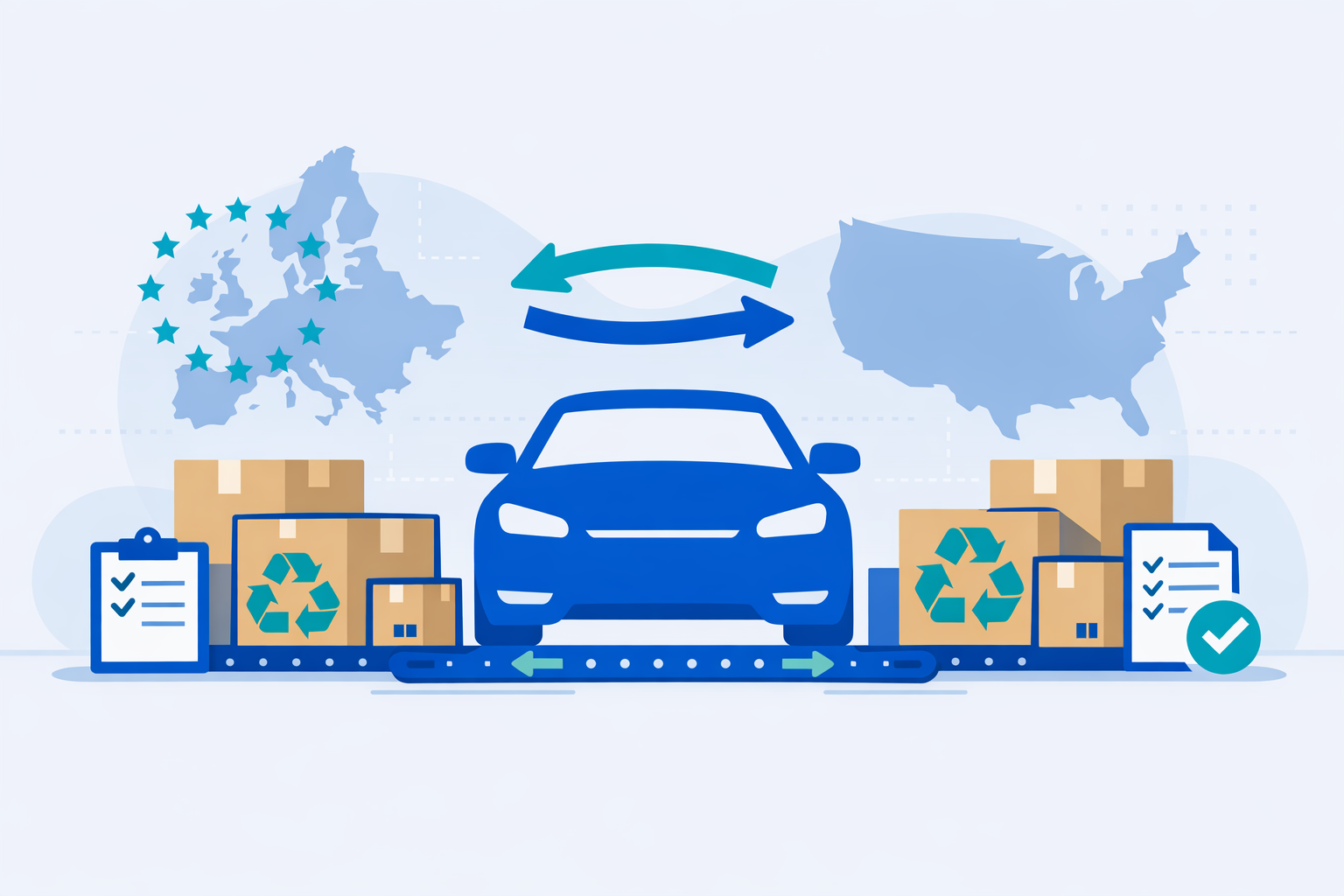
Converging packaging sustainability regulations in the European Union and the United States are compelling automotive original equipment manufacturers (OEMs) and their tier suppliers to revise cross-border contracts and overhaul packaging procurement ahead of enforcement deadlines beginning in August 2026. The EU's Packaging and Packaging Waste Regulation (PPWR), Regulation (EU) 2025/40, is the central driver, while a fragmented but accelerating state-level EPR framework in the US adds parallel compliance pressure on suppliers operating across both markets.
Background
The European Union formally adopted Regulation (EU) 2025/40, commonly known as the PPWR.[1] It entered into force on February 11, 2025, and will generally apply starting August 12, 2026.[2] The PPWR replaces the long-standing EU Packaging Directive with a single, harmonized legal framework across all Member States.[3] Unlike its predecessor, which gave member states significant latitude in transposing rules into national law, the PPWR applies directly and uniformly - meaning automotive packaging entering any EU market must comply without variation.
With the PPWR entering into force, California's SB 343 redefining recyclability claims, and state EPR programs advancing, companies face a rapidly evolving regulatory landscape. Seven US states have enacted packaging-specific EPR laws, all requiring producers to join a producer responsibility organization (PRO), report data, and begin paying fees on varying timelines. For automotive suppliers with cross-border operations, compliance is no longer a single-jurisdiction task.
Details
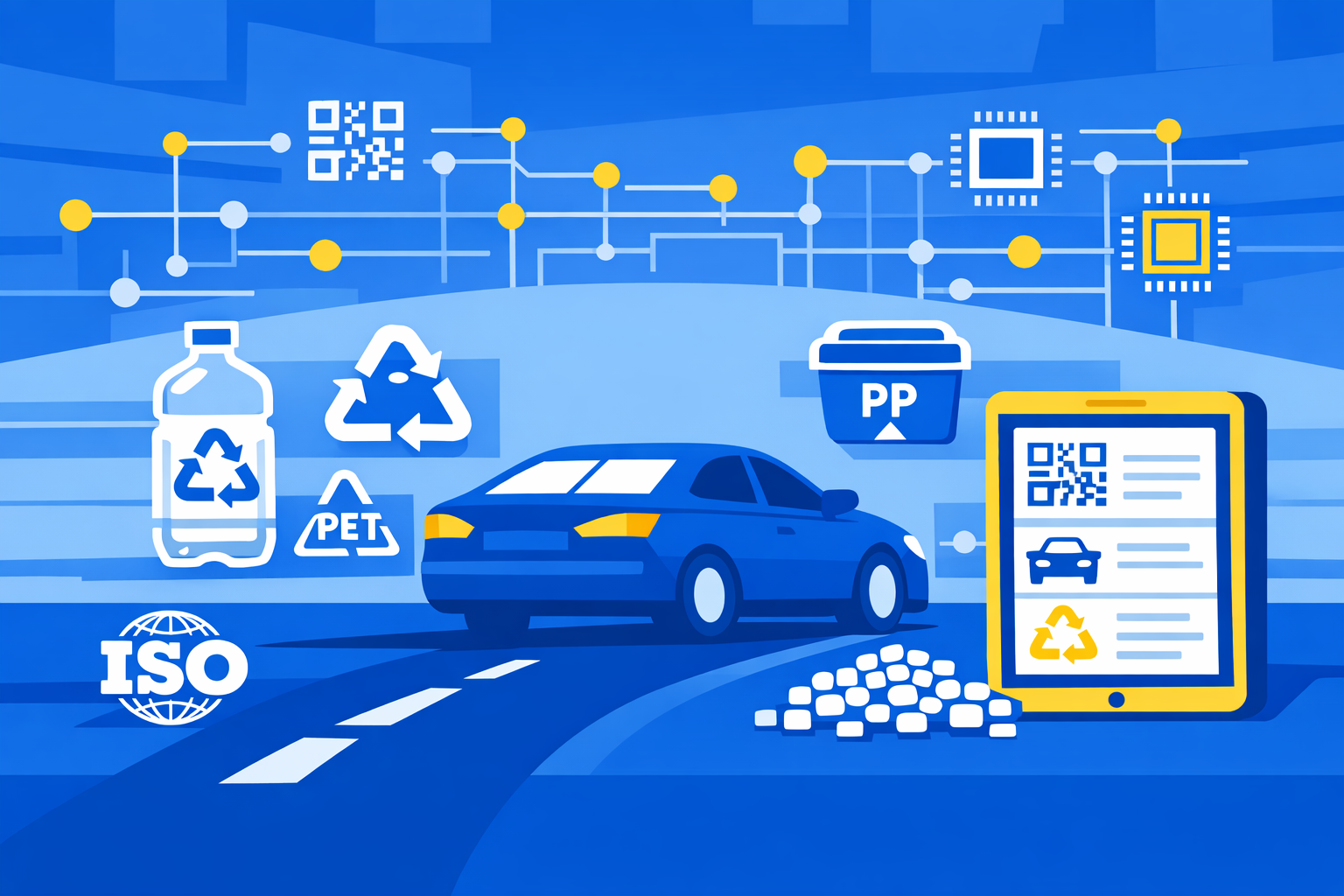
The EU regulation introduces staggered obligations that packaging professionals in automotive supply chains must plan for now. Several detailed requirements - particularly around labeling, recyclability, recycled content, and reuse - will phase in between 2026 and 2030 and beyond.[4] From August 12, 2026, initial obligations take hold: Regulation (EU) 2025/40 requires manufacturers and importers to maintain technical documentation and issue declarations of conformity for all packaging placed on the EU market from August 12, 2026, according to EUR-Lex. Companies must substantiate recycled content claims through documented supply chain evidence, not merely marketing assertions, introducing new data management and supplier engagement obligations - particularly for businesses sourcing packaging globally.
The regulation's most consequential targets for automotive packaging arrive at the decade mark. From January 1, 2030, the PPWR mandates minimum recycled content thresholds of 30-35% post-consumer recycled (PCR) plastic in most packaging types, with targets escalating to 65% by 2040, according to the European Commission. For non-beverage plastic packaging, the threshold is 35% by 2030, rising to 65% by 2040. All packaging must achieve at least Grade C recyclability by January 1, 2030, and Grade B or above by January 1, 2038, where Grade A equals ≥95% recyclable, Grade B ≥80%, and Grade C ≥70% per unit by weight. In 2026, the EU is scheduled to set recycled content calculation methods; by 2027, standards for packaging minimization and reusability will be adopted; and recyclability performance grades will be enforced from 2028.
Traceability poses specific operational demands for automotive suppliers. By December 31, 2026, the European Commission must adopt implementing acts establishing the methodology for assessing, verifying, and certifying - including through third-party audit - the equivalence of rules where recycled content is collected or recycled in a third country. The PPWR's verification methodology may include mandatory independent third-party audits on manufacturers of recycled content placed on the EU market, according to Regulation (EU) 2025/40. This will require automotive OEMs to cascade documentation requirements down to sub-tier suppliers, particularly those operating outside the EU.
On the US side, the EPR landscape directly affects automotive packaging suppliers, though without a unified federal mandate. What changes in 2026 is the level of accountability: many states are moving beyond registration into active reporting, fee collection, and oversight, with fees increasingly tied to packaging weight, material type, and recyclability. For Colorado and Oregon, producer supply reports based on 2025 data are due May 31, 2026, with EPR fee invoices from the Circular Action Alliance planned for January and July 2026. In Maryland, producers must register by July 1, 2026. The bipartisan Recycled Materials Attribution Act was introduced in the US House of Representatives in February 2026, aiming to establish federal standards for recycling and recycled content marketing claims.
For contract renegotiation, procurement and supply chain teams face a compound challenge. Companies must secure reliable sources of high-quality recyclate, often through long-term contracts with recyclers. Accurate, granular packaging data will become essential - supporting not only PPWR compliance but also CSRD reporting and credible sustainability claims.
Outlook
Germany's Federal Minister for the Environment has urged the European Commission to defer the PPWR's application date to January 2027, though it remains unclear whether a postponement will be granted; companies should prepare on the basis of the current August 2026 deadline. On March 30, 2026, the European Commission released new guidance on the PPWR to provide greater clarity and legal certainty ahead of the regulation's application. Automotive suppliers that have not yet initiated supplier audits, PCR sourcing agreements, and documentation workflows risk operational disruption and EPR fee penalties on both sides of the Atlantic as enforcement ramps up through 2026 and into the decade's pivotal 2030 compliance wave.