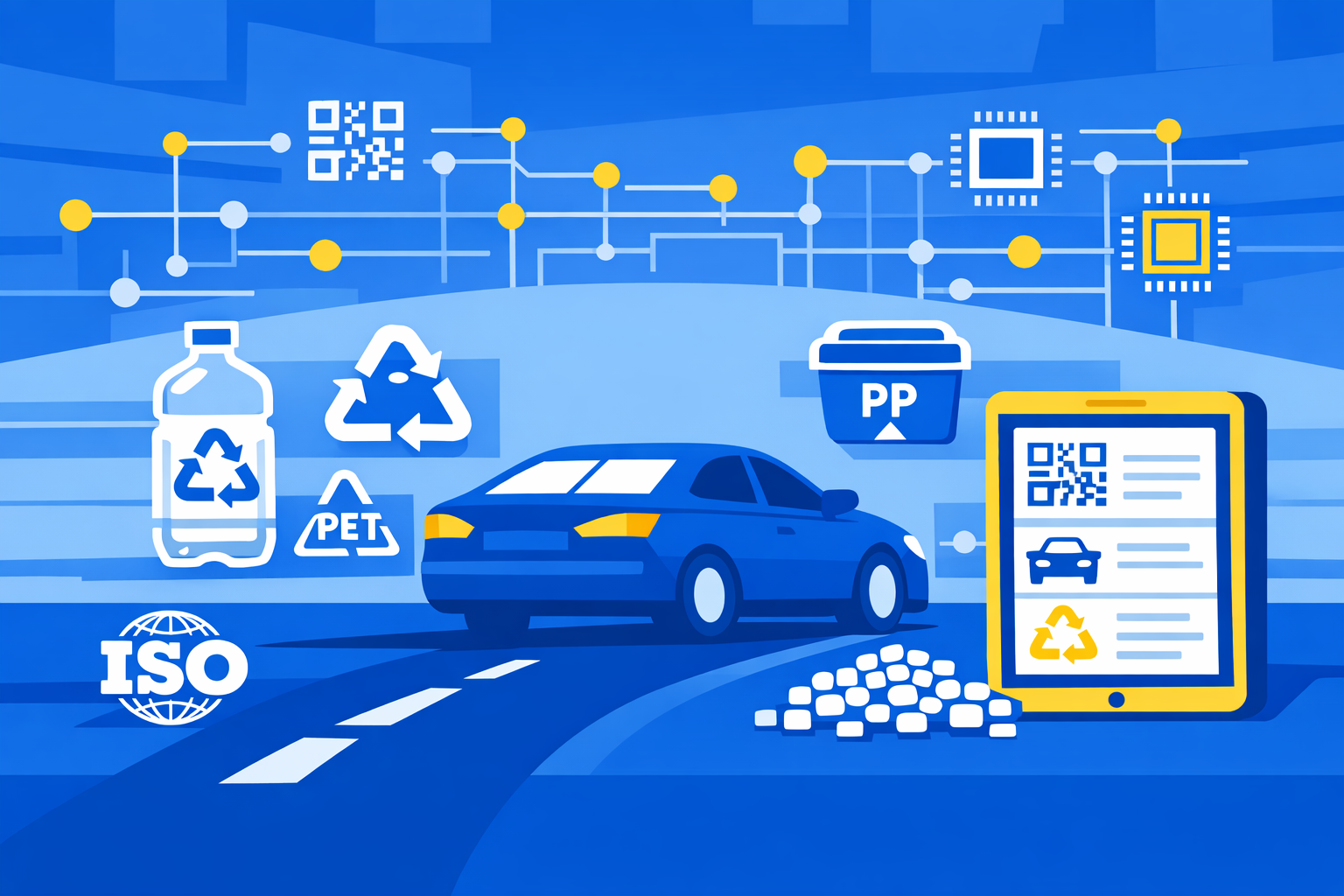
The European Union's phased rollout of Digital Product Passports (DPPs) is accelerating into the automotive sector, imposing new obligations on vehicle manufacturers and their supply chains to capture, standardize, and share granular data on materials, component provenance, and end-of-life pathways - with the first binding automotive deadline arriving in February 2027.
Background
Anchored in Regulation (EU) 2024/1781, the Ecodesign for Sustainable Products Regulation (ESPR), DPPs will become central to EU product compliance. The DPP functions as a digital data container designed to enhance transparency, traceability, and circularity by providing standardized, product-specific sustainability and lifecycle data. The automotive industry sits at the intersection of several overlapping frameworks. The EU has merged the End-of-Life Vehicles Directive and the 3R Type-Approval Directive into a single Regulation on Circularity Requirements on Vehicle Design and Management of End-of-Life Vehicles, which introduces a Circularity Vehicle Passport, an EU-wide Extended Producer Responsibility system, minimum recycled content requirements, and stronger rules on parts reuse.
The digital "circularity vehicle passport," a core feature of the ELV proposal, will be harmonized with other EU digital product passports to avoid duplication and improve data flow. The 2025-2030 Work Plan adopted on April 15, 2025, by the European Commission lists priority products for which ecodesign requirements - and therefore DPP obligations - will be developed progressively between 2026 and 2030.
Details
The first hard deadline falls on February 18, 2027, when every industrial and electric vehicle battery with a capacity over 2 kWh sold in the European Union must carry a Battery Passport. The EU Battery Regulation (Regulation 2023/1542) took effect in February 2024, with the full passport requirement applying from February 18, 2027.[1] Battery passports must include state of health, capacity, carbon footprint, material composition, and sourcing data for critical raw materials such as cobalt, lithium, and nickel, along with end-of-life recycling instructions.[2]
Major automakers, including Audi, Tesla, and Kia, are already running pilots to trace materials and establish data collection processes across their supply chains.[3] Lessons from Battery Passport implementation are expected to inform the rollout of DPPs for other sectors, including full vehicle circularity passports.
The compliance burden across multi-tier supply chains is significant. An estimated 60-80% of required data originates from suppliers across multiple tiers; for an automotive OEM's Battery Passport, data is needed from battery cell manufacturers down to raw material miners and recyclers, and no single entity holds all the necessary information. Industry experts widely suggest that a realistic implementation timeline for DPP compliance is 12 to 18 months.
Under the EU Critical Raw Materials Act, from May 24, 2027, products containing permanent magnets over 0.2 kg must disclose the share of critical raw materials recovered from post-consumer waste. Recyclability requirements for permanent magnets in motor vehicles apply from May 24, 2029.
According to industry surveys cited by compliance analysts, 82% of companies are currently unprepared for DPP requirements ahead of the 2027 mandatory deadlines. A DPP typically contains product identifiers, material and supply chain data, sustainability metrics such as carbon footprint and recyclability, repair and reuse information, and compliance details - all of which must be machine-readable, standardized, and accessible to relevant stakeholders.
Interoperability of data schemas across brands and vendor tiers is emerging as a central technical challenge. The Catena-X automotive data ecosystem is being positioned to support DPP implementation by creating a networked platform for data exchange. Data protection concerns and high implementation costs remain barriers, though a federated ecosystem could help overcome them through secure, standardized interfaces and protocols.
The regulations also carry implications for independent repair networks. The EU Data Act, applicable since September 2025, reshapes access rights for in-vehicle data by adopting a user-centric framework under which users of connected products - including vehicle holders and fleet operators - can access and use data generated through product usage. Data sharing cannot be restricted to certain partners or proprietary platforms; it must be available to a broad range of businesses, including independent repair shops, insurers, and fleet managers. Industry associations, however, have signaled limitations: trade groups have called for sector-specific regulations, noting that the Data Act covers only vehicle-generated data but not vehicle functions and resources, which play an important role in diagnostics.
Outlook
The final content of the ELV Regulation will depend on agreements reached in trilogue negotiations, but even after adoption, the regulatory process will continue through delegated and implementing acts detailing how circularity principles will be applied. New measures under the ELV Regulation are estimated to enable the recycling and reuse of hundreds of tonnes of rare earth materials, around 5-6 million tonnes of steel, 1-2 million tonnes of aluminium, and 0.2-0.3 million tonnes of copper. With the February 2027 Battery Passport deadline confirmed and vehicle-level passport requirements advancing through the legislative process, supply chain directors and packaging engineers responsible for automotive component flows face an intensifying timetable for data infrastructure investment.