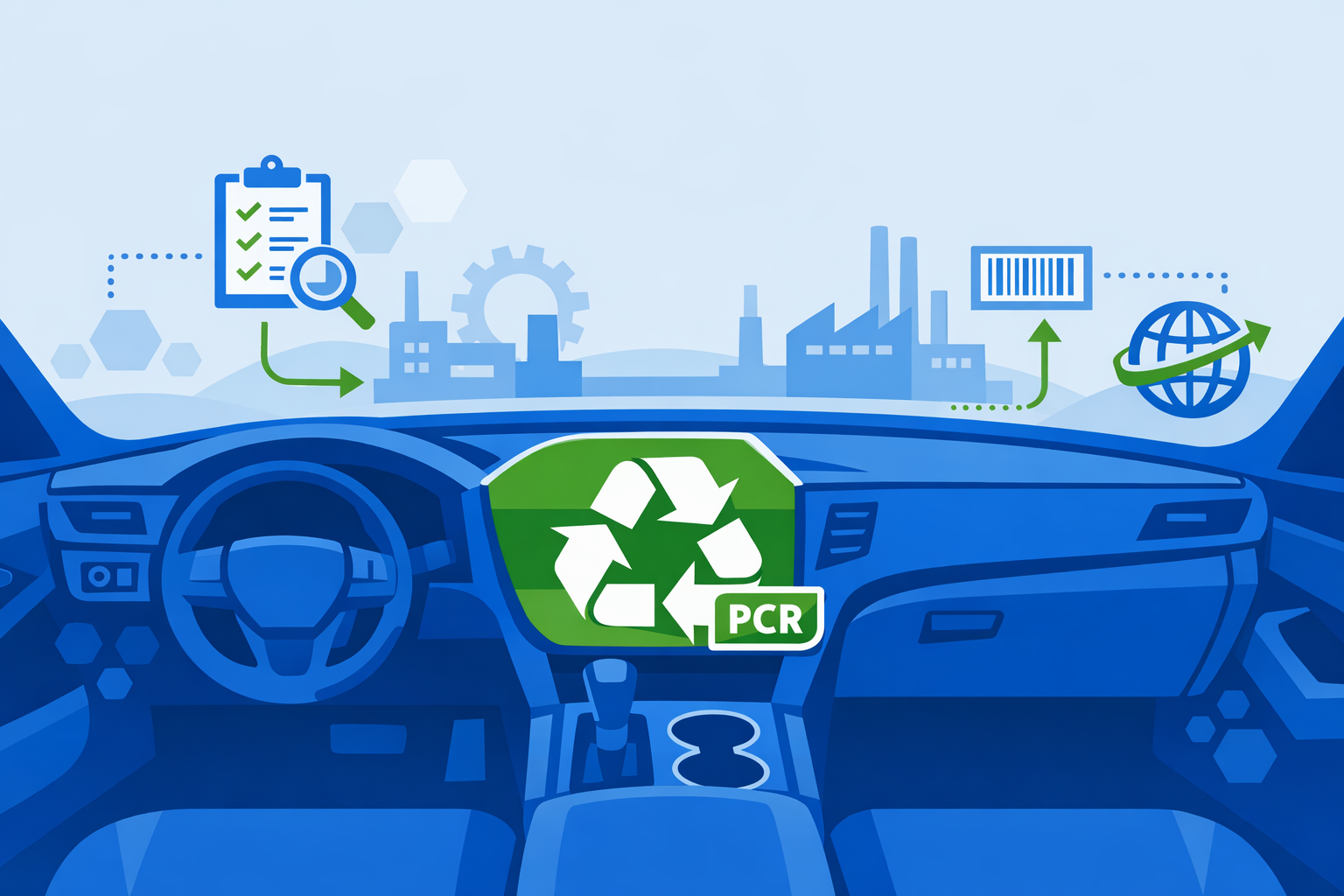
A wave of federal and state legislative activity is converging on recycled plastic content rules, placing new compliance pressure on automakers and their tiered suppliers as they work to align sourcing, testing, and traceability for vehicle interior components across multi-state operations.
Background
The regulatory landscape has shifted considerably over the past twelve months. While most legislative action on recycled content has occurred at the state level, 2025 brought renewed interest in national coordination. As of August 2025, five states had passed laws requiring post-consumer recycled (PCR) content in plastic packaging. That patchwork now poses a compliance burden for OEMs and tier-one suppliers managing multi-plant production networks: stakeholders across the value chain must navigate divergent state definitions and marketing standards that create regulatory uncertainty, inconsistent demand signals, and marketplace confusion.
The vehicle interior segment sits at the center of this friction. Plastics comprise roughly 20% of a modern vehicle's weight, and interior components-including dashboards, door panels, center consoles, and seat bases-typically use ABS, PC/ABS blends, and modified polyolefins. For certain components, such as mono-material polypropylene interior parts, the challenges of introducing recycled content are more straightforward, making them the primary near-term target for automotive manufacturers.
Details
The most significant pending federal measure is the Recycled Materials Attribution Act (RMAA). In February 2026, members of the bipartisan Recycling Leadership Council welcomed the RMAA's introduction-legislation that would establish clear federal standards for recycling and recycled content marketing claims, reducing consumer confusion and creating regulatory certainty for businesses. A key provision directs the Federal Trade Commission to update its Green Guides, which govern environmental marketing claims and have not been revised since 2012.
Introduced in February 2026, the RMAA has been referred to the House Committee on Energy and Commerce, where it awaits further action; as of late April, no hearings were scheduled. The bill carries strong bipartisan support, but competing domestic policy priorities and evolving geopolitical uncertainty could push it down the legislative agenda.
For auto suppliers, the bill's implications extend beyond labeling. House Resolution 7502 seeks to create a consistent national framework to combat misleading claims, standardize recycled content labels, and support advanced recycling methods through third-party certification and mass balance accounting. The RMAA would also establish regulatory and economic certainty across the recycling value chain, where recycled content marketing claims are currently subject to multiple, sometimes contradictory state laws.
Internationally, the EU is setting a higher bar that North American OEMs selling globally must also meet. The EU is negotiating a landmark revision of its End-of-Life Vehicles framework that would, for the first time, mandate minimum recycled plastic content thresholds in new vehicles-requiring 20% recycled plastic within six years of the regulation's entry into force, rising to 25% within ten years. Crucially, a portion of that recycled content must come from end-of-life vehicles rather than solely pre-consumer or industrial waste streams.
Major OEMs are already repositioning their supply chains in anticipation. Ford has pledged to use at least 20% recycled content across its vehicle lineup by 2025, while GM aims for 50% sustainable materials in all vehicles by 2030. Stellantis plans to incorporate 40% recycled content in vehicle plastics by 2030, partnering closely with European recyclers to source post-consumer polypropylene and polyamide compounds.
Supply chain traceability is emerging as a parallel challenge. In 2026, a combination of OEM mandates, evolving industry standards, and tightening global trade requirements is raising expectations for labeling and traceability throughout the supply chain. Stakeholders across the automotive supply chain must collaborate to enable adoption of recycled plastics at a larger scale, with key challenges including material availability, variable material properties, and costs.[1]
The global post-consumer recycled plastics in automotive market was estimated at USD 11.92 billion in 2024 and is projected to grow at a CAGR of 11.1% through 2030, according to Grand View Research.
Outlook
Whether the RMAA advances through the House Energy and Commerce Committee this year will determine how quickly a single federal definition for recycled content-applicable to automotive interiors and the broader supply chain-replaces the current state-by-state framework. California's AB 2253 takes a notably more stringent approach to recycled content claims than the RMAA's broader direction-a divergence that could persist if federal legislation stalls. For procurement and compliance teams at OEMs and tier suppliers, the practical near-term priority is building data infrastructure capable of verifying PCR content at the component level, regardless of which jurisdiction's rules take effect first.