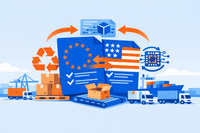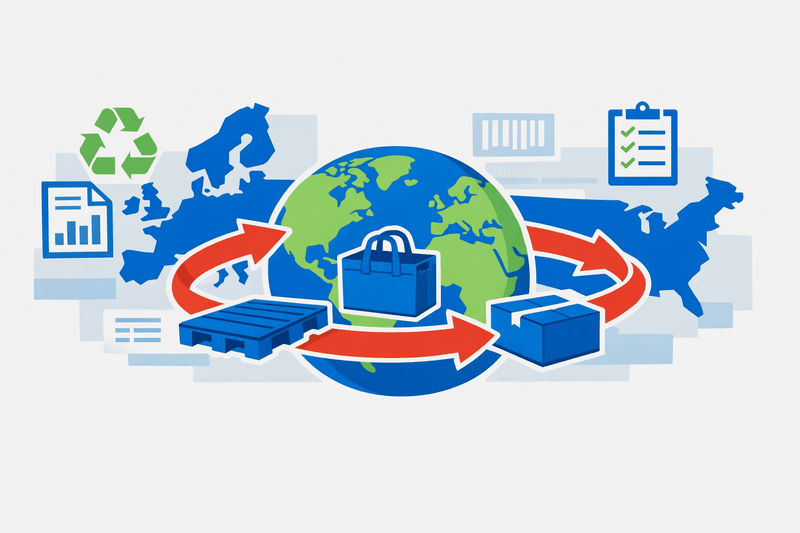
Executive summary. Automotive packaging specifications for the 2026-2028 contract cycle are being reshaped by two primary forces: the EU's new Packaging and Packaging Waste Regulation (PPWR) and an expanding set of North American EPR and plastics rules. For OEMs and Tier suppliers operating trans-Atlantically, this results in a de facto convergence on data, design-for-recycling, and reuse requirements-even as the legal frameworks differ.
This article examines regulatory drivers in both regions, emerging testing and data standards, and key considerations engineers, logistics managers, and procurement teams should incorporate in 2026 sourcing documents.
1. Regulatory reset: why 2026 is a breakpoint for automotive packaging
1.1 Europe: PPWR transitions packaging from directives to direct obligations
Regulation (EU) 2025/40 on packaging and packaging waste (PPWR) entered into force in February 2025 and will generally apply from 12 August 2026.1Packaging waste - Environment - European Commission This replaces the Packaging and Packaging Waste Directive 94/62/EC. Unlike directives, regulations are directly applicable in all Member States without national transposition.2Packaging and packaging waste (from 2026) | EUR-Lex
Notable shifts affecting automotive packaging:
- By 2030, all packaging placed on the EU market must be recyclable, meeting new design-for-recycling criteria and recyclability performance grades.2Packaging and packaging waste (from 2026) | EUR-Lex
- Progressive targets for recycled content in plastic packaging begin in 2030, with stricter requirements following in subsequent decades.2Packaging and packaging waste (from 2026) | EUR-Lex
- Substance restrictions, including bans on certain chemistries (e.g., PFAS in food-contact applications) from August 2026, with expectations for broader scrutiny ahead.3The New EU Packaging and Packaging Waste Regulation – Highlights and Challenges Ahead | PackagingLaw.com
- New labeling and digital disclosure requirements, such as QR-based access to composition and recycling information, will phase in over the late 2020s.4EU Packaging And Packaging Waste Regulation: New Compliance Requirements For E-Commerce - Waste Management - European Union
1.2 Europe: reuse and circularity targets reshape transport packaging
PPWR's focus on reuse in B2B logistics is a major disruptor for automotive supply chains.
From 2030, PPWR requires at least 40% of most B2B transport packaging within the EU be reusable within organized systems, rising to 70% by 2040.5PPWR Timeline: Deadlines & Compliance Steps 2026–2040 I Tanso Blog
OEMs are already redesigning packaging pools and standardizing footprints to ensure 2026-2028 contracts enable future compliance. Industry analyses forecast expanded use of reusable container systems under PPWR.6PPWR: EU Reuse Quotas for Transport Packaging 2030
The EU's forthcoming regulation on vehicle circularity links vehicle content to recyclability and recycled plastics.
The draft ELV regulation backed by the European Parliament proposes plastics in each new vehicle type must contain at least 20% recycled content within six years of the rules' entry into force.7New EU rules on design, reuse and recycling in the automotive sector | News | European Parliament
While not directly regulating packaging, these measures increase demand for recycled materials, making packaging that competes for high-quality recyclate less attractive.
1.3 North America: Fragmented laws, converging expectations
North America lacks a federal packaging law equivalent to PPWR. Instead, state and provincial EPR statutes and federal plastics policies are raising the bar.
- By mid-2025, seven US states-California, Colorado, Maine, Maryland, Minnesota, Oregon, and Washington-had enacted EPR laws covering packaging and paper products.8U.S. Packaging EPR Laws Expand in 2025 | APA Engineering
- Colorado's producer responsibility program for packaging and paper products is scheduled for full implementation on 9 June 2026, becoming the first large-scale US EPR-funded recycling system.9Colorado's Producer Responsibility Program: Plan Approved | Bureau Veritas CPS
- Maine and Oregon will follow, ramping up program obligations through 2026-2027.10Extended Producer Responsibility for Packaging, Waste Management, Maine Department of Environmental Protection
These laws typically require producer funding of municipal recycling, detailed packaging reporting, and often include recyclability standards and future performance targets.
Canada is advancing in parallel with federal plastics policy.
Phase 1 of Canada's Federal Plastics Registry requires producers of plastic packaging and certain other plastic products to report 2024 data by 29 September 2025.11Guide for reporting to the Federal Plastics Registry – phase 1 - Canada.ca The registry demands resin-specific, category-level mass-balance data, reflecting similar structures in the EU PPWR and CSRD.12Recycled content and labelling rules for plastics - Canada.ca
1.4 2026: a shared inflection point
2026 marks simultaneous implementation for cross-continental packaging:
- EU (from 12 August 2026): PPWR enforceable; core design, recyclability, conformity, and documentation obligations apply to all packaging types, including industrial and transport.1Packaging waste - Environment - European Commission
- United States (throughout 2026): EPR phases shift financial and reporting responsibilities to producers and supply chains, notably in Colorado.9Colorado's Producer Responsibility Program: Plan Approved | Bureau Veritas CPS
- Canada (by September 2026): Second-year Federal Plastics Registry reports due, expanding reporting requirements.13Canada’s Federal Plastics Registry has far-reaching reporting obligations
For automotive packaging contracts shipping from late 2026, both EU and North American sites face similar requirements: traceable data, verifiable recyclability, and rising reuse expectations.
2. EU packaging and automotive circularity rules: implications for parts and service-part packs
2.1 From essential requirements to quantified recyclability
The prior EU directive's "essential requirements" on minimization and recoverability suffered from inconsistent application. PPWR introduces more precise, enforceable rules.
Core impacts for automotive packaging:
- Recyclability by design: Packaging must be designed for practical collection, sorting, and recycling at scale.2Packaging and packaging waste (from 2026) | EUR-Lex
- Material-specific rules: Recycled content thresholds are specified for plastics; further criteria will be codified by material and format.3The New EU Packaging and Packaging Waste Regulation – Highlights and Challenges Ahead | PackagingLaw.com
- Substance restrictions: Bans on PFAS in food contact packaging from August 2026 signal stricter expectations for substances hindering recycling.3The New EU Packaging and Packaging Waste Regulation – Highlights and Challenges Ahead | PackagingLaw.com
Consequences for automotive packaging include:
- Emphasis on mono-material or easily separable structures (e.g., corrugated with water-removable labels, mono-PP dunnage) for both inbound and service-part applications.
- Greater focus on coatings, labels, foams, and adhesives that may impair recyclability.
- Stricter documentation for packaging conformity in EU technical files and declarations.
2.2 Reusable loops shift from "best practice" to compliance requirement
The automotive sector has long used pools of reusable totes, racks, and pallets. Odette and national associations have promoted this approach.
Odette's Packaging Management Guidelines (LG14) emphasize increased use of returnable items to replace one-way packaging, reducing waste and environmental impact.14An Odette Publication
PPWR now attaches mandatory reuse quotas to B2B packaging from 2030. Analysts expect more reliance on standardized, durable containers and pallets to meet quotas while controlling logistics cost.6PPWR: EU Reuse Quotas for Transport Packaging 2030
Germany's Packaging Act (VerpackG) already compels OEMs and logistics providers to register and document packaging and prioritize reusable or recyclable options.15Recycling rules tighten for automotive packaging waste | Automotive Logistics This experience influences EU-wide packaging standards at German automotive groups.
2.3 Packaging in the vehicle circularity narrative
Vehicle and CSRD reporting requirements link packaging with broader sustainability KPIs:
- Logistics packaging is increasingly used to highlight waste reduction alongside vehicle design changes.16Resource use and circular economy - Volkswagen Group Annual Report 2024
- CSRD-aligned reporting requires tracking of secondary material use, waste, and recycling performance across both products and logistics, including packaging.17ESG Legislation & Regulatory February 2024
Specifications now must address safety, landed cost, and externally audited sustainability metrics.
3. North American packaging compliance: fragmented laws, similar data demands
3.1 United States: state-level EPR and recyclability expectations
State EPR programs differ in detail but share core features:
- Producer registration with a Producer Responsibility Organization (PRO), eco-modulated fees, and annual packaging reports.8U.S. Packaging EPR Laws Expand in 2025 | APA Engineering
- Covered packaging must be reusable, recyclable, or compostable under state criteria, paralleling EU requirements.187 States Have EPR Packaging Laws, 5 More Assessing Need | LightNOW
- Highly detailed, technical reporting.
AIAG notes EPR reporting in the US requires full material breakdown, weight, and sustainability details such as recycled content, compostability, and recyclability.19Extended Producer Responsibility Around Packaging
Automotive supply chains shipping service parts into these states will increasingly need:
- Standardized material and resin codes.
- Documented post-consumer recycled (PCR) content.
- Clear recyclability statements regarding municipal systems.
Many OEMs align US inbound and service-part packaging specifications with EU standards to minimize duplicative systems.
3.2 Canada: plastics registry and recycled-content proposals
Canada's Federal Plastics Registry focuses on data, with eventual links to product standards.
- Producers must report plastic packaging manufactured, imported, and placed on the Canadian market, by resin type and category, for the 2024 calendar year by 29 September 2025.11Guide for reporting to the Federal Plastics Registry – phase 1 - Canada.ca
- Subsequent years expand reporting coverage, including transport and vehicle-related plastics, with reports due annually by September.13Canada’s Federal Plastics Registry has far-reaching reporting obligations
Draft Canadian rules envision recycled content minimums and enhanced labeling for certain packaging types by 2030.
Draft rules propose minimum recycled content for several rigid and flexible categories, plus disclosure and labelling obligations.12Recycled content and labelling rules for plastics - Canada.ca
For automotive packaging to Canada, this drives:
- Increased PCR use in plastic packaging where feasible.
- Earlier standardization of resin selection and supplier choices to ease registry reporting.
4. Convergence in practice: testing protocols and data standards
Regulatory systems are not mandating specific packaging test methods, but compliance obligations are converging packaging design, testing, and documentation.
4.1 Shared testing frameworks for transport performance
Automotive packaging engineers apply recognized distribution-testing standards:
- ISTA 1/2/3 tests for vibration, shock, compression, and drop.20ISTA 3A Verpackungsprüfung, Transportsimulation
- OEM protocols referencing ISTA or ASTM for combined environmental and mechanical stresses.
Under new regulations, these tests must also confirm that lighter, more recyclable, or reusable packaging still meets protective performance and empty-space limitations (e.g., PPWR's maximum void space from 2030).21PPWR 2025 Explained: Complete Guide to Europe’s New Packaging Regulation - Jarsking
2026 specifications will:
- Explicitly require ISTA or ASTM-based performance testing in RFQs.
- Offer alternative pack designs for route-specific needs (e.g., EU rail vs. NA truck) while holding recyclability and reuse criteria constant.
4.2 Standardized digital packaging data: VDA, Odette, and beyond
Digital master data is central to compliance.
VDA 9008 provides a standardized interface, aligned with Odette, for exchanging packaging information across the supply chain.22VDA | German Association
VDA 4560, published in 2025, addresses packaging materials and concepts aiming to boost material efficiency, waste reduction, and recyclability.23Recommendation These standards reference Odette's guidelines and digital label requirements, supporting returnable packaging management and data exchange.14An Odette Publication
Guidance from AIAG and others urges North American automakers to collect packaging data compatible with EU reporting: material breakdowns, weights, recycled content, and recyclability attributes for multiple markets.19Extended Producer Responsibility Around Packaging
Outcomes include:
- Global packaging specifications adopting unified data models, even if formatted differently for Odette, VDA, AIAG, or internal systems.
- Suppliers providing standardized technical declarations-polymer grade, PCR percentage, recyclability-for both EU and North America.
5. What 2026 automotive packaging contracts will need to cover
5.1 For OEMs and Tier-1s: embed compliance in RFQs and sourcing
By 2026, packaging RFQs must address regulatory details to avoid rework and risk. Typical requirements now include:
- Scope: Packaging destination(s)-EU, US EPR states, Canada, or multiple regions.
- Design-for-recycling: Limits on multi-material structures, restricted use of problematic adhesives/inks/foams, and recycling-stream alignment with PPWR and local systems.
- Reusability: Required share of returnable packaging by lane, and clear pool management protocols.
- Data/documentation: Material declarations including resin types, PCR content, readiness to supply EPR data (mass by material, recyclability, compostability), and test reports confirming that lighter or reusable packaging meets standards.
5.2 For packaging converters: deeper technical questionnaires
Converters should expect more detailed technical questionnaires, including:
- Full material structures and recyclability grades for each component by region.
- Evidence of compatibility with recycling streams, with reference to relevant industry methods (e.g., INGEDE for paper).24Brand owners pushing PPWR compliance requirements down to converters — anyone else being asked for adhesive recyclability declarations?
- PCR content traceability and quality control for performance at increased recycled content levels.25Circularity in the Automotive Industry
Harmonized technical documentation usable across PPWR, EPR, and CSR reporting will be valued.
5.3 For material suppliers: linking resin to recyclability and reporting
Material suppliers must now provide properties relevant to recyclability and compliance:
- Classification against PPWR recyclability and recognized recycling streams.26Design for Recycling (Verpackung)
- Declared PCR content ranges, with certification.12Recycled content and labelling rules for plastics - Canada.ca
- Support for conformity and plastics registry reporting (resin family, recycled content origin).
New materials-especially mono-material and chemically recyclable options-must be characterized for regulatory compatibility.27AI-assisted design of chemically recyclable polymers for food packaging
6. Side-by-side view: 2026 compliance drivers, EU vs North America
| Aspect | European Union (PPWR & ELV) | North America (US EPR & Canada plastics policies) |
|---|---|---|
| Legal instrument | Directly applicable EU regulations (PPWR; upcoming ELV regulation) | State EPR statutes (US); federal registry and plastics agenda (Canada) |
| 2026 milestone | PPWR becomes enforceable on 12 Aug 2026; early design, labelling and substance rules apply | Colorado packaging EPR program goes live June 9, 2026; Canada Federal Plastics Registry enters second reporting year |
| Core packaging expectations | Recyclable by design; progressive recycled-content and reuse targets; material and substance limits | Packaging must be reusable, recyclable or compostable; eco-modulated fees and future performance targets; growing recycled-content emphasis |
| Data/reporting | Packaging material composition, recyclability grade, recycled content; links to CSRD indicators | Detailed packaging EPR reports by material and product category (US states); plastics registry reports by resin, category and fate (Canada) |
| Automotive relevance | Applies to inbound, in-plant and aftermarket packaging across EU facilities; interacts with vehicle circularity rules | Applies to service parts and finished-vehicle accessories sold into covered jurisdictions; packaging data required even if vehicle itself is not in scope |
Sources: EU PPWR legal texts and guidance; EU ELV circularity proposal; US state EPR program documentation; Canada Federal Plastics Registry guidance.1Packaging waste - Environment - European Commission
7. Actionable checklist for 2026 automotive packaging contracts
Automotive packaging programs spanning EU and North America should address the following prior to finalizing 2026-2028 contracts:
- Map regulatory exposure by lane: Identify plants, DCs, and dealers by jurisdiction and classify packaging BOMs accordingly.
- Standardize material hierarchies: Align internal codes with PPWR categories, EPR reporting fields, and Canadian resin families.
- Mandate mono-material or separable designs: Default to mono-material or easily separable packs for higher recyclability grades.
- Set reuse targets by commodity and route: For high-volume, stable flows, define minimum reusable packaging shares to meet 2030 PPWR quotas.
- Integrate EPR data in master data: Ensure systems can record mass by material, PCR percentage, recyclability, and EPR fee category.
- Update test plans for new designs: Revalidate using ISTA/ASTM standards as materials are reduced or PCR content rises.
- Strengthen supply documentation clauses: Require technical files with recyclability and substance declarations aligned with PPWR.
- Synchronize sustainability and packaging data: Link master packaging data to CSRD and ESG reporting to avoid duplication.
- Pilot cross-regional reuse pools: Test standard totes and pallets across regions with compatible labelling/ID protocols.
Frequently Asked Questions
7.1 Are EU and North American automotive packaging requirements converging?
The legal systems differ: the EU centralizes rules in PPWR and the upcoming ELV regulation, while the US and Canada use a patchwork of state and federal measures.1Packaging waste - Environment - European Commission Practically, however, convergence is evident in three areas:
- Demonstrable recyclability or reusability
- Progressive recycled content use
- Detailed, auditable data on packaging materials and end-of-life
Many OEMs are adopting unified global packaging standards with regional annexes.
7.2 What should a "2026-ready" global packaging specification include?
Minimum elements:
- Target recycling stream and recyclability assumptions, e.g., 100% corrugated, mono-PP for rigid recycling
- Detailed material declarations, including resin codes and PCR content
- Confirmation of PPWR-compliant recyclability and EPR compatibility for US/Canada2Packaging and packaging waste (from 2026) | EUR-Lex
- Defined reuse strategy with ownership, return flow, and cleaning protocols
Including these up front mitigates retrofit risks as regulations evolve.
7.3 Are cardboard-only solutions exempt from new packaging rules?
Cardboard and fiber-based packaging are typically favored due to high recycling rates. Some PPWR reuse quotas exempt cardboard transport boxes.28Germany’s New Recyclability Rules for Packaging 2026 | Packaging Post However, design-for-recycling and minimization still apply, and EPR schemes may adjust fees for coatings or composite designs that impair recyclability.26Design for Recycling (Verpackung) High-value components require solutions balancing performance and recyclability.
7.4 Will packaging testing protocols need to change?
Core ISTA/ASTM standards will remain, but application will shift:
- More tests for reusable packaging (lifespan, damage)
- Enhanced testing for lightweight or high-PCR designs20ISTA 3A Verpackungsprüfung, Transportsimulation
- Conditioning related to reuse, such as repeated washing or temperature cycles
Specification documents should cite applicable standards with updated acceptance criteria.
7.5 What is the most critical action for packaging teams in 2024-2025?
Building a harmonized, global packaging data model is the most impactful step for PPWR, EPR, and plastics registry reporting. This involves:
- Aligning internal codes with VDA/Odette specifications and EPR fields22VDA | German Association
- Defining attributes for every packaging item: material, PCR content, recyclability, and reuse status
A robust data backbone enables more agile adaptation to evolving EU and North American requirements.