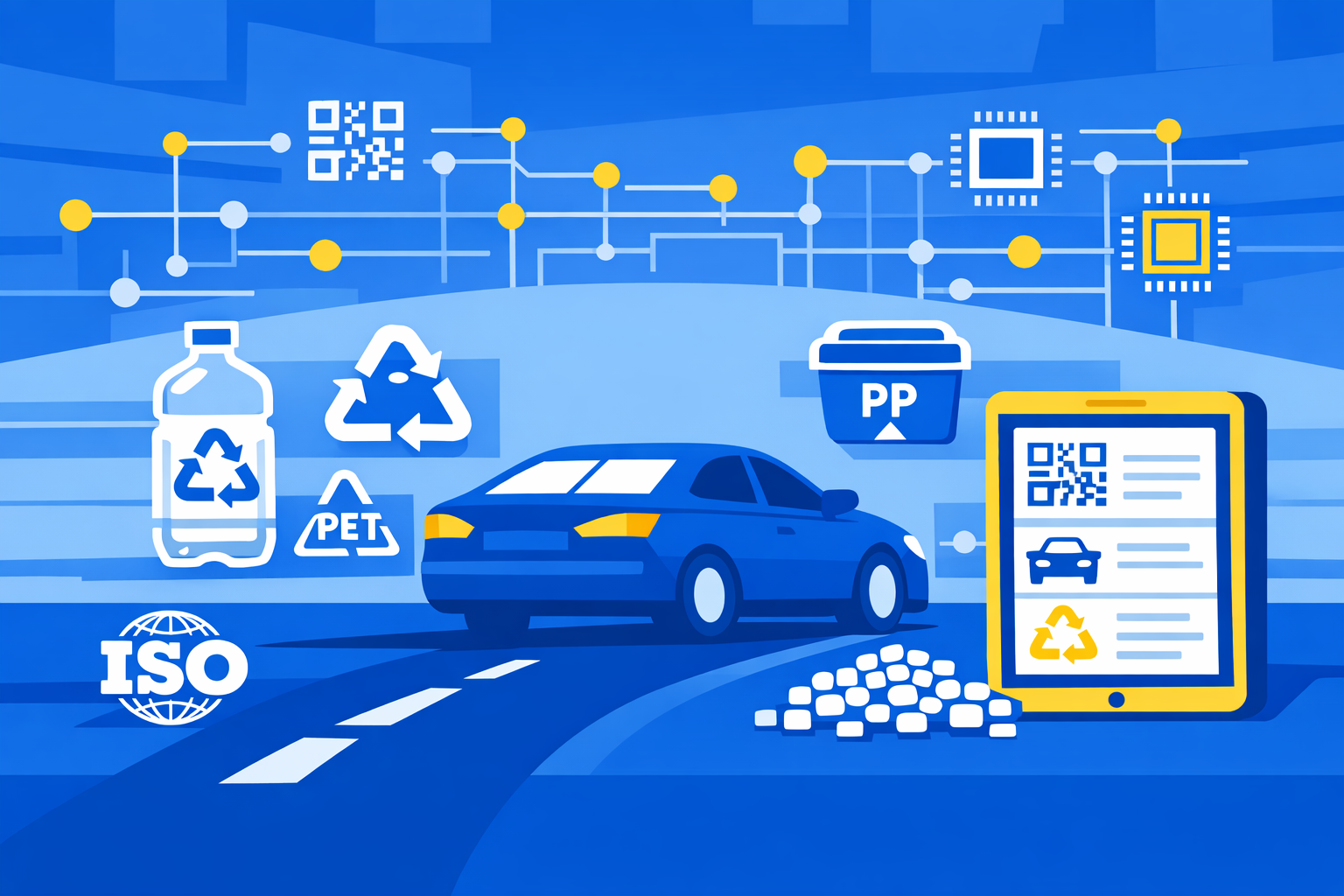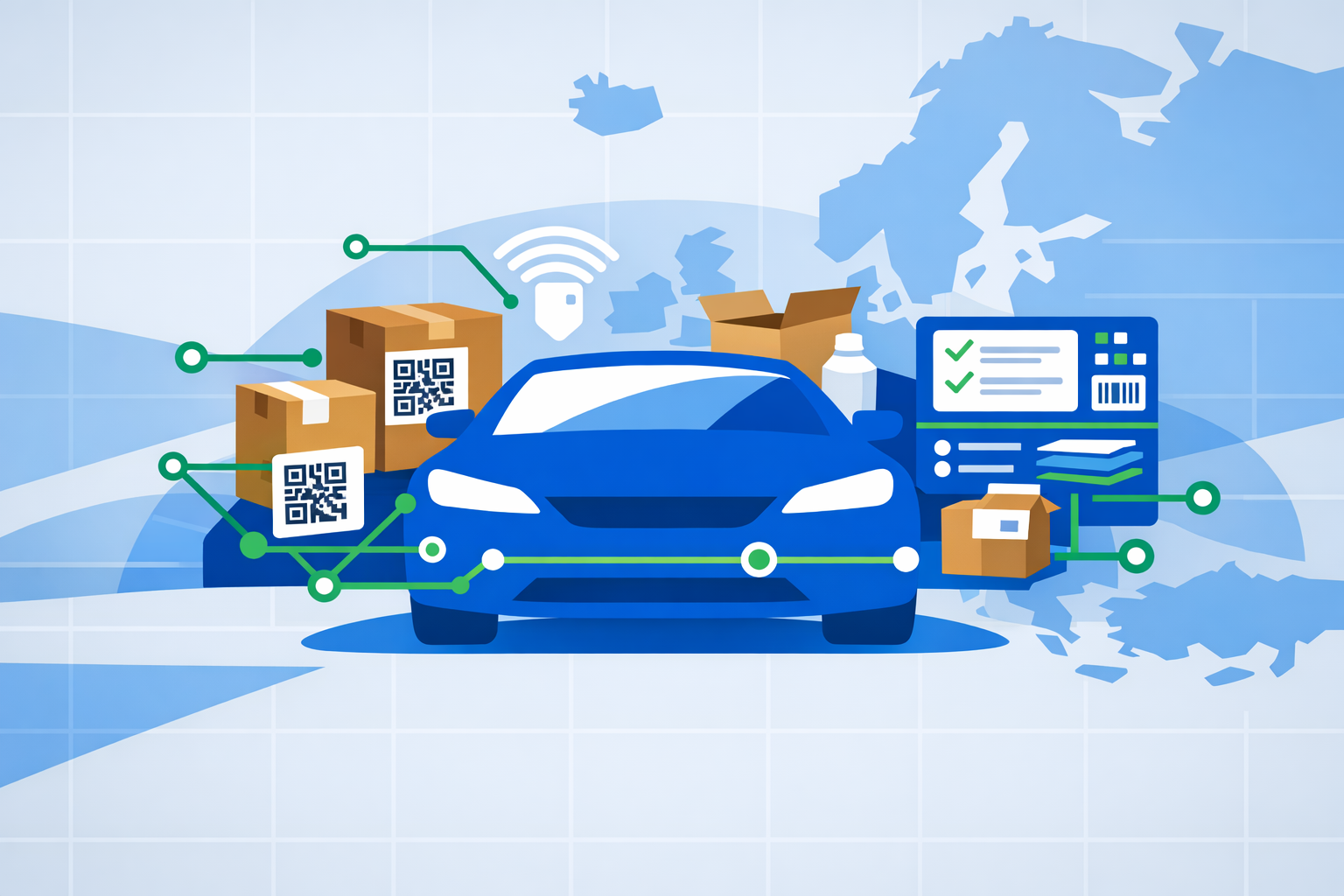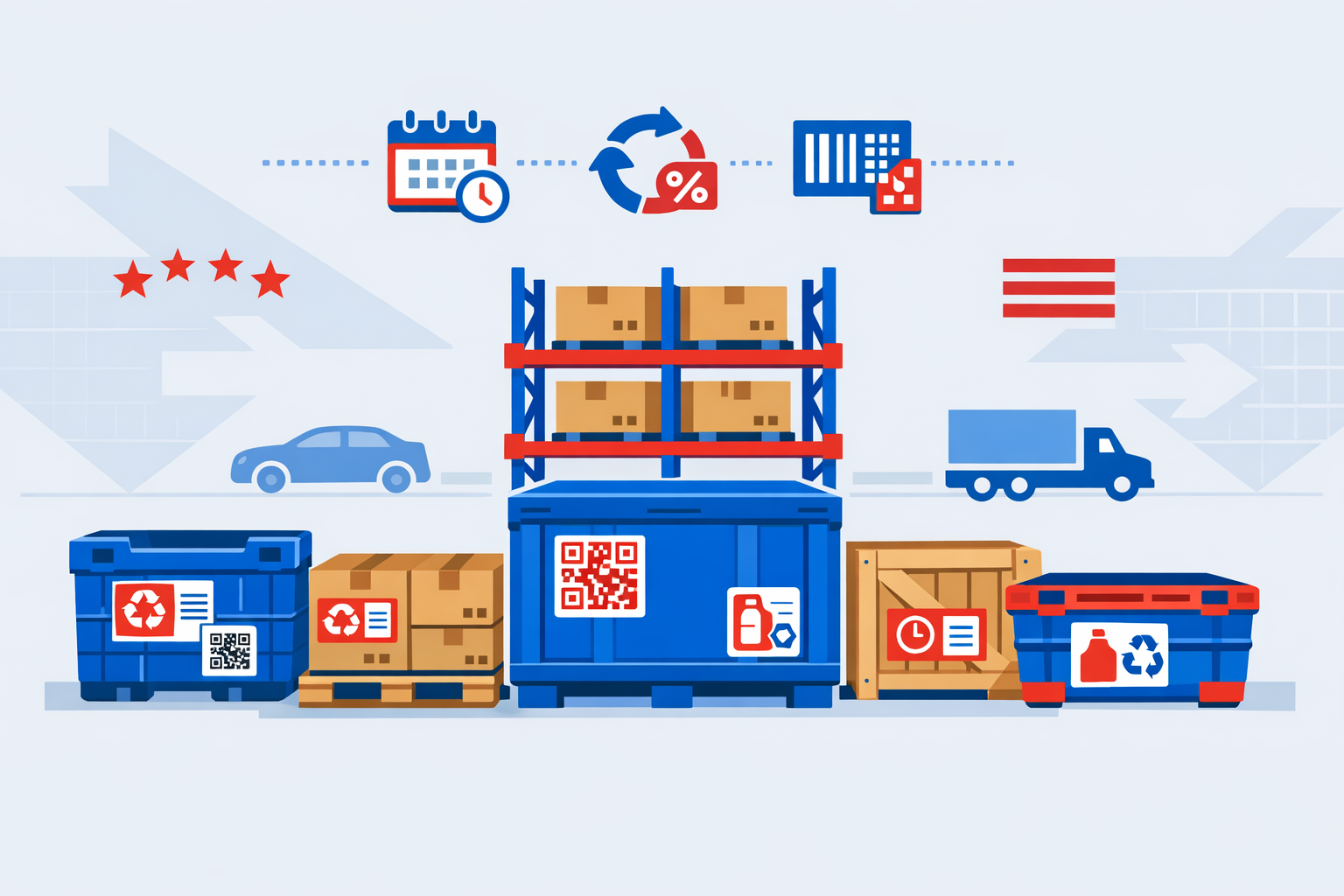
The automotive industry is entering a new regulatory era where packaging is recognized as a strategic asset. By 2026, developments in the EU and US on extended producer responsibility (EPR), recycled content mandates, and labeling rules will converge, reshaping automotive packaging specifications and cross-border sourcing.
For OEMs and Tier 1/2 suppliers, the alignment of EU and US packaging regulations is narrowing the timeframe for redesigning transport, service-part, and aftermarket packaging. Standardizing materials, data, and performance criteria across both regions can reduce compliance friction, avoid duplicative testing, and mitigate risks in the 2026-2030 sourcing cycle.
2026 as a regulatory tipping point for automotive packaging
Regulation (EU) 2025/40 on packaging and packaging waste (PPWR) entered into force on 11 February 2025 and will generally apply from 12 August 2026 across all EU Member States.[1] This is the first instance of harmonized, directly applicable EU rules covering the entire life cycle of transport and industrial packaging in automotive logistics.
State-level EPR frameworks for packaging in the US are also moving toward implementation. As of early 2026, seven US states have enacted packaging extended producer responsibility laws, including California, Colorado, Maine, Oregon, Minnesota, Maryland, and Washington.[2] Colorado and Oregon programs are scheduled to begin in 2026, with fee payments, design criteria, and reporting increasing through the decade.[3]
These timelines synchronize the first wave of EPR compliance pressure on packaging standards across both Europe and North America for global automotive supply chains.
EU packaging regulations: PPWR and industrial transport packaging
PPWR extends EU regulations beyond consumer goods to include industrial and transport packaging for components, modules, and vehicles. This covers reusable totes, steel and plastic racks, expendable packs, and protective inner dunnage.[4]
Key PPWR provisions relevant to automotive packaging:
- Mandatory recyclability: From 2030, all packaging must meet recyclability criteria outlined in Annex II, including sortability and impact on secondary raw material quality.[5]
- Recycled content in plastic packaging: Minimum shares of post-consumer recycled content will be required in plastic packaging from 2030-ranging from 10% to 35% depending on category, with higher targets from 2040.[6]
- Reuse targets for transport packaging: From 1 January 2030, at least 40% of transport and sales packaging must be reusable, increasing to 70% by 2040, subject to exemptions like pallet wrap and strapping.[7]
- Waste reduction: Member States must cut per capita packaging waste by 5% by 2030, 10% by 2035, and 15% by 2040, relative to 2018 levels.[8]
- Labelling and data carriers: From 2028, packaging must carry standardized symbols and an identification marker, often a QR code, providing details on material composition, recycled content, and disposal routes.[9]
The automotive sector is coordinating its response. The Odette Packaging Expert Group is reviewing PPWR requirements and preparing guidelines to help OEMs, suppliers, and packaging providers implement the regulation in automotive supply chains.[10] This will likely influence packaging specifications, returnable packaging pools, and the acceptance of recycled materials in Europe.
US packaging regulations: patchwork EPR with converging design levers
The US lacks a federal packaging EPR law. Packaging EPR is emerging through state statutes, with early programs in Maine and Oregon, followed by California, Colorado, Minnesota, Maryland, and Washington.[11] Separate state mandates address recycled content and recyclability claims.
Key factors influencing automotive packaging decisions:
- State EPR schemes: Colorado's Producer Responsibility Program for Statewide Recycling will fully launch in 2026, making participation mandatory for covered packaging and paper, with design criteria and fee modulation.[3] Oregon's program, operated by Circular Action Alliance, uses a similar approach.[12]
- Recycled-content mandates: Several states require minimum post-consumer recycled (PCR) content in plastic beverage containers and certain rigid packaging. California and Washington, for example, increase requirements up to 25-50% PCR by 2030-2031 for specific bottle categories.[13]
- Truth-in-labelling rules: California's SB 343 ("Truth in Recycling") will prohibit recyclability claims on packaging manufactured after 4 October 2026 unless the material is collected, sorted, processed, and recycled at scale in the state.[14] Enforcement actions around misleading recyclability claims emphasize the need for evidence-based labeling.[15]
Automotive manufacturers shipping into these states will face EPR compliance and recycled-packaging design questions similar to those in the EU, despite differing terminology and timelines.
Where EU and US packaging standards are converging for automotive supply chains
Despite differing legal structures, several themes align across EU and US regimes, directly impacting automotive packaging standards:
- Extended producer responsibility costs tied to material choices and packaging design
- Design-for-recycling requirements discouraging complex, multi-material structures
- Minimum recycled-content expectations for plastics; emerging for other materials
- Standardized labelling and data carriers supporting sorting, reuse, and EPR reporting
- Data transparency on material composition, recycled content, and end-of-life destination
Summary table:
| Design lever / obligation | EU (PPWR & national EPR) | US (state EPR & related laws) |
|---|---|---|
| Legal structure | Directly applicable EU regulation, harmonizing national rules from Aug 2026 | State statutes; no federal EPR, resulting in patchwork obligations |
| Scope of EPR | All packaging, including industrial and transport packaging for B2B flows | Varies by state; often consumer-facing, with many including B2B packaging and paper |
| Recyclability design criteria | Mandatory recyclability from 2030 per design-for-recycling criteria | Implied via labelling laws (e.g., SB 343) and eco-modulated EPR fees |
| Recycled-content requirements | Binding PCR targets by 2030/2040 for plastics; guidance for other materials | PCR mandates for certain containers; increasing scope expected |
| Reuse / return systems | Quantified reuse targets (e.g., 40% of transport packaging by 2030) | Pilot projects and incentives; no harmonized targets |
| Labelling & data carriers | Harmonized symbols plus QR/data carrier with material/recycling data | Restrictions and voluntary/PRO-driven labelling schemes |
| Data & reporting | EU-wide format; aligned with EPR and CSRD reporting | State-specific portals; increased use of PROs |
For OEMs and suppliers, these common levers offer an opportunity to design once and localize only as needed.
Implications for OEM and Tier automotive packaging specifications
Material selection and recycled content
Automotive packaging primarily uses PP, HDPE, steel, and wood for returnable items, with corrugated board, foams, and films for expendable packaging. PPWR and state-level US EPR laws require these materials to be evaluated for recyclability, traceability, and PCR content as well as performance.
Key implications:
- Higher PCR in rigid plastics: Suppliers are piloting PP and HDPE compounds with 10-30% PCR, meeting anticipated regulatory thresholds while retaining necessary properties.[4]
- Reducing problematic materials: EU rules restrict certain heavy metals and PFAS, prompting phased removal of some coatings and foams in favor of mono-material solutions.[16] US policies add pressure on non-recyclable foams and composites.[17]
- Stronger business case for reuse: EU reuse targets and EPR fee structures strengthen the economics for shared pools of returnable packaging between sites and suppliers.[18]
Standardized test methods and performance criteria
Regulators do not prescribe specific automotive packaging tests, but OEMs increasingly link qualification plans to recognized standards for impact, vibration, and stacking. Under PPWR, recyclability and reuse must be demonstrated along with mechanical performance.
Considerations include:
- Aligning specifications with recognized testing standards and documentation showing recyclability (e.g., separable components, polymer purity).
- Using unified test sets for EU PPWR and US EPR assessments to avoid duplication.
- Including end-of-life test results in global packaging standards for containers and pallets.
Documentation, declarations of conformity and supplier contracts
From August 2026, EU operators must issue declarations of conformity referencing PPWR and retain detailed technical documentation.[19] OEMs and Tier suppliers are translating this into:
- Bill-of-materials by polymer, fiber type, and additives
- Documented PCR percentages by weight for plastics
- Evidence of recyclability and reuse cycles
- EPR registration numbers and proof of scheme participation[20]
These requirements are now common in supplier onboarding and annual packaging compliance reviews.
How packaging manufacturers are retooling for higher recycled content
Packaging manufacturers serving automotive are adjusting lines and specifications to accommodate higher PCR shares in demanding logistics environments.
Technical responses include:
- Resin and compound optimization: Re-compounding PP and HDPE with stabilizers and impact modifiers to address PCR variability while preserving part tolerances.[4]
- Barrier and surface design: Using coatings or in-mold labels compatible with recycling, avoiding problematic laminates.[5]
- Lightweighting with structural reinforcements: Optimizing designs to cut mass while retaining stiffness, backed by FEA and real-world testing.
- Reuse-ready packaging: Designing containers and racks for specific rotation targets, with digital tracking for cycles and repairs.[21]
These measures support the adoption of recycled packaging without compromising protection or efficiency.
Data transparency, unified labels and end-of-life tracking pilots
Data and labeling are central for EPR compliance and operational efficiency in automotive logistics.
Existing harmonized labeling frameworks
The Global Transport Label (GTL) was developed by Odette (Europe), AIAG (North America), and JAMA (Japan) for harmonized container labeling. It is now widely used with barcodes and 2D codes in automotive packaging.[22] GTL is a foundation for integrating sustainability and EPR data into existing labels rather than creating new systems.
PPWR and digital carriers
PPWR anticipates QR codes or other data carriers on packaging for sharing information on reusability, collection, and recyclability, and to track rotations.[23] Automotive packaging pools can benefit by:
- Embedding unique IDs linking items to material passports and conformity declarations
- Capturing rotations, repairs, and end-of-life details at the container level
- Feeding traceability data into EPR reporting and sustainability disclosures
End-of-life tracking pilots
Pilot programs in fast-moving consumer goods offer applicable models for automotive packaging:
- HolyGrail 2.0 trials in Germany show digital watermarks on packaging achieve over 90% detection in sorting rigid plastics by polymer and application.[24]
- QR-code pilots in European retail have tested deposit return integration, consumer-facing recycling instructions, and traceability using GS1 standards.[25]
- US agencies, like Oregon DEQ, are reviewing digital watermarking as part of recycling modernization, indicating the potential for international adoption.[26]
Automotive supply chains can extend these technologies from consumer to B2B flows, combining GTL with QR/data-matrix codes for material IDs, recycled-content claims, and packaging standards across EU and US operations.
Risk management for cross-border automotive packaging supply chains
PPWR and varying US state rules present regulatory risk for global automotive packaging programs, especially those serving both EU and North America.
Key risk areas and mitigation strategies:
Regulatory variants
- Map packaging SKUs by market, aligning them with EU PPWR, national EPR (e.g., Germany's VerpackG), and US state EPR and labeling laws.[20]
- Identify where a single global spec is not feasible (e.g., foams banned in the EU but allowed in some US applications).
Supplier certification verification
- Require third-party certificates or test reports for PCR content and recyclability, not just self-declarations.[27]
- Cross-check EPR registrations against public records or PRO portals.
Third-party audits and traceability
- Use independent auditors for data sampling, claim tracing, and fee-class verification where eco-modulated EPR fees apply.[13]
- Integrate packaging data into ESG and CSRD reporting to catch discrepancies early.
Contractual safeguards
- Embed compliance clauses for PPWR and state-EPR in 2026-2030 packaging contracts, with remedies for non-compliance due to regulatory changes.[28]
- Specify change-control processes for material substitutions affecting recyclability or PCR content.
These steps lower the chance of non-compliance, penalties, or unforeseen repacking costs.
Actionable conclusions and next steps for 2026 EPR compliance
Over the next 12-24 months, automotive OEMs and suppliers should:
Create a packaging governance team
- Include engineering, logistics, sustainability, regulatory, procurement, and IT.
- Assign ownership of global packaging standards and PPWR/EPR interpretation.
Segment the packaging portfolio by risk and priority
- Identify high-volume, multi-market packaging SKUs for redesign and documentation.
- Flag packaging likely to fail recyclability or US labelling criteria.
Define global baseline packaging standards
- Set minimum recyclability and PCR-content targets compatible with PPWR and the most stringent US state rules.
- Align with industry frameworks (Odette, AIAG, GTL) for streamlined labeling and data exchange.
Upgrade packaging data and IT systems
- Implement a central master-data system for material composition, PCR content, weight/volume, EPR classification, and labels.
- Prepare for QR or digital product passport pilots.
Integrate EPR criteria into sourcing and RFQs
- Require suppliers to document recyclability, PCR content, EPR registrations, and data-sharing abilities.
- Consider total EPR fee exposure in lifecycle cost assessments.
Pilot unified labeling and end-of-life tracking
- Combine GTL-compliant labels with QR/data-matrix codes on select returnable packaging between EU and US plants.
- Use pilots to validate data structures for PPWR conformity and US PRO reporting.
By treating EPR as a cross-functional design, procurement, and data challenge, automotive companies can standardize packaging, reduce complexity, and build more resilient cross-border supply chains.
Frequently Asked Questions
What counts as "automotive packaging" under EPR rules?
Neither EU nor US EPR schemes have a unique category for automotive packaging. Any material or container used to protect, ship, or present products is considered packaging, including:
- Primary packaging for components (bags, trays, boxes)
- Secondary packaging (inner cartons, dividers, cushioning)
- Transport and industrial packaging (KLTs, racks, pallets, wraps, large export crates)
Under PPWR, both transport and industrial packaging are in scope for recyclability, recycled content (for plastics), and reuse targets.[4] US state EPR laws usually cover consumer-facing packaging, but many include B2B transport packaging entering the waste stream in-state.
Do PPWR requirements replace national EPR schemes like Germany's VerpackG?
PPWR harmonizes technical packaging requirements (recyclability, PCR content, labeling, reuse) across the EU but does not eliminate national EPR systems. Germany's VerpackG and the LUCID register continue as the mechanism for producer responsibility.
Packaging placed on the German market must comply with PPWR design rules and be registered under VerpackG.[20] Similar dual structures exist in other Member States.
Is there a federal US requirement equivalent to PPWR?
No. US packaging regulation is driven by state law. There is no federal EPR for packaging or a national counterpart to PPWR. However, overlapping state EPR programs, recycled content mandates, and labeling rules are setting de-facto national expectations for multi-state brands.
Automotive manufacturers shipping into states with EPR or recyclability labeling laws should assume packaging design, PCR content, and labeling may need to meet the strictest state standard.
How should packaging teams handle different recyclability labels in the EU and US?
Separate data from on-pack artwork:
- Maintain a single authoritative data set on material composition and recyclability per packaging SKU.
- Use this data to generate region-specific labels: EU-compliant recycling/reuse symbols with QR codes for PPWR, and state-compliant claims (or omissions) for US markets like California.[9]
Leverage global standards such as GTL and GS1 for consistent codes across regions.
When should 2026-2030 contracts reflect PPWR and EPR requirements?
With PPWR generally applying from 12 August 2026 and several US EPR programs going live around the same time, packaging contracts signed in 2025-2027 should already:
- Reference PPWR obligations (recyclability, PCR content, labeling, reuse) and national laws (e.g., VerpackG, French AGEC law).[1]
- Allocate roles for technical documentation, declarations, and EPR registrations.
- Include mechanisms for adjusting materials, designs, and pricing if regulations change during the contract.
Including these terms reduces mid-contract redesigns and unplanned EPR costs as regulations evolve on both sides of the Atlantic.