Automotive OEMs on both sides of the Atlantic are overhauling supplier packaging contracts as converging regulatory deadlines in the European Union and the United States impose new recycled-content mandates, extended producer responsibility (EPR) obligations, and digital traceability requirements ahead of August 2026. The EU's Packaging and Packaging Waste Regulation (PPWR) represents a structural shift in how packaging is designed, specified, sourced, tracked, and financed across automotive supply chains. In the US, seven states now have packaging EPR programmes in place at various stages of implementation, with key deadlines set for 2026 and beyond.
Regulatory Background
The PPWR entered into force on 11 February 2025 and will generally apply from 12 August 2026. The regulation replaces the previous Packaging and Packaging Waste Directive 94/62/EC with a single, directly applicable legal framework across all 27 EU member states. It imposes strict, binding obligations across the entire value chain - from manufacturers and importers to distributors - covering recyclability, mandatory recycled content, reuse systems, harmonised labelling, and packaging minimisation.1Traceability in Logistics: Scaling Auto-ID Successfully | MHP – A Porsche Company
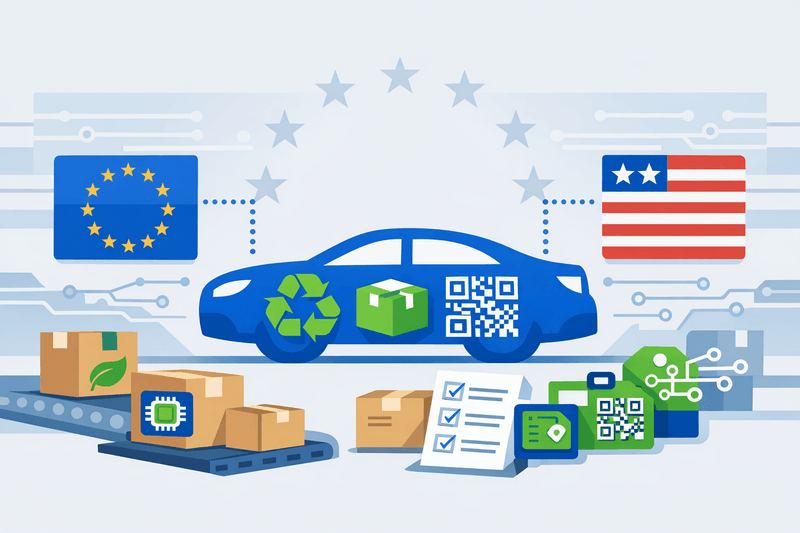
From 2027, packaging must carry digital identifiers such as QR codes linking to structured environmental information, including material composition, recyclability, and reuse details. The PPWR mandates a data carrier on all packaging to link to a Digital Product Passport, providing consumers, recyclers, and authorities with detailed information about the packaging's entire lifecycle.
In the United States, several EPR mandates moved from legislative theory to binding compliance in 2025, with seven states - Maine, Oregon, Colorado, California, Minnesota, Maryland, and Washington - now having packaging EPR laws. Oregon became the first state to officially launch its EPR programme on July 1, 2025, with mandatory PRO membership fees and noncompliance penalties of up to $25,000 per day.
Auto Industry Impact
Purchasing is the decisive lever for translating new packaging requirements into supplier specifications, contracts, and cost models. At AIAG's 2025 IMDS Conference, Toyota's Collin Stecker and Stellantis's Dan Hankinson outlined the direct financial implications for the sector. Through an industry working group, seven original equipment manufacturers reported paying about $1.1 million to Oregon alone. "It is a sizable economic impact on the auto industry right now," Stecker said, warning that costs will escalate as additional states adopt similar laws.
Hankinson highlighted how material choice directly affects fees, noting that while paper fiber carries a fee of "only 7.6 cents per pound," plastics carry significantly higher fees. "That's a huge indicator of where we're going to go with EPR," he said.
As of 2026, the Suppliers Partnership for the Environment (SP) is providing a new monthly EPR packaging policy brief as a members-only resource to help automotive companies track the evolving landscape. OEMs are expected to comply with EPR regulations and will need packaging information from their suppliers to support those obligations. Even companies not directly defined as "producers" may be required to report packaging data to customers doing business in relevant EPR states.
Starting in 2026, the PPWR requires companies to digitally track packaging and meet recycling quotas, making traceability a key compliance lever. Industry associations like the German Association of the Automotive Industry (VDA) are actively promoting the harmonisation of Auto-ID standards, collaborating with OEMs and suppliers through working groups to develop practical, end-to-end reference models and interface guidelines.
What Comes Next
From August 2026, fines will be imposed for noncompliance, and companies must meet new requirements on recyclability, labelling, packaging minimisation, and conformity assessment. Mandatory minimum recycled content targets for plastic packaging in the EU begin in 2030, with thresholds ranging between 30% and 65% depending on the packaging category. In the US, 2026 will be defined by the first major fee payment cycles and the expansion of EPR. Automotive packaging suppliers and OEMs that have not yet begun revising contracts and data-collection workflows face growing financial and market-access risk on both continents.