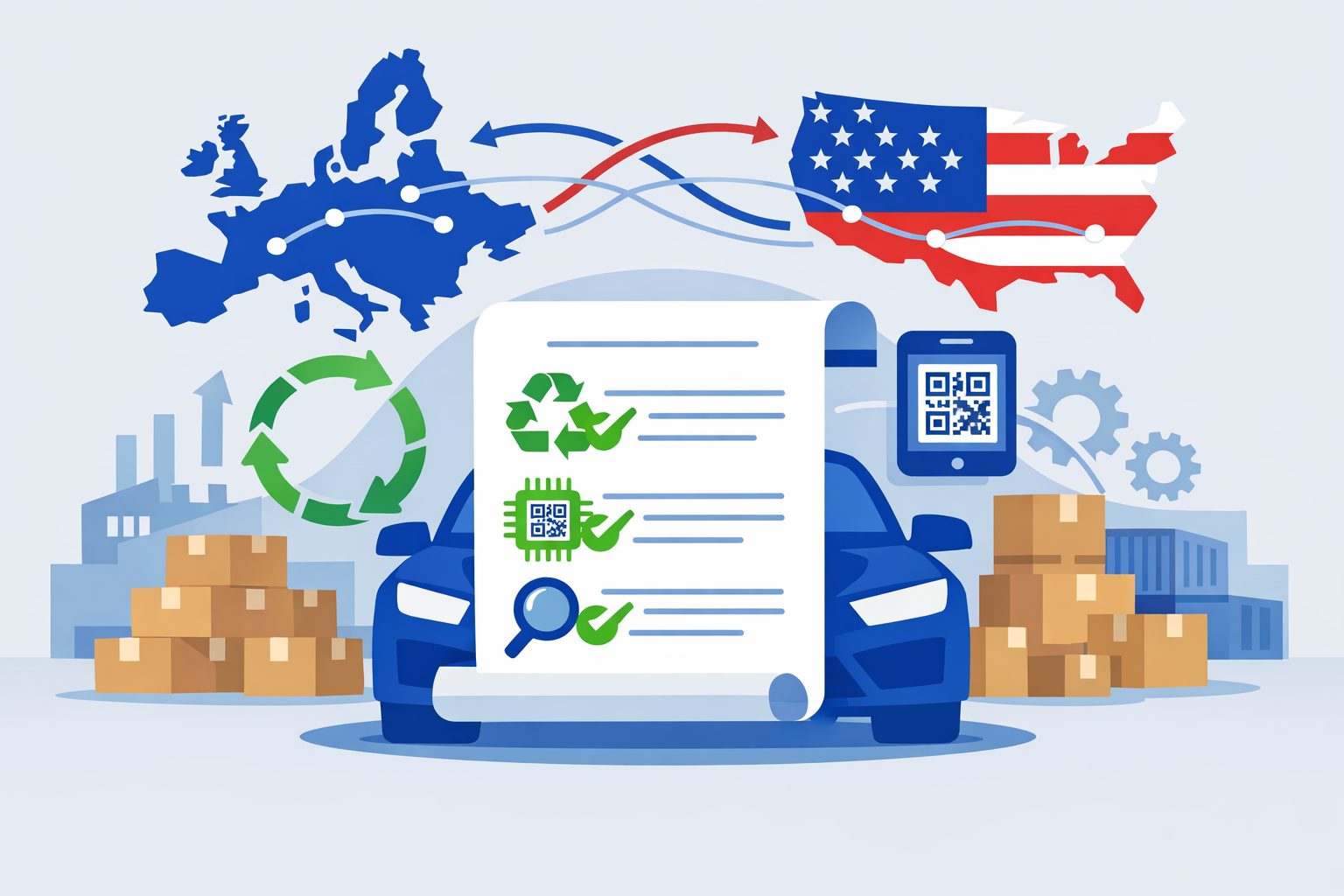
A growing body of packaging and sustainability regulation on both sides of the Atlantic is forcing automotive original equipment manufacturers to revisit cross-border supplier contracts at a pace the industry has rarely seen. With the EU's Digital Product Passport framework advancing toward enforcement and the Packaging and Packaging Waste Regulation applying from August 2026, procurement teams and legal departments face a compressed timeline to embed new compliance obligations into existing agreements - without derailing supply continuity.
The Regulatory Pressure Driving Contract Rewrites
Two converging regulatory frameworks sit at the center of the disruption.
On the EU side, Regulation (EU) 2025/40 - the Packaging and Packaging Waste Regulation (PPWR)[1] - entered into force on February 11, 2025, and will broadly apply from August 12, 2026. The regulation establishes enforceable minimum recycled-content targets for packaging, with a 30% recycled-content floor by 2030 and a 65% target by 2040. It applies to all operators placing packaging on the EU market, including manufacturers, importers, and distributors based outside the EU.
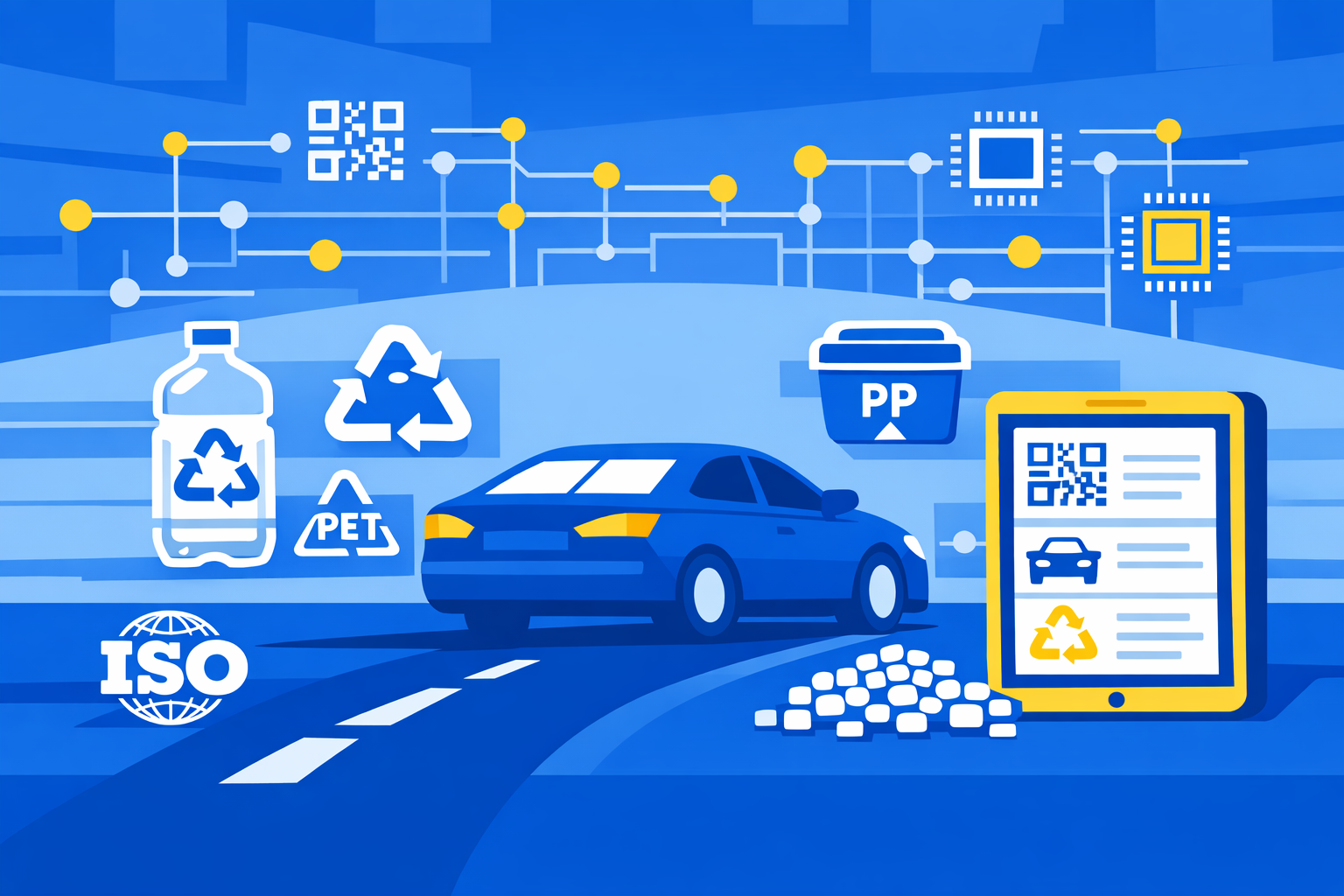
Alongside the PPWR, the EU's Digital Product Passport (DPP)[2] is advancing under the Ecodesign for Sustainable Products Regulation (ESPR), which took effect in July 2024. The DPP functions as a structured digital record - accessible via QR code, NFC chip, or RFID tag - storing verified data on a product's materials, recycled content, carbon footprint, and end-of-life pathways. By July 2026, the European Commission will deploy a central DPP registry to support enforcement and transparency, with automotive batteries subject to mandatory passport requirements from February 2027.
On the US side, the regulatory landscape remains fragmented but is accelerating. As of mid-2025, seven US states had enacted Extended Producer Responsibility (EPR) legislation covering packaging, with California, Oregon, and Colorado imposing recycled-content reporting deadlines in 2026. The absence of a unified federal DPP equivalent means US-based automotive suppliers serving EU markets must build compliance infrastructure that satisfies European standards regardless of domestic obligations.
Key contrast: The EU framework is centralized and prescriptive - one standard across 27 member states. The US system remains state-level and fragmented, creating a dual compliance burden for cross-border automotive supply chains.
What Changes in the Contracts
Recycled-Content Thresholds and Verification
Until recently, supplier agreements for automotive packaging rarely specified post-consumer recycled (PCR) content percentages. That is changing fast. OEMs sourcing parts and packaging from North American and Asian tier-one suppliers are inserting minimum recycled-content clauses tied directly to PPWR thresholds, with phased step-up provisions aligned to the 2030 target.
Critically, manufacturers must prove compliance through verifiable documentation[3], and the PPWR introduces eco-modulated EPR fees - lower for packaging with high recycled content, higher for virgin-material-based formats. This creates a direct financial incentive embedded in the procurement relationship: suppliers unable to substantiate recycled-content claims may expose OEMs to higher EPR fee liability, making third-party certification a contractual prerequisite rather than a preference.
Certifications such as the GreenBlue Recycled Material Standard and ISCC PLUS are increasingly referenced in qualification documentation. OEMs are also inserting audit rights provisions allowing them to verify supplier claims through on-site assessments or third-party audits - a clause largely absent from legacy agreements.
DPP Data-Sharing Clauses
The DPP requirement introduces a structurally novel change to contract language: mandatory data-sharing obligations. Digital passports are only as reliable as the upstream data feeding them[4], meaning OEM compliance depends entirely on suppliers providing verified, machine-readable information on material composition, geographic origin, recycled content percentages, and carbon footprint by lifecycle stage.
The DPP must contain over 100 data attributes[5], including material composition with geographic origin for conflict minerals, carbon footprint broken down by lifecycle stage, and recycled content percentages. Contracts are now being drafted to specify:
- Data format and frequency: suppliers must submit structured, machine-readable data aligned with ESPR field definitions
- Version control: passport data must be updated when bills of materials change or production sites shift
- Tiered access rights: separating public-facing consumer data from regulator-accessible compliance documentation and proprietary commercial data
- Liability allocation: defining which party bears penalties if DPP data is found inaccurate or incomplete during a market surveillance audit
The obligation to implement the DPP lies with the economic operator placing the product on the market[6], regardless of where it is manufactured. European OEMs importing North American auto parts carry the compliance liability - but their ability to fulfill it depends on data quality from US and Canadian tier-one and tier-two suppliers. In practice, the risk flows back through the contract.
Regulatory Timeline: Key Milestones for Cross-Border Auto Supply Chains
| Date / Deadline | Regulation / Requirement | Cross-Border Impact |
|---|---|---|
| Feb 2025 | EU PPWR (2025/40) enters into force | All packaging on EU market - including from US exporters - enters scope |
| Aug 2026 | PPWR general application date | Enforceable recycled-content reporting across supply chain begins |
| Jul 2026 | EU DPP central registry deployed | OEMs and tier-ones must register DPP data for batteries and industrial equipment |
| Dec 2026 | ECHA substances-of-concern review | May restrict additional materials in automotive packaging |
| Feb 2027 | Battery Passport mandatory | Industrial and EV batteries entering EU must carry full DPP |
| 2027-2028 | ESPR delegated acts: aluminium, tyres, vehicles | DPP cascades into broader automotive parts contracts |
| 2030 | PPWR 30% recycled-content target | Minimum threshold applies to all plastic packaging across EU supply chains |
EU vs. US Framework: Compliance Architecture Side by Side
| Compliance Factor | EU Framework (PPWR / ESPR / DPP) | US Framework (State EPR / EPA) |
|---|---|---|
| Structure | Single harmonized regulation across 27 member states | Fragmented - 7+ state EPR laws, no federal DPP mandate |
| Recycled-content targets | 30% by 2030, 65% by 2040 (packaging) | State-level PCR thresholds; vary by jurisdiction |
| Traceability tool | DPP - mandatory, machine-readable, QR/RFID-linked | No federal equivalent; sector-specific serialization only |
| Who bears obligation | Any operator placing product on EU market, regardless of origin | Producers/importers in regulated states only |
| Enforcement | Market access restriction; DPP registry verification | Eco-modulated EPR fees; state enforcement |
| Data retention | 5-10 years post-sale accessibility required | No federal packaging data retention mandate |
| Cross-border complexity | One standard; requires EU representative for non-EU manufacturers | Companies must manage multiple state schemes simultaneously |
Supplier Qualification: The Upstream Pressure Point
For tier-one suppliers, the contract revisions represent both a compliance burden and a qualification threshold. OEMs are increasingly treating DPP data readiness as a supplier qualification criterion - not merely a contractual obligation. Suppliers unable to demonstrate a credible data architecture risk being deprioritized in sourcing decisions during the next contract cycle.
Updating supplier contracts to include data submission obligations and requesting consistent bill-of-materials documentation[7] are now standard steps in DPP preparation frameworks recommended by compliance advisors. Platforms such as Catena-X and IMDS (International Material Data System)[8] are emerging as the practical exchange hubs through which OEMs and suppliers standardize compliance data sharing - improving consistency and reducing manual error in cross-border documentation.
The Automotive Industry Action Group (AIAG) is also developing voluntary supply chain transparency frameworks to give North American suppliers a structured pathway toward meeting EU data obligations without bespoke integration for each OEM customer.
Industry leaders speaking at the Odette 2025 conference highlighted the urgency of mapping responsibilities across the supply chain and identifying efficiency gains beyond compliance. One consultant from MHP, an IT subsidiary of Porsche, noted that some packaging has been in use for eight, nine, ten years or more - raising immediate questions about responsibility for historical documentation[9].
Data Sovereignty: The Hidden Cross-Border Complication
One compliance dimension receiving less attention in contract negotiations is data sovereignty. The EU's DPP framework operates under GDPR, which imposes European data localization expectations. US manufacturers serving European markets must implement full DPP compliance for those products regardless of domestic requirements[5] - but managing data flows between North American ERP systems and EU-compliant digital registries creates operational and legal friction.
Data sovereignty tensions add compliance complexity as jurisdictions impose conflicting requirements[5]: EU GDPR mandates European data-localization principles, while US systems may lack equivalent data residency capabilities. Contracts are beginning to address this through data processing addenda and clarified API integration standards - but the legal exposure remains underappreciated by many tier-two and tier-three suppliers that have not yet initiated DPP readiness programs.
Pricing Implications and Risk Allocation
The contract rewrites are not compliance-neutral from a commercial standpoint. Suppliers absorbing new costs - third-party certification, DPP system integration, PCR material sourcing, and audit readiness - are seeking cost-pass-through provisions or renegotiated pricing schedules.
The EU estimated the PPWR would cost around €9.4 billion in initial compliance expenditure, with long-term benefits projected at €50 billion[9]. For suppliers operating on thin automotive margins, absorbing even a fraction of that compliance infrastructure cost without contractual relief creates real financial exposure.
OEMs are responding in varied ways: some offer compliance co-investment programs, sharing the cost of supplier DPP integration; others treat compliance capability as a pass/fail qualification criterion. The split is reshaping competitive dynamics, particularly for mid-size tier-one suppliers lacking the IT infrastructure of larger global peers.
Securing reliable sources of high-quality recyclate - often through long-term contracts with recyclers[3] - is another pressure point. With EU demand for post-consumer recycled resin rising ahead of the 2026 application date, supply constraints are emerging, and contracts locking in PCR feedstock through 2028 or 2030 are becoming a strategic procurement priority.
What OEMs and Suppliers Should Prioritize Now
For packaging engineers, procurement leads, and sustainability managers navigating this transition, the following actions are highest priority ahead of the August 2026 enforcement window:
- Audit existing supplier contracts for gaps in recycled-content specification, DPP data obligations, and audit rights. Legacy agreements almost universally lack these provisions.
- Map parts and packaging to ESPR delegated act timelines - identify which components face mandatory DPP requirements by 2027 and prioritize those supplier relationships for renegotiation.
- Require structured, machine-readable data from tier-one and tier-two suppliers as a condition of continued qualification. Establish a minimum viable data set aligned with ESPR field definitions.
- Embed third-party certification requirements - ISCC PLUS, GreenBlue RMS, or equivalent - directly in supplier quality agreements, with audit rights provisions.
- Address data sovereignty in contract addenda - clarify which party manages EU GDPR compliance for DPP data flows and what data residency architecture is required.
- Lock in PCR feedstock supply agreements early to guard against recycled-material price spikes as EU demand accelerates toward 2030 targets.
Compliance is not a single deadline. The PPWR should be viewed as a multi-year transition, with phased obligations stretching from 2026 into the 2030s[1]. OEMs and suppliers that treat it as a series of rolling deadlines - rather than a one-off project - will be better positioned to absorb regulatory additions without disruption.
For more on how North American automakers are responding to state-level EPR mandates in parallel, see US Tightens 2026 Recycled-Content Mandates Under Updated Auto Packaging EPR Rules and Auto Supply Chains Embrace Ocean-Plastic Packaging as Certifications Tighten.
FAQ
Q: Does the EU's Digital Product Passport apply to packaging, or only to auto parts themselves? The DPP under the ESPR applies to regulated products - initially batteries and industrial equipment, expanding to vehicles and additional categories through 2028-2030. The PPWR separately governs packaging, introducing recycled-content targets and traceability obligations. Both frameworks interact for automotive shipments crossing the EU border, and both are driving contract revision pressure simultaneously.
Q: Do North American suppliers need to comply with EU DPP rules if they don't sell directly into the EU? Yes, indirectly. The obligation to implement the DPP lies with the economic operator placing the product on the EU market[6] - typically the OEM or importer. But that operator's compliance depends on data and material documentation from upstream suppliers. Contracts are increasingly making this an explicit supplier obligation.
Q: What third-party certifications are recognized for recycled-content verification? ISCC PLUS (International Sustainability and Carbon Certification) and the GreenBlue Recycled Material Standard are among the most widely accepted in automotive supply chain contexts. ESPR delegated acts will specify recognized verification standards on a product-category basis as they are published.
Q: What happens if a supplier can't meet DPP data requirements in time? Under the ESPR, products without a compliant DPP risk being denied market access in the EU. For OEMs, this creates a direct supply risk. Contracts being negotiated now increasingly address this through force majeure carve-outs, transition timelines, and - in some cases - OEM-funded compliance support programs for critical suppliers.
Q: How does the EU's 30% recycled-content target by 2030 affect packaging for automotive spare parts? The PPWR's recycled-content targets apply to packaging - the materials used to contain, protect, and ship products, including industrial and B2B packaging used in automotive spare-parts logistics. This includes plastic packaging common in aftermarket and spare-parts supply chains, which must meet minimum PCR content thresholds phased in between 2026 and 2030.