EU co-legislators reached a provisional political agreement in December 2025 on the new End-of-Life Vehicles (ELV) Regulation, introducing Europe's first mandatory recycled-plastic content targets for new vehicles and requiring a Digital Vehicle Circularity Passport (DVCP). The framework will oblige OEMs, tier suppliers, and packaging partners to share standardized material data across the supply chain.
Background
EU institutions reached a political agreement on the revised ELV framework in December 2025, and the compromise text was published in February 2026. The shift from a directive to a directly applicable regulation is more than a legal update-it reflects a broader policy move from end-of-life waste management toward lifecycle-based circularity. The new rules form part of a convergent regulatory push: a suite of updated legislative measures began taking effect in mid-2025 under the EU Circular Economy Action Plan and the Sustainable Products Initiative, setting legally binding requirements for recycled content in plastics, digital product passports for traceability, and design-for-recycling mandates.
Only 19% of plastics from end-of-life vehicles is currently recycled in the EU, according to data cited in the ELV agreement. Most materials recovered from ELVs consist of metal waste that is shredded but not sufficiently sorted or valorized. That gap underpins both the recycled-content targets and the mandatory traceability infrastructure now being legislated.
Details
The regulation introduces phased mandates for recycled plastic content in new vehicles. Under the provisional agreement, a minimum of 15% recycled plastic content will be required six years after entry into force, rising to 25% after ten years; at least 20% of those recycled content targets must be sourced from end-of-life vehicles, equating to 3% ELV-sourced recycled content at Phase 1 and 5% at Phase 2. The mandates apply to passenger cars, light commercial vans, regular heavy-duty vehicles, motorcycles, and special-purpose vehicles.
Interior components face particular scrutiny. Plastics comprise about 20% of a modern vehicle's weight, with interior parts such as dashboards, door panels, center consoles, and seat bases typically using ABS, PC/ABS blends, and modified polyolefins. Components including bumpers, interior panels, and dashboards must be separated during disassembly to enable high-quality recycling, and approaches such as chemical recycling may be needed to process complex plastic mixtures.
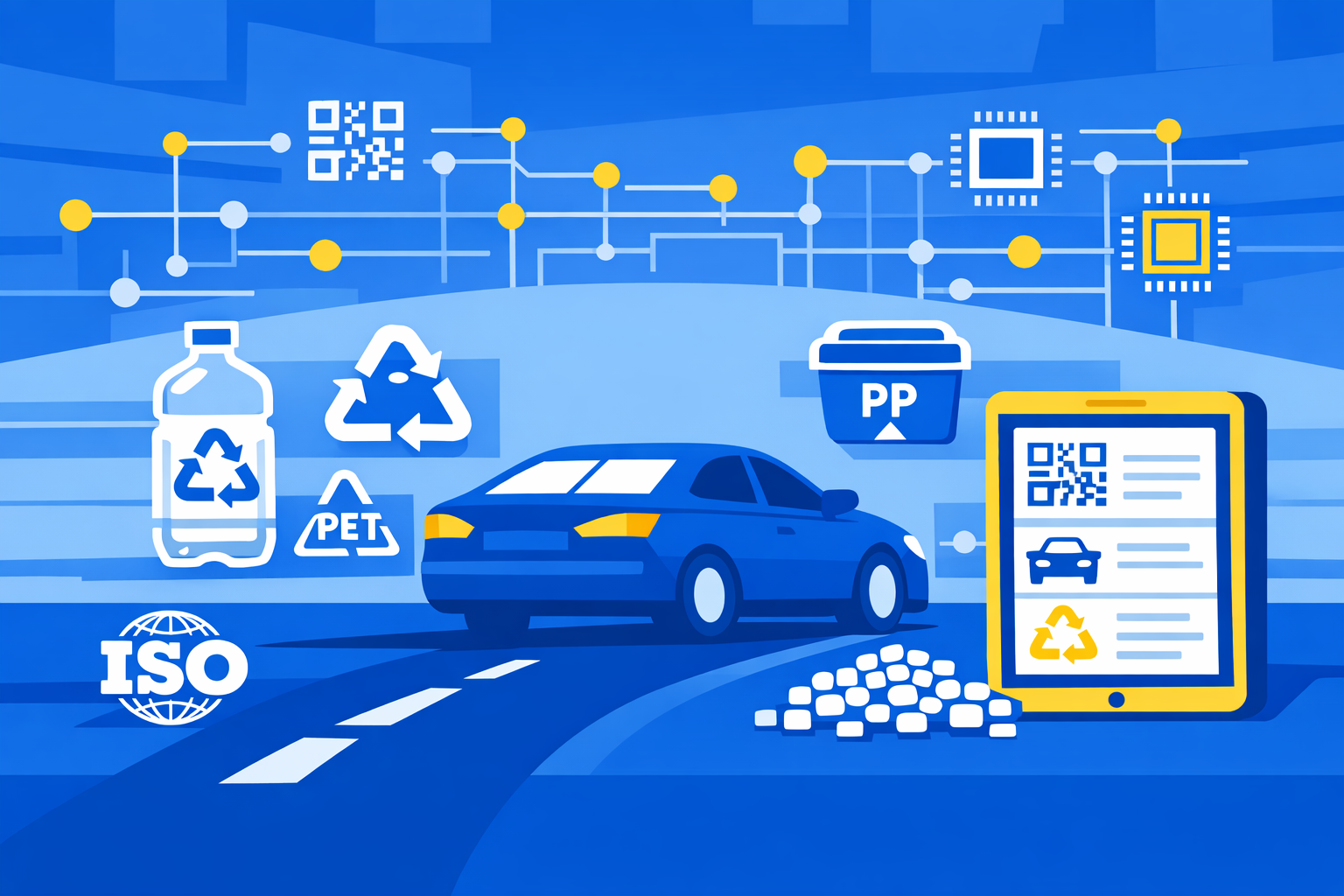
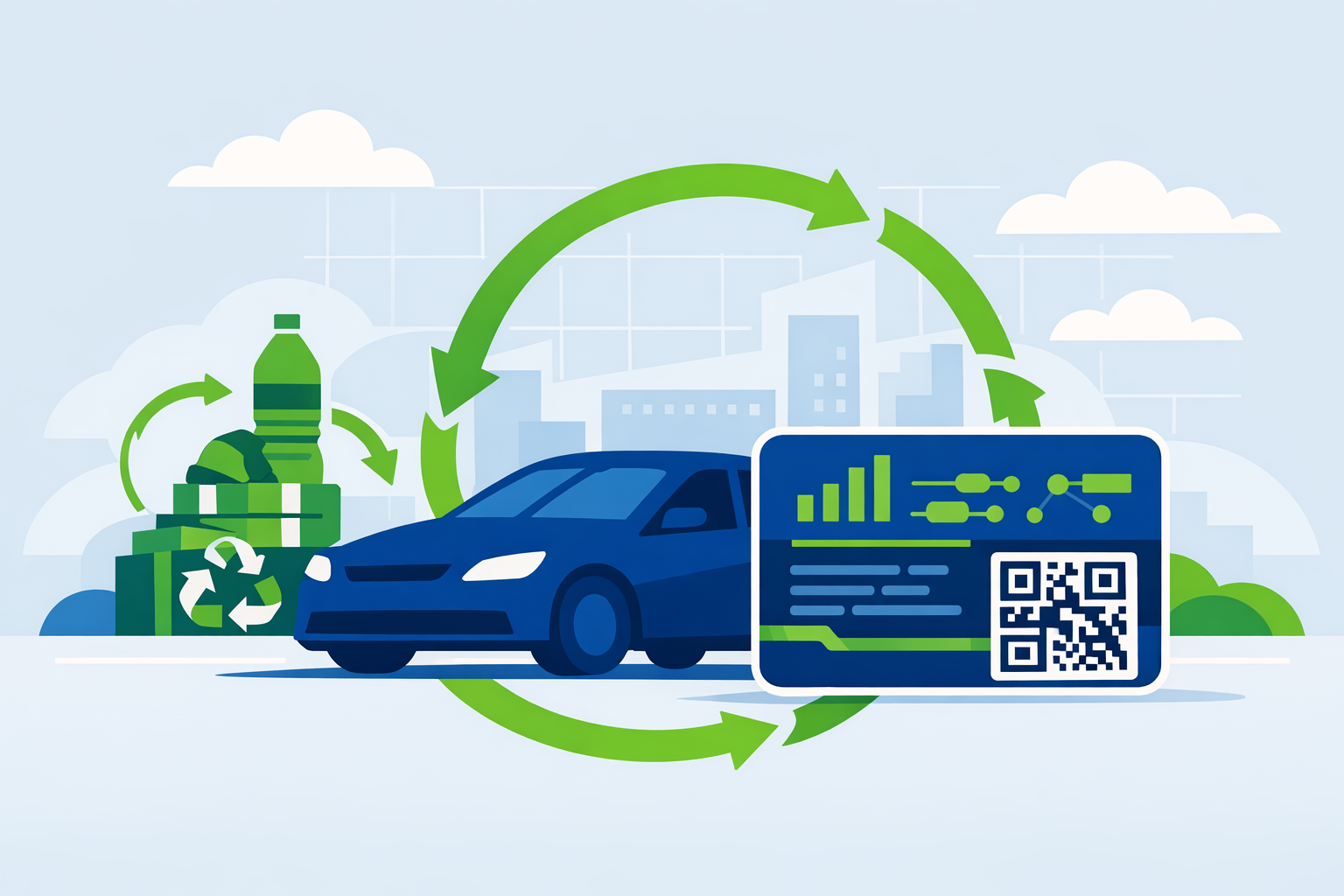
Central to compliance is the Digital Vehicle Circularity Passport. The regulation mandates a digital product passport (DPP) for vehicles; for end-of-life vehicles, the DPP will provide detailed information on components, materials, and recyclability, enabling more efficient dismantling and maximizing resource recovery. Starting in mid-2025, manufacturers must embed detailed material data into components through mandatory DPPs, listing polymer types per ISO 1043, additives and fillers, joining methods, and end-of-life handling instructions.
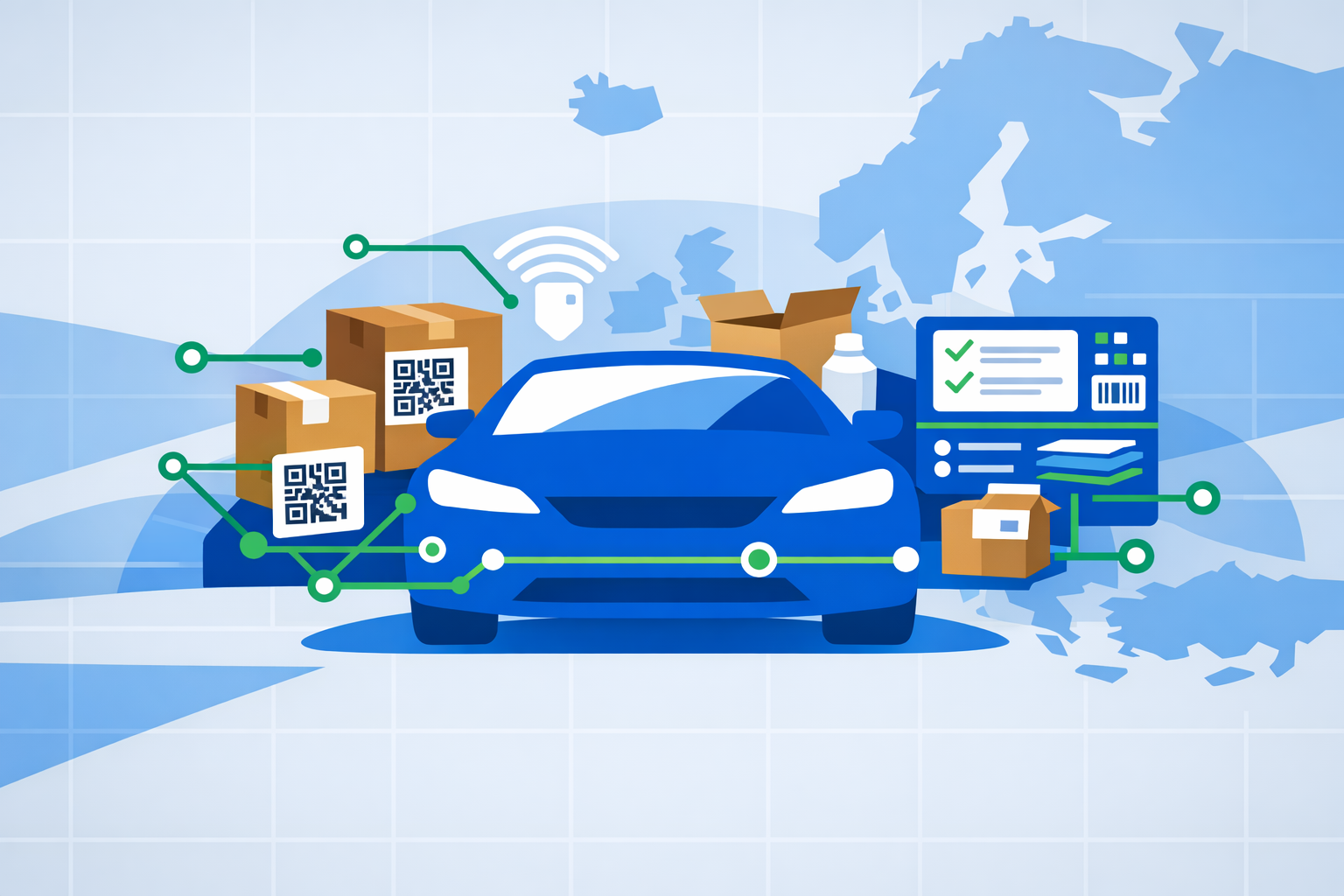
The data requirements cascade directly to packaging and supplier declarations. The DPP must be accessible via a physical or digital data carrier-such as a QR code, RFID chip, or barcode-affixed to the product or its packaging and compliant with ISO 15459 standards. It must be available electronically and free of charge to all stakeholders, and manufacturers and importers will be required to maintain it for at least 10 years after market placement. Porsche has already demonstrated this approach in practice, working with traceability software provider Circularise to trace plastics across multiple supplier tiers while maintaining data privacy.
Several leading OEMs and tier suppliers are moving to align with the tightening framework. Stellantis has stated plans to use 40% recycled content in vehicle plastics by 2030, focusing on non-visible structural parts including battery trays and underbody shields. Tier 1 supplier Faurecia has developed PP and ABS compounds tailored for injection molding with up to 50% recycled content, offering the dimensional stability and surface quality required for automotive interiors. BASF has developed chemically recyclable polyamide grades using pyrolysis oil feedstock certified through mass balance, designed to help OEMs meet recycled content targets without sacrificing component quality.
Outlook
Before formal adoption, the provisional agreement must still be endorsed by the Council and the European Parliament. One of the most consequential new elements-mandatory recycled material requirements for plastics-creates the legal basis for targets, but exact percentages and calculation methodologies are expected to be defined through later implementing acts. For supply chain and packaging teams, the ESPR emphasizes interoperability and digital accessibility, requiring companies to prepare structured, machine-readable data that can be shared securely across the value chain-a readiness challenge that extends from OEM product lifecycle management systems through to Tier 2 and Tier 3 packaging declarations.