The FAA's proposed framework for routine beyond-visual-line-of-sight drone operations is accelerating real-world pilots in automotive spare parts logistics, with Michigan emerging as the first state to launch a funded program delivering car components directly to dealerships by air.
Background
On June 6, 2025, President Trump signed Executive Order 14307, "Unleashing American Drone Dominance," directing the FAA to publish a proposed rule enabling routine BVLOS operations for commercial and public safety purposes, with a final rule required within 240 days. In response, the FAA published its Notice of Proposed Rulemaking (NPRM) for Part 108 on August 7, 2025-a document exceeding 700 pages-representing the most significant development in commercial drone regulation since Part 107 was introduced in 2016.
The proposed framework would replace the current waiver-based approval system, which has proved a persistent bottleneck for commercial operators. As of October 2024, the FAA had issued only 190 BVLOS waivers in total since 2020. Part 108 would introduce a scalable, performance-based structure with two tracks: operating permits for lower-risk missions such as package delivery, surveying, and agriculture; and full operating certificates for higher-risk, larger-fleet operations requiring safety management systems. The proposed rule also introduces new operator roles-Operations Supervisors and Flight Coordinators-to replace traditional remote pilot roles for BVLOS missions.
Automotive Sector Moves First
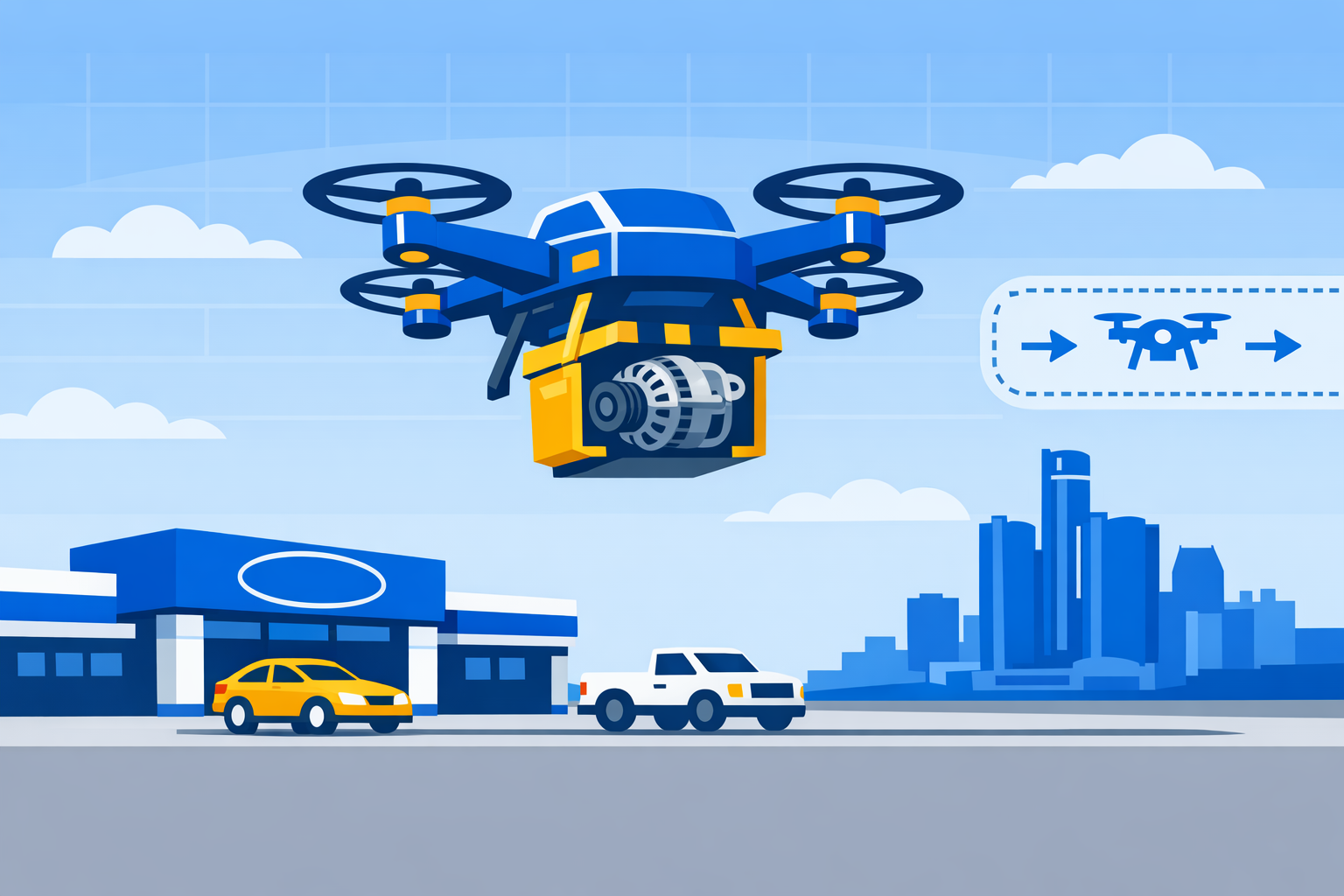
On July 17, 2025, drone company blueflite, Jack Demmer Ford, Centrepolis Accelerator, Airspace Link, and DroneUp launched a pilot program to deliver automotive parts by drone in the Detroit metropolitan area, funded by a $740,000 grant from Michigan's Advanced Air Mobility (AAM) Activation Fund. The initiative targets high-demand car parts, operating autonomous drones within a 12-mile radius of Jack Demmer Ford dealerships in Southeast Michigan, along the Ann Arbor-Detroit drone corridor.
The program addresses a recognized inefficiency in aftermarket parts logistics: road congestion and workforce shortages routinely disrupt dealership service operations, causing vehicle downtime and customer delays. By routing deliveries through the air rather than by ground transport, the partners aim to reduce repair turnaround times and strengthen supply chain resilience across the region's dense automotive supplier network.
Airspace management is handled through Airspace Link's enterprise-grade Drone Operations Management System (DOMS), which provides real-time operational oversight, advanced security frameworks, and urban airspace coordination. Governor Gretchen Whitmer signed Executive Directive 2025-4 to support drone use for both business and government operations in Michigan, positioning the state as a national leader in Advanced Air Mobility. The pilot's backers describe it as "a blueprint for scaling drone logistics across the automotive sector, and beyond."
Drone delivery economics show promise for small, high-value components. In 2025, drone delivery is estimated to offer cost savings of up to 70% for light packages compared to truck deliveries in eligible corridors. The Detroit pilot focuses on sensors, electronic modules, and specific trim pieces-components that are lightweight, frequently needed for common repairs, and highly sensitive to fulfillment delays.
Regulatory Safeguards and Industry Response
The Part 108 proposal introduces several layers of safety oversight. Operations under Part 108 must connect to certified Automated Data Service Providers (ADSPs) for traffic management and airspace deconfliction, as established under proposed Part 146. TSA background checks are required for operations supervisors and flight coordinators, and operators must maintain detailed logs covering flights, maintenance, training, incidents, and cybersecurity breaches.
After the public comment period closed on October 6, 2025, the FAA received more than 3,000 public comments. Industry concerns include the NPRM's reliance on population density as the primary risk metric, which critics argue disadvantages operations at access-controlled sites-such as automotive distribution centers-where mitigations like geofencing already reduce risk. A coalition of operators including the Drone Service Providers Alliance warned that requiring FAA review for every operational area "effectively becomes another waiver system."
Outlook
Under the Executive Order's 240-day timeline, a final Part 108 rule was expected by approximately March-April 2026, but after the FAA reopened the comment period in January 2026, industry observers now expect finalization in spring 2026, with implementation following 6-12 months later. For automotive aftermarket operators, finalization of Part 108 would eliminate the need to seek individual waivers for each new delivery corridor, significantly lowering the regulatory barrier to scaling drone logistics across service networks in rural and semi-urban markets. OEM parts suppliers and aftermarket distributors are monitoring the Michigan pilot closely as a proof of concept before committing to wider infrastructure investments.