The Federal Aviation Administration has issued its most significant drone regulation in nearly a decade-a proposed rule that would allow commercial operators to fly unmanned aircraft beyond visual line of sight without obtaining individual flight waivers. Logistics carriers and auto-parts shippers are now mapping the change into their long-term delivery strategies.
On August 7, 2025, the FAA, together with the U.S. Department of Transportation, TSA, and the Department of Homeland Security, published a notice of proposed rulemaking (NPRM) poised to reshape the regulatory landscape for commercial drone operations in the United States.[1] The 700-plus-page proposal represents the most significant development in commercial drone regulation since Part 107 was introduced in 2016. U.S. Transportation Secretary Sean Duffy announced the long-awaited NPRM on August 5, 2025, stating that it would create a standardized framework enabling commercial drone operators to fly beyond visual line of sight without applying for individual waivers.
Background
Under the current regime, BVLOS operations require individual Part 107 waivers-a process demanding separate FAA approval, extensive safety documentation, and site-specific authorizations for each operation. The process is time-consuming and unpredictable. Part 108 aims to replace this patchwork of waivers with a clear, standardized set of rules allowing certified operators to conduct BVLOS missions as routine.
The rulemaking has a direct political driver. On June 6, 2025, the President issued Executive Order No. 14307, "Unleashing American Drone Dominance," directing the Secretary of Transportation to propose a rule enabling routine BVLOS operations for commercial and public safety purposes. A final rule is to be published within 240 days of the order's date.
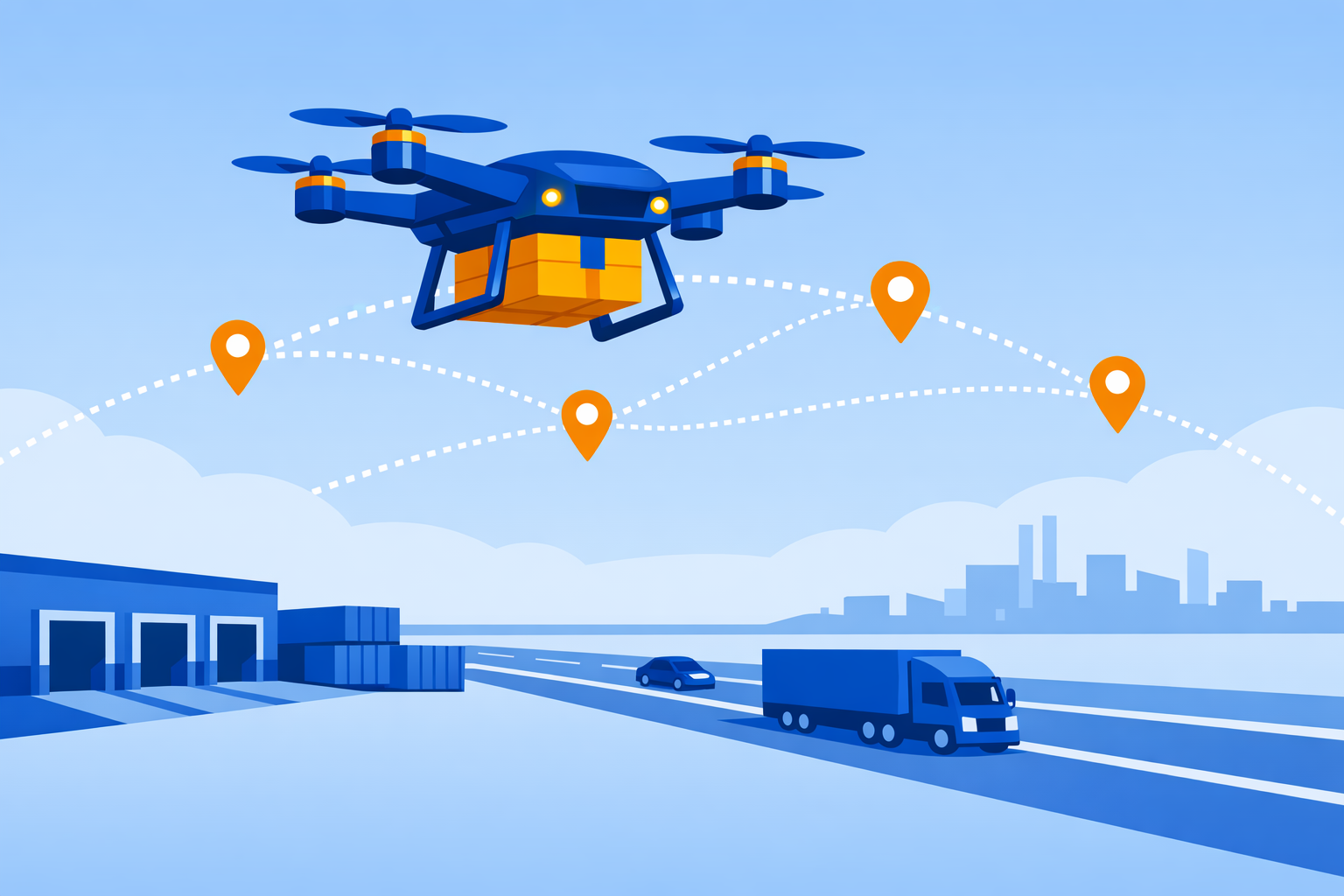
For auto-parts logistics, the framework matters because existing last-mile and inter-facility delivery models rely heavily on ground transport for high-frequency, lower-weight component runs-precisely the use case BVLOS drone operations address. Industries such as energy, agriculture, logistics, and public safety stand to benefit most from these changes.[2] The proposed rule explicitly lists package delivery as one of the core approved use cases under Part 108, alongside agriculture, aerial surveying, and public safety operations.
Details
The proposed rule would establish performance-based regulations for the design and operation of UAS at low altitudes beyond visual line of sight, as well as third-party services-including UAS Traffic Management (UTM)-that support these operations.
Key operational boundaries are specific. Operations would occur at or below 400 feet above ground level, launching from pre-designated, access-controlled locations. Operators must secure FAA approval for their intended flight areas, specifying boundaries, daily operation estimates, and zones for takeoff, landing, and loading.
The proposal introduces two distinct authorization tiers. Operating permits suit lower-risk operations with limitations on aircraft size, weight, and scope, offering a streamlined approval process for routine missions in less densely populated areas. Operating certificates enable more complex operations with larger aircraft and greater flexibility, including flights over people, but require more rigorous FAA oversight, safety management systems, and comprehensive training programs.
Notably, drones up to 110 pounds are eligible for BVLOS under the proposed Part 108, compared with the current 55-pound limit under Part 107. Safety separation is also codified: drones would need technologies enabling them to automatically detect and avoid other aircraft and would yield to all manned aircraft broadcasting their position via ADS-B.
Compliance responsibilities shift significantly from individual pilots to operator organizations. The proposed rule eliminates individual pilot certification; instead, the operating entity must ensure staff are properly trained-a corporate responsibility model that marks a key departure from Part 107, where operational responsibility falls on the individual operator.
After the 60-day comment period closed on October 6, 2025, the FAA received over 3,000 public comments reflecting widespread industry perspectives. Concerns centered on the transition for existing waiver holders. Industry drone associations noted that the NPRM lacks a clear mechanism for operators with existing Part 107 BVLOS waivers to move to Part 108 and urged the FAA to create a streamlined grandfathering pathway recognizing proven safety records.
For carriers integrating drone flights with traditional trucking networks, UTM connectivity is a critical preparation item. UTM will enable multiple drones to operate under BVLOS regulations in low-altitude airspace below 400 feet above ground level; BVLOS refers to any drone operation flown outside the pilot's direct line of sight. Operators must use FAA-approved Automated Data Service Providers to support scalable BVLOS operations, keeping drones safely separated from both other drones and crewed aircraft.
Outlook
A final rule is expected by spring 2026, with implementation anticipated 6 to 12 months after publication. The FAA reopened a limited comment period on January 28, 2026, specifically addressing electronic conspicuity standards-the technology drones use to detect and yield to manned aircraft-indicating that at least one technical element remains under active revision.
Following final rule publication, operators should expect a 6-to-12-month implementation period before requirements become enforceable. Organizations that begin preparation now will be positioned to operate as soon as the rule takes effect. For supply chain and packaging professionals in the automotive sector, that preparation includes auditing current carrier networks for UTM integration readiness, reviewing insurance and liability structures that now apply at the organizational rather than individual pilot level, and identifying which distribution nodes-such as parts distribution centers and dealer hubs-qualify as pre-designated BVLOS launch and landing sites under the proposed framework. The transition to routine drone-based auto-parts delivery hinges not only on the final rule but on how quickly operators can meet the new data, safety, and airspace coordination standards it demands.