Regulators in Europe and North America are advancing mandatory recycled-content requirements for automotive interior components, forcing OEMs and Tier 1 suppliers to redesign procurement strategies, qualify new material grades, and audit supply chains long dependent on virgin plastics.
Background
Regulatory pressure is most advanced in Europe, where the EU's End-of-Life Vehicles (ELV) Regulation revision - proposed by the European Commission in 2023 and now moving through co-legislative proceedings - represents the most consequential shift in automotive materials policy in decades. The framework links vehicle design requirements directly to end-of-life treatment for the first time. The joint European Parliament committee adopted its report on the ELV Regulation revision on 7 July 2025, with 79 votes in favour, 27 against, and 11 abstentions.
Under the Parliament committee's position, new vehicles would be required to contain a minimum of 20% recycled plastic by weight from post-consumer plastic waste, six years after the regulation's entry into force - a reduction from the Commission's original 25% proposal, reflecting acknowledged supply chain constraints. The original Commission proposal required at least 25% recycled plastic in new vehicles, with 25% of that fraction derived from end-of-life vehicles - equating to approximately 6.25% closed-loop content overall.
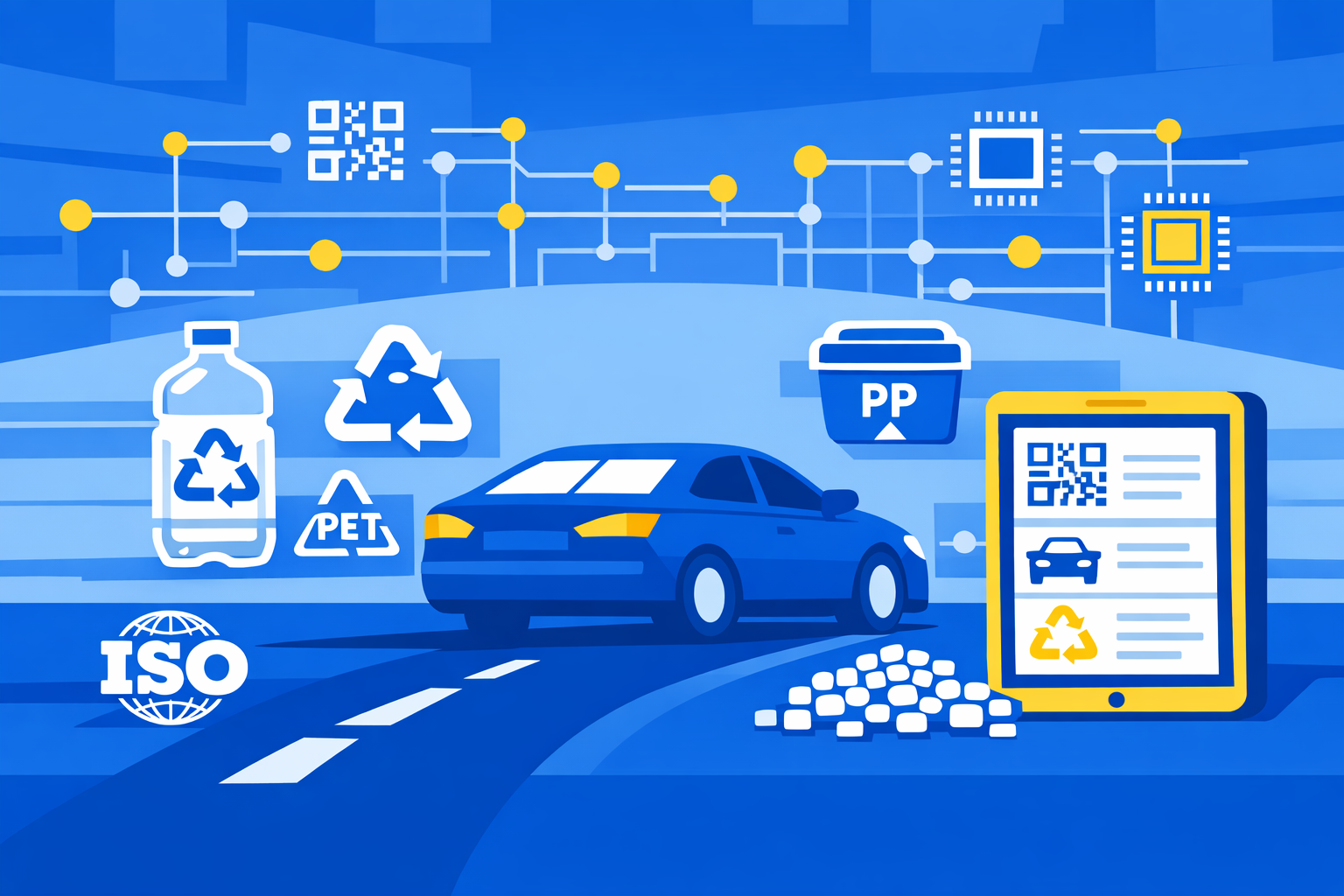
Alongside the mandatory targets, the EU's 2025 directive requires manufacturers to embed detailed material data into components through mandatory digital product passports, listing polymer types, additives, joining methods, and end-of-life handling instructions. This traceability infrastructure is considered a prerequisite for sorting automation and regulatory auditing across the supply chain.
In the United States, no equivalent federal mandate specifically targets recycled content in automotive interior components. However, pressure is building through other channels. By late 2025, California, Colorado, Maine, Maryland, Minnesota, Oregon, and Washington had rolled out Extended Producer Responsibility (EPR) programs for packaging, making producers responsible for post-consumer packaging and linking costs to recyclability and environmental impact. At the federal level, the EPA has focused primarily on plastic recycling infrastructure and advanced recycling classification rather than imposing component-level recycled-content mandates for automotive interiors.
Details
The practical challenge for the supply chain is substantial. Automotive-grade recycled polypropylene (rPP), polyethylene (rPE), and polyamide (rPA) remain in short supply, and most plastics from scrapped vehicles are either downcycled into non-automotive applications or incinerated due to the lack of standardized collection and sorting systems, according to IDTechEx. An analysis by the EU's Joint Research Centre found that about 3% of plastics that go into car manufacturing end up in the recyclates market.
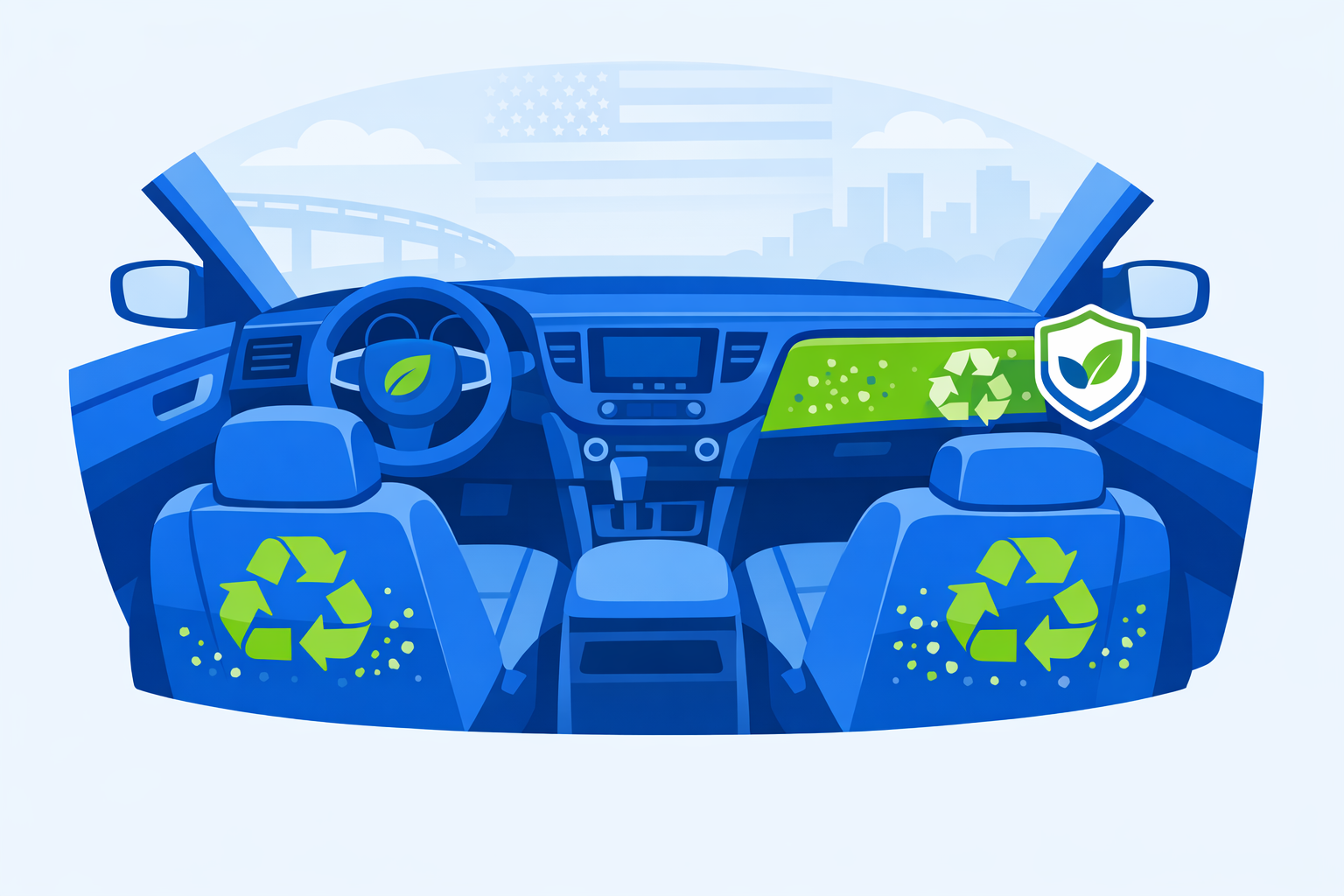
The cost gap between virgin and sustainable plastics remains a significant barrier to wider adoption in automotive applications, IDTechEx noted. That cost differential is a central concern for OEM procurement teams, particularly for interior applications - dashboards, seating fabrics, and door trim - where surface quality and VOC emissions standards constrain material substitution.
Testing requirements are also intensifying. According to testing firm SGS, recycled materials can introduce variability in composition, emissions, and mechanical performance, creating new testing and verification challenges for manufacturers, with material heterogeneity, potential contamination, and batch-to-batch inconsistency requiring robust analytical validation and quality assurance protocols. Verification against standards such as ISO 14021 is increasingly required for supplier qualification.
Some OEMs and Tier 1 suppliers are moving ahead of mandates. Stellantis has committed to using 40% recycled content in vehicle plastics by 2030, partnering with European recyclers to obtain post-consumer polypropylene and polyamide compounds, with a focus on non-visible structural parts. Tier 1 supplier Faurecia has developed polypropylene and ABS compounds under its NAFILean and MATTrim brands, tailored for injection molding with up to 50% recycled content. BASF has developed chemically recyclable polyamide grades, including Ultramid Ccycled, which use pyrolysis oil feedstock certified through mass balance accounting.
For mono-material polypropylene interior components - a common substrate for dashboards and door panels - IDTechEx analysts note that the challenges to introducing recycled content are more straightforward to overcome, making these the major near-term target for automotive manufacturers.
Outlook
The EU ELV Regulation is expected to enter into force once trilogue negotiations between the Parliament, Council, and Commission conclude, setting the compliance clock for OEMs selling into the European market. US-based manufacturers with European sales exposure will face equivalent pressure regardless of domestic federal inaction.
Industry observers anticipate that digital product passport requirements and recycled-content thresholds will ripple into global supplier contracts, as OEMs seek unified specifications rather than maintaining divergent regional procurement standards. Investment in recycling facilities and advanced sorting infrastructure will determine whether automotive-grade post-consumer recyclate supply can meet the volume and consistency demands that mandatory targets will create.