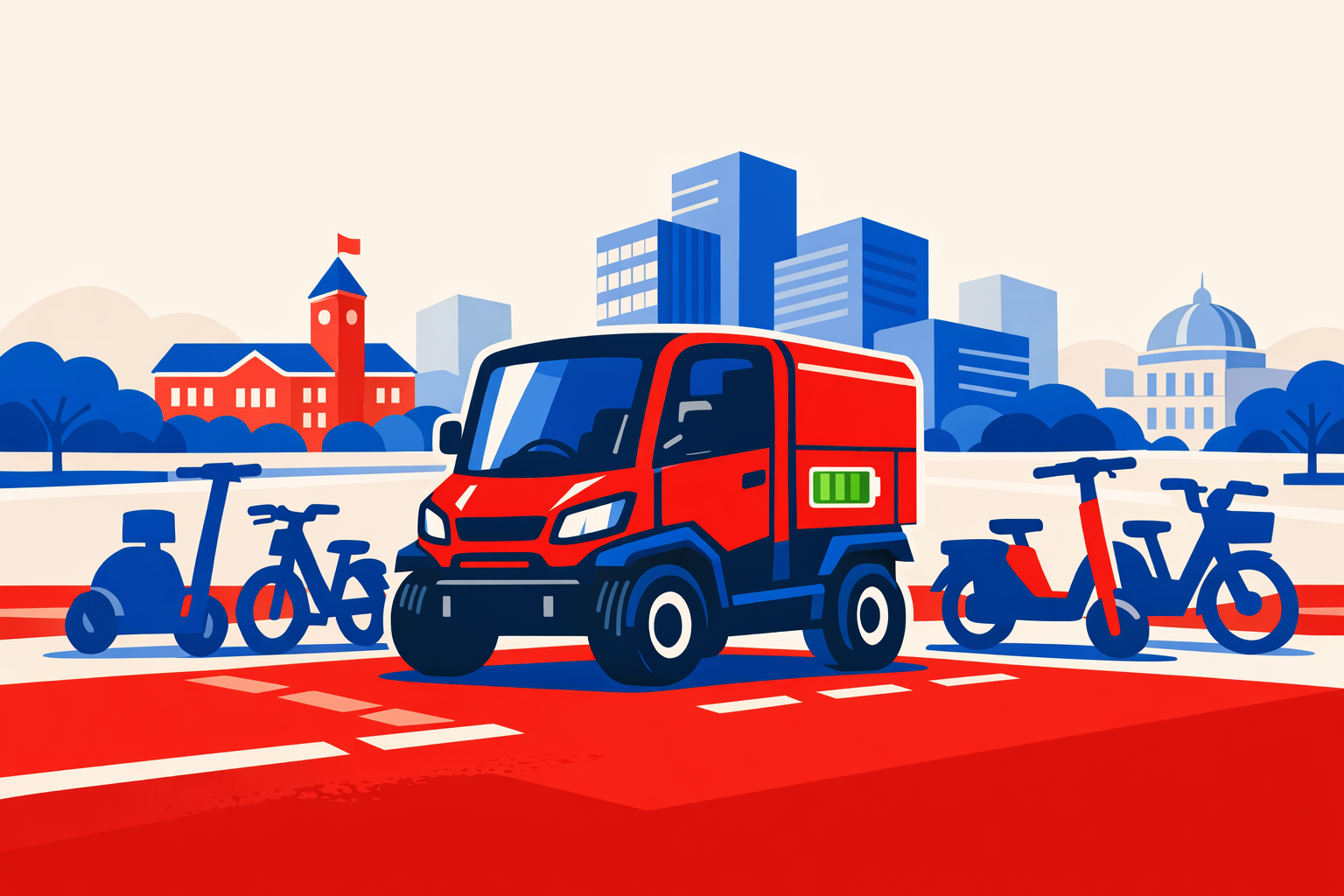
Honda's urban logistics venture Fastport has signed a commercial agreement with Third Lane Mobility - parent company of shared micromobility operators Bird and Spin - to deploy its all-electric eQuad vehicle in urban field operations across the United States. The deal marks the first confirmed commercial use of the platform since it moved beyond prototype testing.
Background
Fastport was established by Honda in 2023 through the automaker's New Business Innovation Lab in Torrance, California, with the goal of developing purpose-built electric vehicles for last-mile urban logistics. Honda formally unveiled the Fastport eQuad prototype at Eurobike in Frankfurt, Germany, in June 2025, announcing plans to begin first-edition deliveries by late 2025 and general mass production in summer 2026. U.S. production of the eQuad is planned for the Honda Performance Manufacturing Center in Marysville, Ohio - the same facility that previously produced the Acura NSX.
The April 16, 2026 announcement with Third Lane Mobility represents one of the first commercial deployments of the eQuad and its accompanying Fleet-as-a-Service (FaaS) platform, with sales to commercial customers now underway.
The partnership addresses a structural inefficiency that has long burdened the shared micromobility sector. Bird and Spin operate e-scooter and e-bike programs in more than 200 cities worldwide, yet their field teams have historically relied on full-size vans and trucks for battery swaps, vehicle rebalancing, and routine maintenance - meaning zero-emission consumer devices were serviced by gas-powered commercial vehicles.
Details
Initial deployments of the eQuad will launch in select university campus markets and major metropolitan areas across the United States, according to the April 16 joint announcement. Bird and Spin field teams will use the vehicles for battery swapping, repositioning scooters and e-bikes to match rider demand, and routine maintenance. Specific launch markets, fleet volumes, and integration timelines have not been disclosed.
The eQuad is a single-rider, all-electric four-wheel vehicle engineered for use in bike lanes and compact urban corridors, with a maximum speed of 12 miles per hour. The larger model supports a payload of up to 650 pounds; the smaller variant handles up to 320 pounds. Both variants are powered by Honda's swappable Mobile Power Pack batteries, which eliminate fixed charging downtime. The vehicle incorporates software-defined vehicle (SDV) capabilities, including over-the-air updates, fleet diagnostics, and API-ready integration managed through Fastport's FaaS platform. The larger model has a range of up to 23 miles when fully loaded, according to Honda specifications.
"We created Fastport and our eQuad micromobility vehicle to address rising urban congestion, emissions and operating costs where full-size commercial vehicles are less practical," said Jose Wyszogrod, general manager of Fastport.
Stewart Lyons, CEO of Third Lane Mobility, framed the commercial case alongside municipal sustainability commitments. "The partnership between Bird and Fastport is really about bringing a zero-emissions fleet to support vision zero goals in a way that's more economical for our business," Lyons said. Many cities condition Bird and Spin operating licenses on demonstrated sustainability practices, according to Destination Charged, making the eQuad's zero-emission profile a compliance consideration as much as a cost one.
The FaaS platform combines AI-powered dashboards, real-time diagnostics, and over-the-air software updates, enabling fleet operators to monitor utilization, optimize routes, and scale without the capital overhead of traditional vehicle ownership. Fastport positions the model as a way for operators to right-size their fleets - matching vehicle type to the specific demands of dense urban environments rather than defaulting to full-size commercial alternatives.
Outlook
Fastport has confirmed the eQuad and FaaS platform are commercially available in multiple regions across the United States, with the company indicating it is expanding deployments as partnerships scale. Beyond shared micromobility, Fastport is targeting a broader set of commercial segments, including parcel and grocery delivery, food and beverage service, direct-to-consumer distribution, and municipal fleet operations.
Use of bike lanes is subject to local regulations, according to Honda's own disclosure - a variable that will influence deployment viability market by market and remains a key regulatory consideration for urban logistics operators evaluating the platform.