A cluster of EU-backed Moldovan entrepreneurs is converting locally collected paper waste into sustainable packaging for industrial and automotive applications, positioning the country as an emerging test case for circular packaging models ahead of sweeping EU regulatory deadlines.
Background
The Republic of Moldova has become an unexpected hub for paper-waste-to-packaging innovation, driven in part by structured grant programs under the European Union's EU4Youth initiative. The EU4Youth - Youth Employment and Entrepreneurship programme trained 170 young people in Armenia, Georgia, and Moldova in 2024, guiding them from ideas to viable business plans. A total of 36 young entrepreneurs across those three countries received microgrants, of whom 18 were young women and 17 were classified as disadvantaged young persons. The programme operates under the EU's Eastern Partnership framework and is funded by the European Union and the Lithuanian Ministry of Foreign Affairs.
The policy backdrop has sharpened commercial interest in the sector. The EU's Packaging and Packaging Waste Regulation - Regulation (EU) 2025/40 (PPWR) - entered into force on 11 February 2025 and will generally apply from 12 August 2026. The regulation mandates that all packaging placed on the EU market must be designed for recyclability or reusability by 2030, and sets a 65% recycling rate target for all packaging waste by 2025, rising to 70% by 2030. Packaging waste in the EU has increased by over 20% over the last decade, and the regulation applies to all materials and origins, covering manufacturers, importers, and distributors.
Details
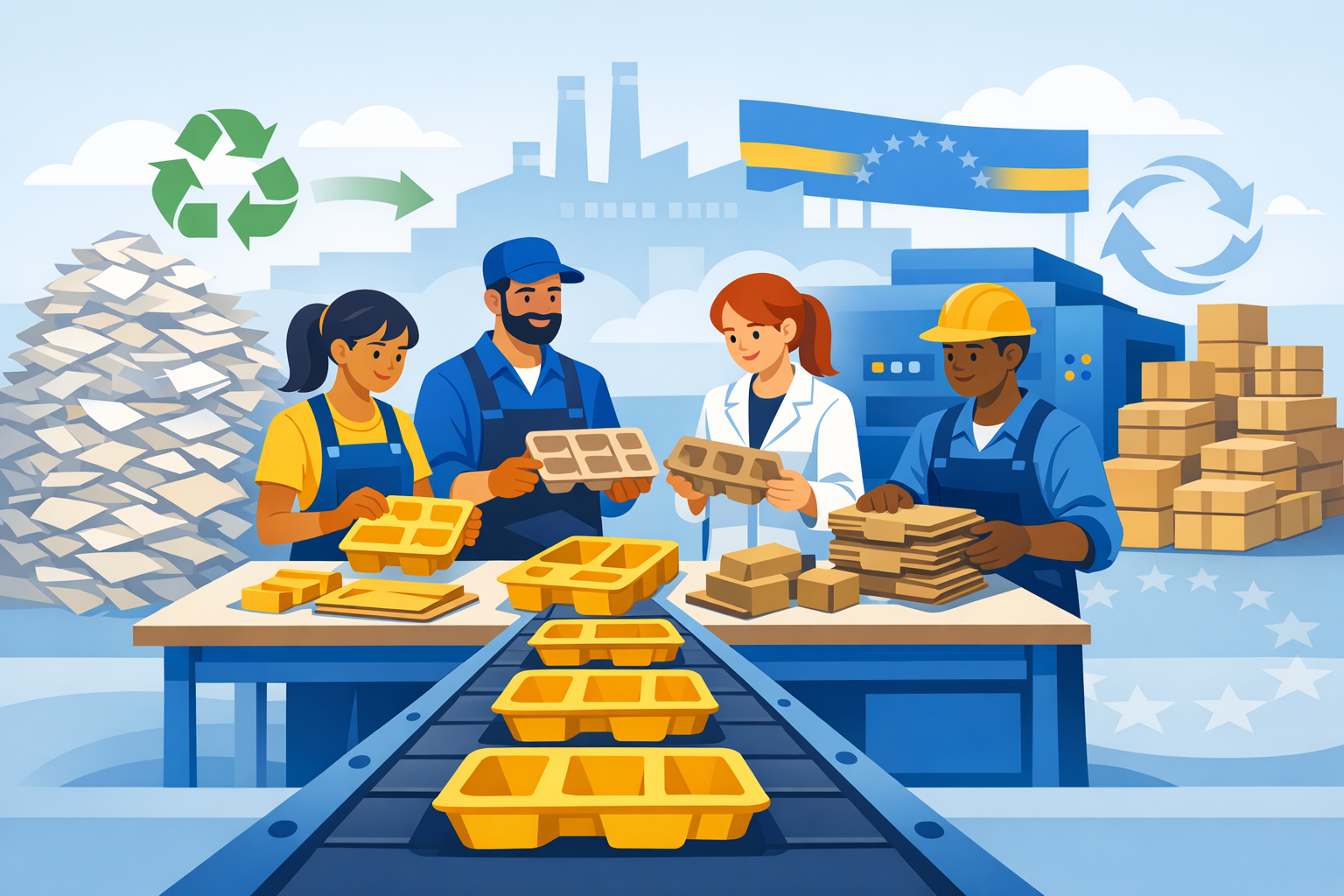
Among the ventures drawing attention is Repack, a Moldovan startup selected for the UNDP-supported BOOST: Green Futures acceleration programme. Repack transforms local paper waste into compostable trays designed to replace plastic in packaging applications including fruit, vegetable, and industrial product packaging. The project's scalability-using locally sourced feedstock and decentralized production-has attracted interest from sustainability managers examining low-cost circular sourcing for automotive aftermarket parts.
Separately, Alin Hartik, who manufactures recyclable paper and cardboard packaging, received a grant of nearly 300,000 Moldovan lei (approximately €15,000) from the Organization for Entrepreneurship Development to automate production processes. Automation grants of this type signal that Moldova's paper-recycling packaging segment is maturing from craft-scale output to semi-industrial capacity.
The EU4Youth EUnlocking project, co-funded by the European Union and implemented by a consortium led by Germany's Gustav-Stresemann-Institut, further underpins this ecosystem. Its targets include establishing an active network of 500 social entrepreneurs in Moldova and Ukraine and creating an EcoHub that provides seed funding for up to 15 social start-up initiatives focused on environmental sustainability. This institutional scaffolding-combining microgrants, mentoring, and cross-border learning exchanges-is what supply chain and procurement professionals say distinguishes the Moldovan model from isolated pilot projects in larger EU markets.
Broader EU infrastructure investment reinforces the waste-feedstock pipeline. The European Union committed €1.8 million to modernize waste management systems in the Moldovan municipalities of Călărași, Ungheni, and Leova, with voluntary collection centers designed to handle paper and cardboard waste, among other materials. These centers, implemented through UNDP Moldova, aim to ensure a more reliable and traceable supply of post-consumer paper waste for downstream processors.
Replication potential across EU candidate and member states is a key question for packaging engineers and supply chain directors. The EU4Youth programme combines capacity building, policy support, and micro-financing to create favorable ecosystems for social entrepreneurship in the Eastern Partnership countries, which include Armenia, Azerbaijan, Belarus, Georgia, Moldova, and Ukraine. Industry observers note that the financing architecture-modest upfront grants paired with acceleration support-is deliberately designed to be replicated in regions with similar waste volumes and limited industrial infrastructure.
Outlook
With the PPWR's core obligations taking effect in August 2026 and mandatory reuse targets for transport packaging applying from 1 January 2030, automotive suppliers sourcing from or exporting to EU markets face tightening timelines to qualify paper-based and compostable packaging solutions. Moldovan startups operating within EU-aligned grant frameworks may offer procurement leads a compliant and cost-competitive supply chain entry point. Whether individual micro-enterprises can reliably meet the quality, volume, and traceability requirements demanded by automotive OEMs and tier-one suppliers remains the central operational question for the sector.