Only a small fraction of North America's automotive technicians are currently EV-proficient - yet EVs are projected to account for more than 50% of new vehicle sales by 2030, and the repair market is accelerating accordingly. For independent service shops, that math creates both a mounting liability and a narrow window of competitive opportunity. A wave of new credentialing initiatives, trade association partnerships, and community college programs is targeting that gap - but barriers of cost, tool access, and proprietary data remain formidable.
The Skills Gap Is Real and Widening
Demand for technicians who can safely work on electric vehicles is outpacing supply. Industry research indicates that only a small fraction of technicians today are truly EV-proficient - even as EV registrations climb and early models age out of warranty.
The core challenge is not simply a lack of ambition among independent shops. Dealerships expect new hires to understand both ICE and EV platforms, but legacy training often lacks depth in high-voltage systems - and that gap creates opportunity. Independent shops that move early stand to capture premium labor rates, while fleet operators, rental companies, and municipal agencies actively seek qualified EV maintenance partners.
The urgency is compounded by service capacity constraints. In recent studies of EV owners, more than 80% needed at least one service visit in the first year, while same-day service availability dropped from roughly 40% in 2023 to under 30% in 2024, with more owners reporting waits of three days or longer. That pressure is pushing EV owners toward independent shops - provided those shops are qualified to help.
The Credentialing Landscape: Who Is Setting the Standards?
A multi-tier credentialing framework is emerging to serve technicians across the skills spectrum.
ASE xEV Electrical Safety Certifications
The most widely recognized independent credential comes from the National Institute for Automotive Service Excellence. ASE's xEV High-Voltage Electrical Safety certifications were developed to share existing industry standards, concepts, and practices for individuals working in the automotive, truck, and commercial electrical industry.
The program operates at two levels:
- Level 1 - xEV Electrical Safety Awareness Certification: Covers high-voltage electrical safety awareness to identify hazards and reduce associated risks when working on or near electrified propulsion vehicles (xEVs) and/or high-voltage components. Priced at $38.99[1] and delivered via online exam.
- Level 2 - xEV Technician Electrical Safety Certification: Targets service professionals, technicians, and specialists who have received high-voltage electrical training and demonstrated skills and knowledge related to the construction, operation, and repair of high-voltage vehicles. Priced at $49.99 and valid for five years[1].
Although hybrids have been on the road for more than 20 years, many shops remain unfamiliar with the risks of high-voltage vehicles or uncomfortable working on or around them. The ASE certifications are designed precisely to address that awareness deficit.
OEM Academy and Blended Learning Programs
Beyond ASE, manufacturer-specific pathways are accelerating. OEM academies - Tesla, Ford, GM, Hyundai, and others - certify technicians on their specific EV platforms, tools, and software workflows.
For independent shops without OEM affiliation, blended programs like FutureTech's EVPro+[2] fill a critical role. EVPro+ offers a one-stop blended learning program for automotive transportation service professionals - from technicians and service advisors to instructors, engineers, and managers - with online components, in-person training, and an optional certification test that yields an SAE-ITC certificate valid for five years.
Community and technical colleges are also scaling up delivery. Carroll Community College's Hybrid/Electric Vehicle Technician program serves both current auto technician students and experienced mechanics. One college official noted that the program "doesn't just benefit students - it sparks the ignition for local small automotive repair businesses."
Key Credential Programs at a Glance
| Program / Provider | Level | Format | Credential Issued | Core Focus |
|---|---|---|---|---|
| ASE xEV Electrical Safety (Level 1) | Awareness | Online exam | ASE xEV L1 Certificate | HV hazard ID, non-HV maintenance |
| ASE xEV Technician Electrical Safety (Level 2) | Technician | Online exam | ASE xEV L2 Certificate (5-yr) | HV isolation, diagnostics, repair |
| FutureTech EVPro+ (SAE-ITC) | L1-L3 Blended | Online + in-person | SAE-ITC Certificate (5-yr) | Hybrid/EV/PHEV systems and diagnostics |
| UTI Automotive & EV Technology | Post-secondary | In-person campus | Diploma + OEM MSAT eligibility | EV powertrain, Bosch diagnostics |
| George Brown College EV Technician | Certificate | Self-paced online | EV Technician Certificate | HV diagnostics, BMS, charging stations |
| Legacy EV Fundamentals Bootcamp | Fundamentals | Hands-on in-person | Completion certificate | BMS, fault-finding, training bench work |
High-Voltage Safety: The Non-Negotiable Foundation
Any EV training program must begin with one fundamental: high-voltage systems are unlike anything independent shops have serviced before.
⚠️ Safety First: A traditional car battery operates around 12 volts; EV battery packs typically range between 400-800 volts. In most electric vehicles, anything over 60 volts DC or 30 volts AC is classified as high-voltage. Working on live circuits without documented authorization, proper PPE, and lockout/tagout procedures can be fatal.
OEMs and independent training providers now require technicians to hold formal high-voltage certification before disconnecting a pack, opening an inverter, or touching orange-sheathed cabling. The consequences of skipping this step are severe: EV batteries are powerful and sensitive, and improper handling can cause damage or trigger thermal runaway - a dangerous chain reaction that can lead to fire.
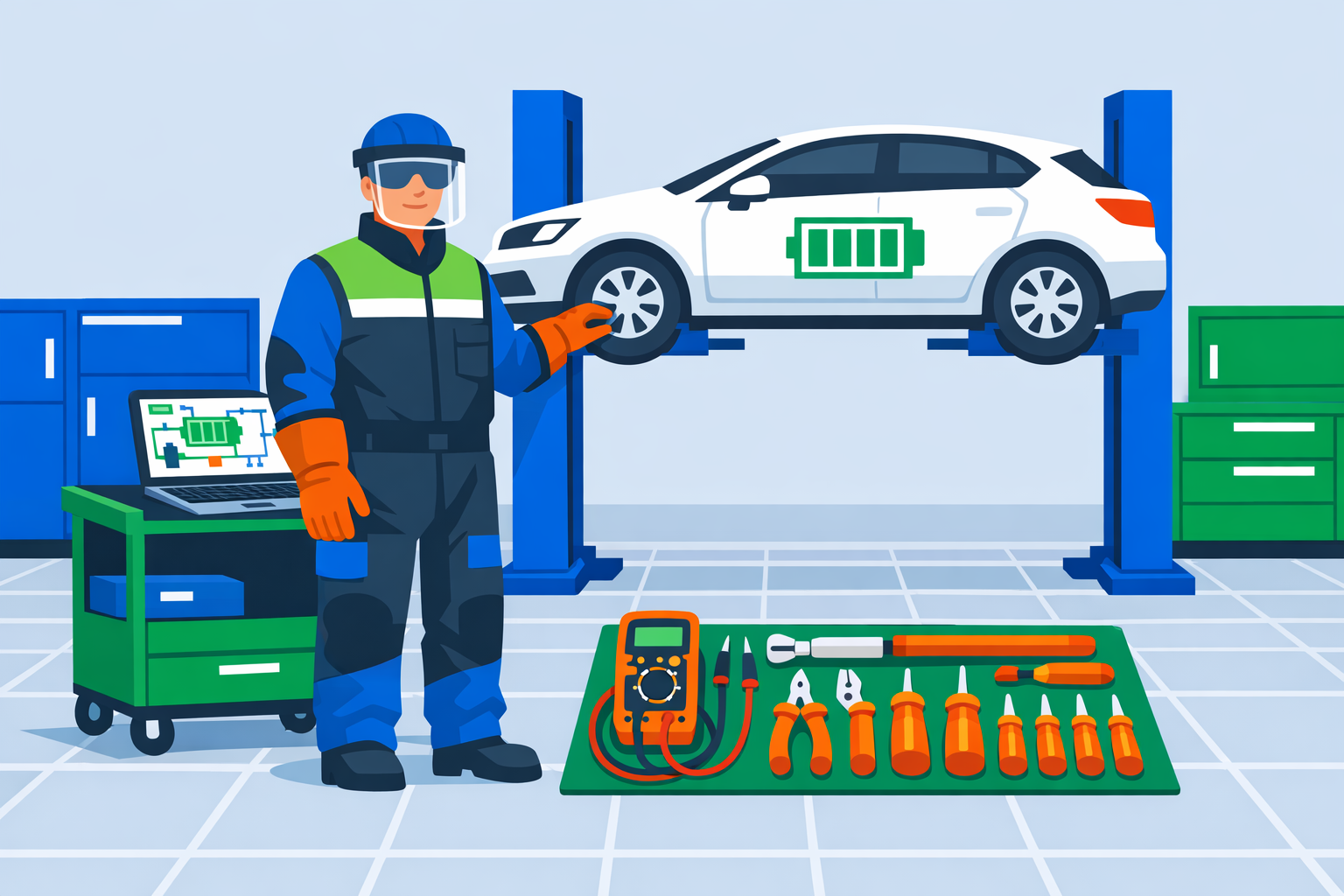
The required shop equipment investment reflects this new risk profile. Technicians need PPE - including insulated gloves, face shields, and voltage testers - and shops should invest in insulated hand tools, lockout/tagout kits, and lifts with adequate weight capacity and reach. While this equipment represents a significant upfront cost, it enables a broader service menu and signals to customers that the shop takes EV maintenance seriously.
Diagnostic Data Access and the OTA Challenge
Credentials and equipment are only part of the equation. Access to vehicle diagnostic data - particularly in an era of over-the-air (OTA) software updates - is emerging as a structural constraint on what independent shops can actually service.
U.S. right-to-repair efforts and state-level data access laws are giving independent shops more room to operate on modern vehicles, including EVs. However, OEMs like Tesla still control their proprietary software stacks and servers, limiting how far third parties can go without manufacturer cooperation.
For battery state-of-health assessments - a core competency for any shop handling used or aging EVs - independent specialists can perform meaningful work, including detailed capacity and thermal checks. HV contactors and cooling components are also feasible for shops with high-voltage training. However, only the OEM can push official over-the-air updates, restore features tied to a VIN, or perform security-critical software fixes.
As battery warranties extend to 8-10 years, long-term monitoring and recalibration become routine tasks - and technicians who master Battery Management System (BMS) diagnostics position themselves as essential assets, not interchangeable labor.
Pilot Programs and the Urban-Rural Service Divide
The most pragmatic response to the skills gap is emerging at the metro level, where micro-facility operators and mobile service providers are building scalable EV service models.
Next-generation mobile maintenance concepts - like Amerit Fleet Solutions' EVolution MSC - can support 90% of repairs for electric and ICE fleet vehicles and rescue downed EVs by providing 5-10 miles of charge on the spot. These mobile units are especially significant for fleet operators in dense urban corridors where bringing vehicles to a fixed facility disrupts operations.
The urban-rural gap in service quality, however, remains a strategic concern. In a multi-site fleet scenario, urban drivers may access depot or public charging infrastructure easily, while rural drivers with longer routes and home-based starts face entirely different challenges. The same asymmetry applies to service access: EV-certified independent shops are concentrated in metros, leaving rural fleet operators - municipal agencies, agricultural contractors, school districts - with limited options.
Delivery fleets with return-to-base operations are advancing faster than expected in electrification, while school districts and other public-sector operators struggle to translate funding commitments into operational vehicles. Closing the rural service gap will require deliberate expansion of credentialing programs into community colleges and technical institutes outside major metro areas.
Implications for OEM Aftersales Strategies and Shop Owners
The proliferation of EV credentialing programs carries significant implications for OEM aftersales networks. As independent shops gain standardized HV credentials and diagnostic tool access, the dealership's historic monopoly on post-warranty EV service will erode - particularly for routine battery health checks, thermal system maintenance, and non-firmware repairs.
For independent shop owners weighing EV specialization, the path is clear but capital-intensive:
- Start with credentials. ASE xEV Level 1 and Level 2 provide the industry-recognized baseline. EV certification also helps protect technicians and employers through legal and insurance coverage.
- Invest in equipment methodically. Dedicate at least one bay to high-voltage service, and keep PPE, insulated tools, a battery table, and fire-safety gear in that area only - training the entire team on its protocols.
- Prioritize BMS diagnostic capability. Battery state-of-health assessments are a high-demand, high-value service as early EV models age out of warranty.
- Monitor right-to-repair developments. State-level data access legislation will progressively determine which OTA-adjacent procedures independent shops can perform.
As ASE's president and CEO has noted, the technician shortage requires collaboration across all industry segments - "dealer versus independent" silos weaken the entire pipeline. For the independent aftermarket, that means engaging actively with the credentialing infrastructure now being built - before the skills gap becomes a competitive chasm.
The transition to a high-voltage service landscape is not a future scenario. It is an operational reality reshaping labor markets, shop economics, and OEM aftersales strategies today. Shops that invest in EV training, safety infrastructure, and diagnostic access now will be positioned to capture the growing volume of out-of-warranty and fleet EV service that no single OEM network can absorb alone.