A rapidly expanding patchwork of U.S. state packaging Extended Producer Responsibility (EPR) laws is hitting the automotive supply chain with measurable financial and operational force. Seven states now have active legislation, and at least five more are expected to follow by the end of 2026.
Background
A new era of corporate environmental regulation is reshaping compliance obligations for companies that manufacture, distribute, or sell packaged products. While EPR laws have long existed in the U.S. for paint, electronics, and batteries, packaging has now joined the list - and state-enacted laws are quickly shifting the financial and operational burden of waste management from municipalities to producers.
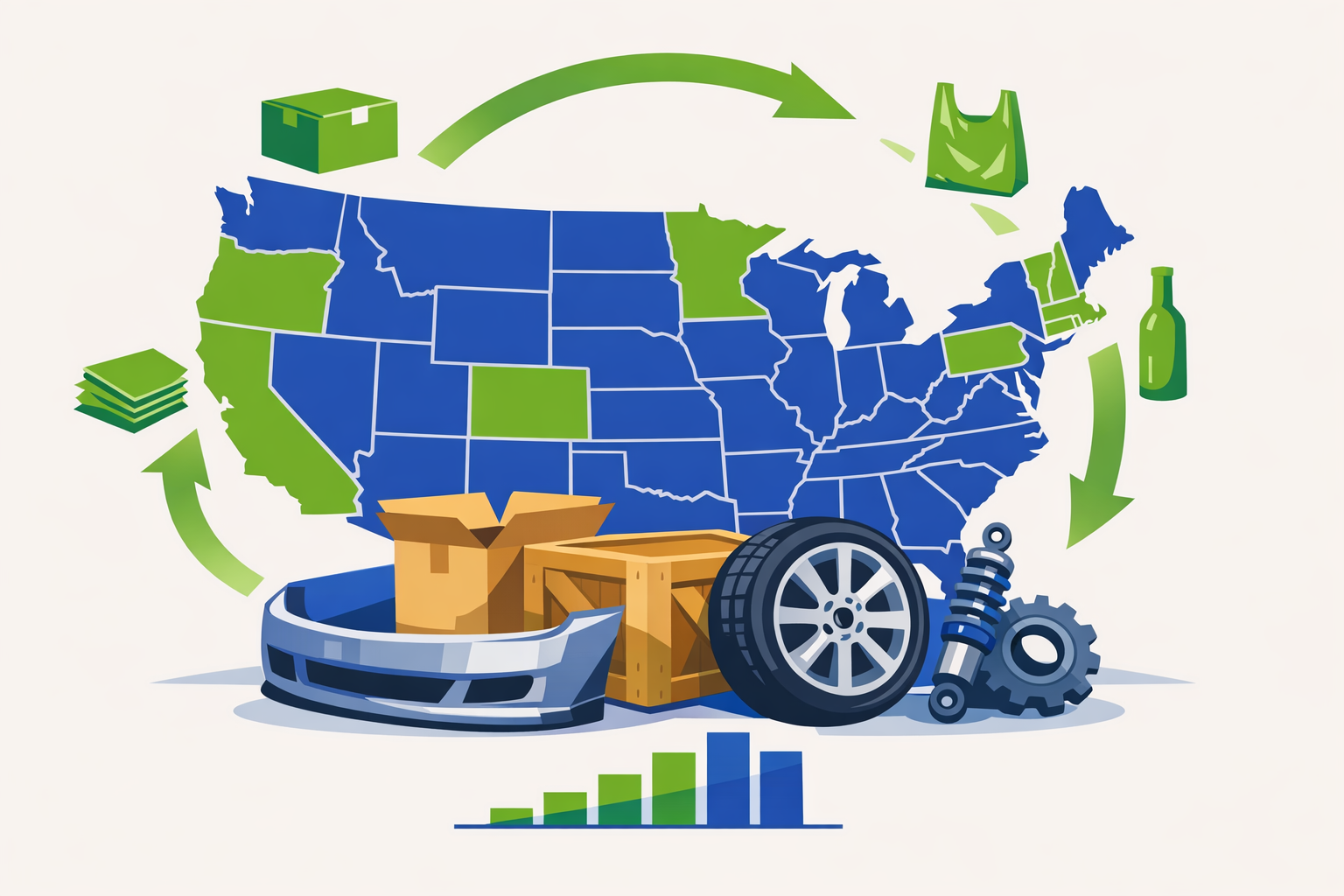
As of October 2025, seven states - Maine, Oregon, Colorado, California, Minnesota, Maryland, and Washington - have enacted comprehensive EPR packaging laws. The automotive sector is among the most broadly affected. EPR is rapidly reshaping how companies manage packaging across the United States, a dynamic outlined by Toyota's principal engineer for EPR/chemical regulated reporting, Collin Stecker, and Dan Hankinson, program manager for Mopar Global Product Regulatory Compliance at Stellantis, at AIAG's 2025 IMDS Conference.
The laws share a common structure: they fundamentally alter who pays for and manages packaging waste, shifting responsibility from local governments and taxpayers to manufacturers, importers, and distributors. Producers now bear responsibility for the entire packaging lifecycle, from production to post-consumer disposal.
Details
The financial stakes for auto brands are already quantifiable. Through an industry working group, seven original equipment manufacturers reported paying approximately $1.1 million to Oregon alone. "It is a sizable economic impact on the auto industry right now," Stecker said, warning that costs will escalate as additional states adopt similar laws.
Material selection directly drives fee exposure. Hankinson highlighted how material choice affects fees: while paper fiber carries a fee of just 7.6 cents per pound, plastics carry significantly higher fees. "That's a huge indicator of where we're going to go with EPR," he said. For auto parts suppliers that rely heavily on plastic protective packaging, this fee differential creates a strong incentive to shift toward paper-based or lightweighted alternatives.
Fee collection timelines vary by state. Oregon was the first to require producer fee payments when its program began on July 1, 2025, while Colorado's fee obligations began in January 2026. In California, fee obligations start in January 2027. Despite these staggered schedules, many states now share a harmonized May 31 reporting deadline through the Circular Action Alliance (CAA), making the administrative burden more streamlined even as the financial stakes grow.
Data collection has proven especially challenging. "The amount of data that is available for the packaging isn't the same as that we would have had ready for our parts," Stecker said. States vary widely in reporting categories, with Oregon and Colorado using roughly 60 material categories and California requiring 95. Companies must store records for up to five years and be prepared for audits.
Scope creep is another operational risk. Stecker noted "there's a much larger umbrella of items and operations that gets caught under the scope of these EPR laws." On-site reviews uncovered unexpected reportable materials and, in some cases, parts with "excessive bagging," while similar products used dramatically different packaging approaches.
Stecker attributed the regulatory push largely to stagnant recycling performance: "Currently, only 21% of product packaging is recycled on average at the consumer level."
Producers that fail to register and comply in Oregon face noncompliance penalties of up to $25,000 per day. Oregon's EPR program launch also faced an early legal challenge when the National Association of Wholesaler-Distributors filed a lawsuit on July 30, 2025, alleging violations of the Dormant Commerce Clause and Due Process Clause. The suit argues the law unfairly targets out-of-state producers and burdens interstate commerce.
Industry engagement has, in some cases, shaped outcomes. Multi-industry coalitions helped narrow business-to-business reporting requirements in Maine, and California withdrew an initial proposal deemed overly burdensome.
Outlook
EPR legislation has passed in seven states, and five more carry a high probability of enacting laws in 2026.[1] States still actively considering EPR legislation include Illinois, Massachusetts, New York, and Tennessee. For auto parts suppliers operating across multiple jurisdictions, the imperative is immediate: register with the CAA, audit packaging materials at the SKU level against state-specific covered-materials lists, and model fee exposure by material type before the next round of invoices arrives.