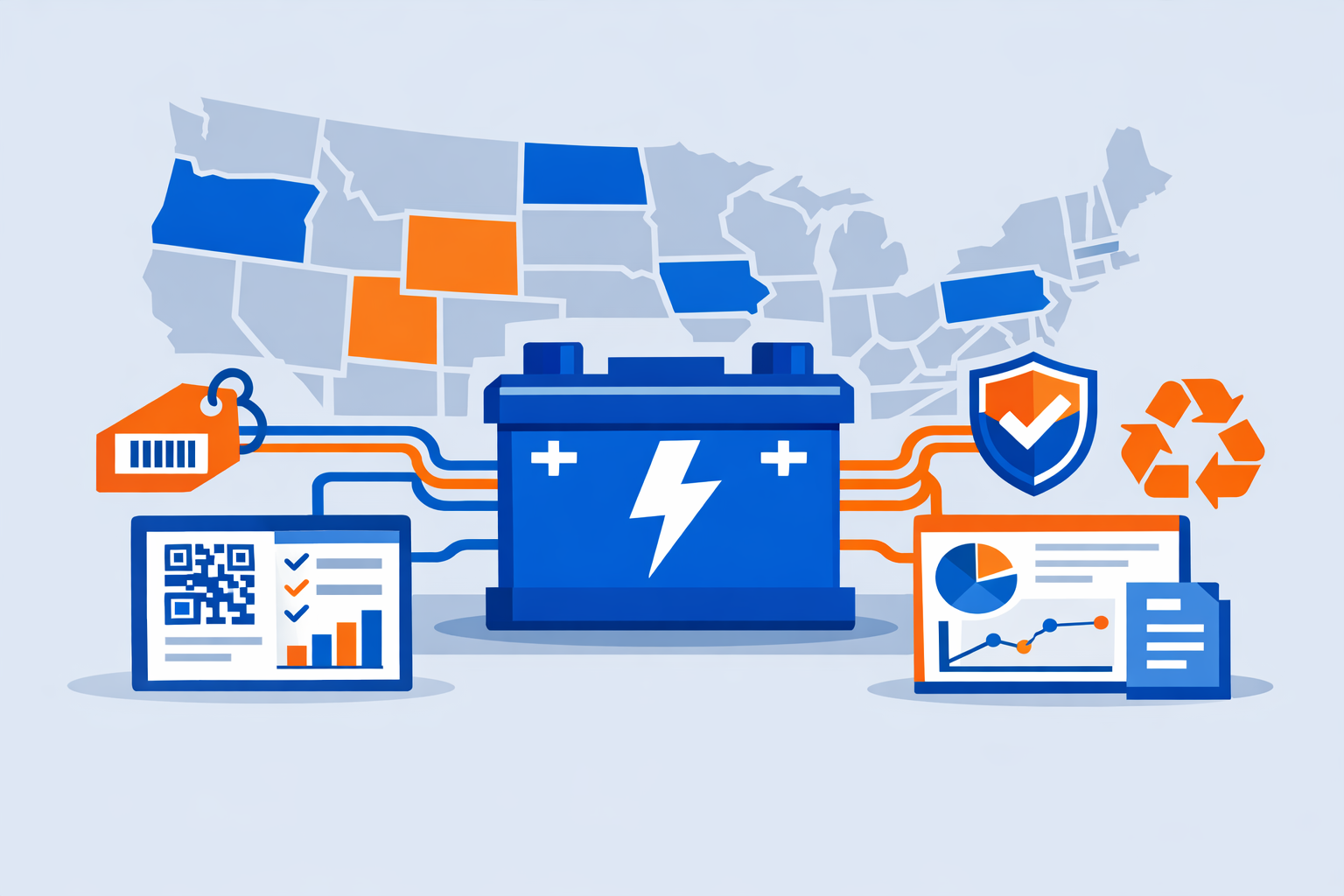
A fast-expanding patchwork of state battery extended producer responsibility (EPR) laws is forcing Tier-1 automotive suppliers to overhaul data collection, product labeling, and end-of-life planning ahead of 2027-2028 enforcement deadlines. Nine states and jurisdictions-California, Colorado, Connecticut, Illinois, Nebraska, New Jersey, Vermont, Washington, and Washington D.C.-have enacted battery EPR laws, with several additional states advancing active legislation.
Background
State-level battery stewardship frameworks require producers to join and fund Battery Stewardship Organizations (BSOs) that operate collection and recycling infrastructure. The model, already established in Europe, shifts end-of-life management costs from municipalities to producers. For the automotive sector, regulatory pressure is compounded by the proliferation of battery-containing components across vehicle platforms, including EV modules, 12V systems, and ancillary electronic assemblies.
In 2025 alone, Nebraska, Colorado, and Connecticut passed new battery EPR legislation requiring covered producers and retailers to join and fund a battery stewardship organization. These additions joined existing programs in states such as Illinois, where producers must have participated in an approved battery stewardship plan since January 1, 2026, with a full disposal ban for portable and medium-format batteries taking effect January 1, 2028.
Vermont enacted the first U.S. battery EPR law in 2014 and expanded its program in 2024 to include rechargeable batteries and battery-containing products, establishing a legislative template other states have since adopted.
Key Deadlines and Diverging Requirements
The deadline landscape varies considerably across jurisdictions, creating a multi-state compliance burden for suppliers operating national supply chains. In Washington, administrative rules under Chapter 173-905 WAC took effect January 16, 2026, with portable battery collection required from July 1, 2027, and large-format vehicle battery collection not mandated until 2029. Under that same law, sale or distribution of portable batteries not covered by a stewardship plan is prohibited beginning July 2027.
On labeling, Washington is among the more prescriptive states. Beginning in 2028, large-format batteries and battery-containing products sold in Washington must be marked to identify the producer, with full chemistry labeling required from 2030. California takes a different approach: under SB 1215, manufacturers of battery-embedded products must submit annual reports to CalRecycle noting battery chemistry, estimated volumes sold, and recycled material content beginning July 1, 2027.
In California, battery producers must participate in a stewardship plan approved by CalRecycle no later than April 1, 2027. Nebraska's disposal ban for covered batteries takes effect January 1, 2028, matching Illinois's timeline. New Jersey's disposal ban on covered batteries becomes effective January 8, 2027.
Fee structures also diverge. Washington's plan review fee for 2026 is $63,066, with an annual administrative fee of $357,634 charged to each Battery Stewardship Organization. Non-compliance penalties in some states are substantial; New York imposes civil penalties of up to $5,000 for violations of battery recycling requirements.
Pressure on Tier-1 Suppliers
The fragmented regulatory landscape is placing Tier-1 suppliers-those that directly supply components to OEMs-under compounding pressure. Battery EPR regulations vary by state and format, covering small, medium, or large battery formats, and in some instances by specific chemistry. That variation means a single product line crossing multiple state markets may trigger different registration, labeling, and reporting obligations simultaneously.
Industry audits have highlighted significant data readiness gaps. According to consulting firm Seraph, one Tier-1 supplier discovered that 11% of material costs were being lost due to design choices that made battery recovery nearly impossible. After introducing traceability measures such as QR codes and modular redesigns, waste dropped by 18% and repair turnaround times improved without slowing production.
Suppliers are increasingly turning to centralized compliance platforms and early-stage design changes to address multi-state obligations. Cirba Solutions Chief Commercial Officer Jay Wago noted that "EPR legislation is reshaping how producers manage their battery obligations." The company, one of the largest U.S. battery recycling processors, has positioned its national collection infrastructure as a turnkey compliance route for producers managing obligations across multiple jurisdictions.
Outlook
The U.S. EPA and Department of Energy are developing a national EPR framework for batteries under the Bipartisan Infrastructure Law, with a Report to Congress expected to outline best practices for battery recycling collection and harmonize disparate state approaches. However, that framework is not expected to preempt state programs. Meanwhile, the Oregon EPR litigation-following a February 2026 federal injunction blocking enforcement of the state's Plastic Pollution and Recycling Modernization Act-has introduced legal uncertainty that could affect the scope of EPR programs beyond packaging. Tier-1 suppliers with multi-state footprints are advised to accelerate BSO enrollment and data system audits ahead of the 2027 compliance wave.