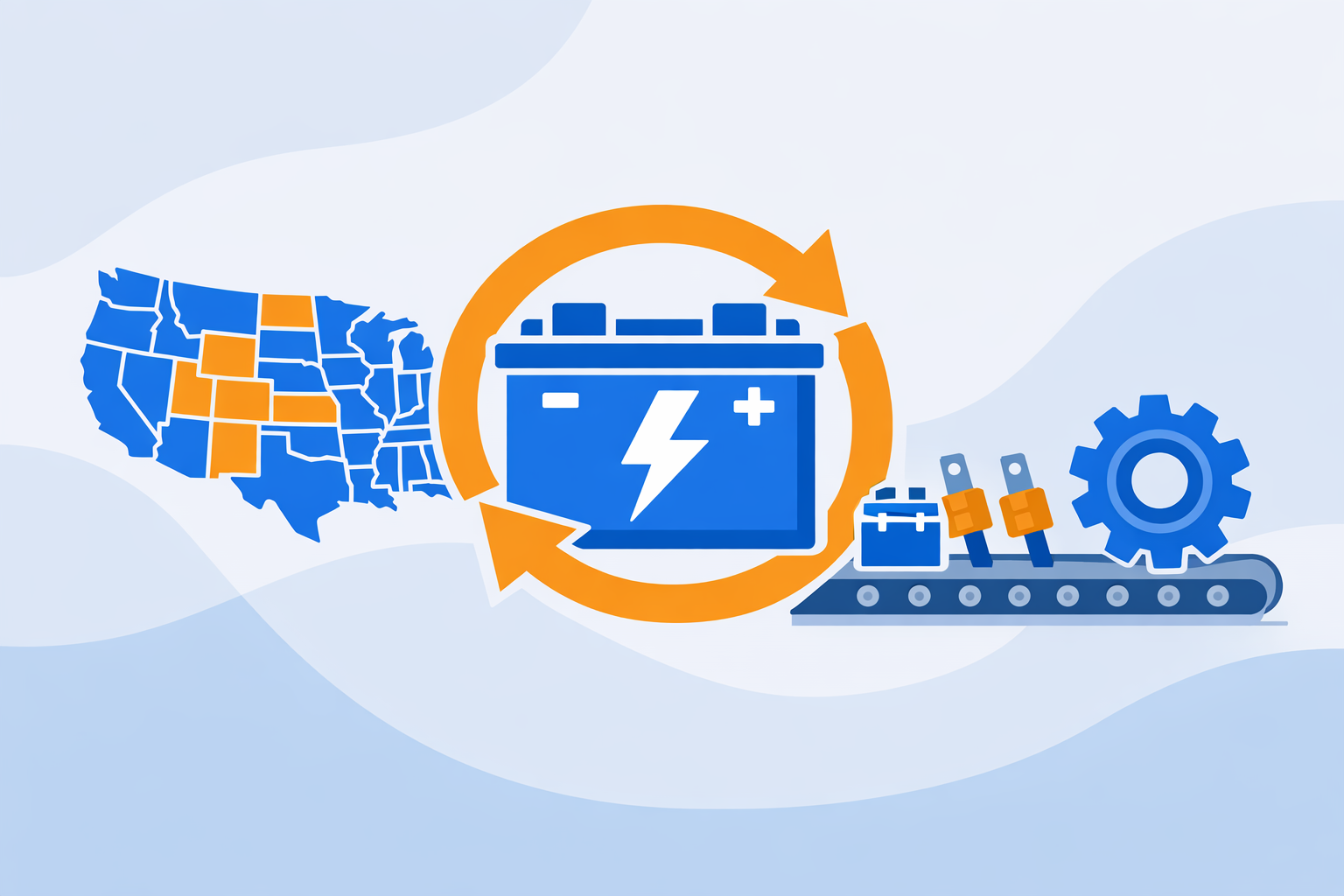
A wave of state battery extended producer responsibility (EPR) laws, with compliance deadlines concentrated in 2027 and 2028, is forcing auto parts manufacturers and battery-containing product suppliers to overhaul end-of-life cost planning, partner with recyclers, and adapt product designs ahead of enforcement. At least eight U.S. states-including California, Washington, Illinois, Connecticut, Nebraska, Colorado, and Vermont-have enacted mandatory battery stewardship frameworks requiring producers to fund collection and recycling programs or face bans on selling products in those markets.
Background
By 2027, more than 61 million Americans will live in states that require recycling of all household batteries-up from fewer than one million in 2024, according to data compiled by Call2Recycle. The rapid legislative expansion reflects growing concern over battery fires in the waste stream, the loss of critical materials such as lithium, cobalt, and manganese, and the financial burden batteries place on municipal waste systems.
Battery stewardship regulation in the United States is evolving rapidly as more states introduce EPR frameworks, placing end-of-life management responsibility on manufacturers, brand owners, and importers. The result is an increasingly complex and fragmented compliance landscape for companies selling batteries or battery-powered products.
These laws shift recycling costs from taxpayers to producers, representing a fundamental restructuring of who pays for recycling infrastructure. EPR statutes require companies that manufacture, import, or brand products to fund the collection, sorting, and recycling of those materials after consumers discard them.
Key Deadlines and State Requirements
California is among the most aggressive movers. The state's Rechargeable Battery Act requires producers of covered batteries sold in California to participate in a CalRecycle-approved stewardship plan no later than April 1, 2027, funding programs for collecting and recycling most batteries sold in the state. A companion law expands California's Electronic Waste Recycling Act to cover battery-embedded products, requiring consumers to pay a fee at the point of sale effective January 1, 2026, with new manufacturer reporting requirements starting July 1, 2027.
Washington State has adopted a similar approach. Its law requires battery producers to create a statewide collection system for portable and medium-format batteries, with collection sites beginning to accept portable batteries July 1, 2027, and medium-format batteries January 1, 2029. Producers must join and fund a battery stewardship organization; those that do not participate in an approved plan may not sell covered batteries in Washington. Washington's Department of Ecology set its administrative fee for 2026 at $357,634, allocated proportionally across registered Battery Stewardship Organizations based on market share.
In the Midwest, Illinois' Battery Stewardship Act requires producers selling covered batteries in the state to participate in an approved stewardship plan by January 1, 2026, or face a ban on battery sales. After January 1, 2028, a disposal ban for all portable and medium-format batteries takes effect.
Two states enacted comprehensive battery EPR laws in 2025, intensifying the compliance calendar. Connecticut passed HB 5019, establishing producer responsibility for consumer batteries, while Nebraska enacted LB36, the Safe Battery Collection and Recycling Act. Under Connecticut's law, producers of covered batteries and battery-containing products must join a Battery Stewardship Organization by January 1, 2027, with retailers prohibited from selling noncompliant products as of July 1, 2028. Nebraska Governor Jim Pillen signed LB36 on May 20, 2025, establishing a producer-funded stewardship program developed in collaboration with state officials, local governments, and national partners including the Product Stewardship Institute. Under Nebraska's law, producers must join a state-approved Battery Stewardship Organization beginning January 1, 2028, to sell batteries in the state.
Supply Chain Implications for Auto Parts Producers
The proliferation of state laws creates a compliance patchwork that directly affects auto parts suppliers whose components include batteries or battery-containing products. Companies face new challenges in data collection, reporting, and tracking evolving requirements across jurisdictions. Producers-defined under most state laws as the manufacturer, brand owner, importer, or exclusive licensee-must evaluate whether their specific battery formats fall within covered categories, which vary by weight, watt-hour rating, and product type.
Manufacturers selling products with loose or easily removed batteries must review their supply chains and ensure battery suppliers are prepared to meet new requirements. In Washington State, beginning in 2028, large-format batteries, covered batteries, and battery-containing products must be marked to identify the producer[1]-a labeling requirement with direct implications for parts specification and packaging.
Noncompliance carries market access risk. Penalties can be severe: in New York, for example, businesses face civil penalties up to $5,000 for violating battery recycling requirements.
Outlook
Beyond states with enacted laws, pending or proposed legislation could extend household battery recycling requirements to another 68 million Americans, potentially covering up to 129 million people nationwide by 2027.[2] The battery recycling industry will need to scale significantly, with key growth areas including expanded drop-off locations, increased processing capacity, stronger transportation logistics, and larger, more efficient facilities. For auto parts suppliers already managing complex, multi-tier supply chains, compliance with the emerging state-by-state EPR patchwork is likely to become a standing operational cost-and a prerequisite for market access across a growing share of the U.S. population.